KHARTOUM: Sudan’s warring sides accused each other on Thursday of being behind breaches of the latest cease-fire that was negotiated by Saudi Arabia and the US, now in its third day.
The one-week truce was violated only minutes after it came into effect on Monday night, with residents of the capital Khartoum reporting air strikes and artillery fire shaking the city.
There have since been further breaches of the cease-fire agreement, which is meant to allow for much-needed humanitarian aid to reach war-ravaged parts of the north African country.
It is the latest in a series of truces that have all been systematically violated.
Since April 15, Sudan’s capital and other parts of the country have been gripped by brutal urban warfare between the regular army, the Sudanese Armed Forces (SAF), and the paramilitary Rapid Support Forces (RSF).
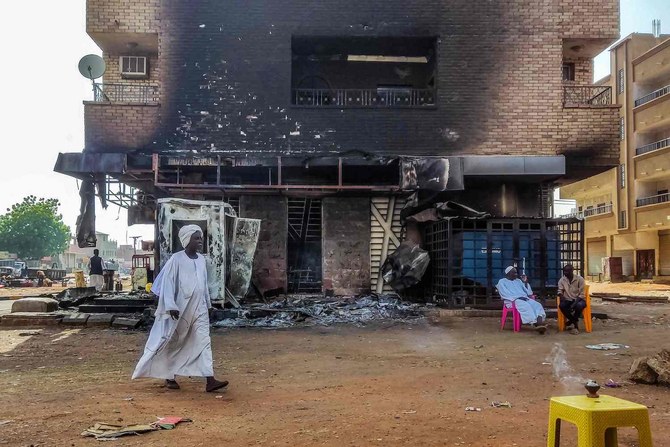
But though the current cease-fire has been violated, it has allowed for a lull in fighting that has seen frightened residents cautiously venture out of their homes, some for the first time in weeks.
Many have gone out for supplies of food and water or to seek much-needed medical attention after nearly six weeks of fighting that has sharply depleted vital supplies and pushed the health care system to the brink of collapse.
In a statement issued late Wednesday, the RSF, which is led by Mohammed Hamdan Daglo, sought to place the blame for cease-fire breaches on the army led by Sudan’s de facto leader Abdel Fattah Al-Burhan.
The army “launched a series of unwarranted attacks today,” the RSF said, adding that “our forces decisively repelled these assaults.”
“Our forces successfully shot down a SAF MiG jet fighter,” it said, reiterating however that it remained “committed to the humanitarian truce.”
The army responded Thursday morning, saying it had “countered an attack on armored vehicles by the militias of the Rapid Support Forces in a clear violation of the truce.”
The US, who brokered the cease-fire alongside Saudi Arabia, warned the warring parties against any further violations.
The State Department said that observers had detected the use of artillery, drones and military aircraft as well as fighting both in the capital Khartoum and in the western region of Darfur.
“We have continued to see violations of the cease-fire,” State Department spokesman Matthew Miller told reporters.
“We retain our sanctions authority and if appropriate we will not hesitate to use that authority.”
The UN envoy for the Horn of Africa, Hanna Tetteh, said the continued fighting was “unacceptable and it must stop.”
Desperately needed aid has yet to reach the capital despite the fighting easing.
The conflict has so far killed more than 1,800 people, according to the Armed Conflict Location and Event Data Project.
More than a million Sudanese people have been displaced, in addition to 300,000 who have fled to neighboring countries, according to the United Nations.
Conditions have been particularly alarming in Darfur, already ravaged by a conflict that erupted in 2003 and saw then president Omar Al-Bashir unleash the feared Janjaweed militia to crush a rebellion among ethnic minority groups.
The RSF traces its origins to the Janjaweed.
The UN’s refugee coordinator in Sudan, Toby Harward, said the town of Zalengei in Central Darfur state “has been under siege by armed militias for the last days.”
Numerous facilities “have been attacked and looted, civilians are unable to seek medical care as health care facilities are targeted, and gangs on motorcycles intimidate government workers and restrict civilian movements,” he added.
Representatives of the warring Sudanese generals have since early May been involved in negotiations in the Saudi city of Jeddah.
But analysts have repeatedly warned that the two generals are likely prepared for a prolonged conflict.
Sudan expert Alex de Waal described the conflict as being the result of a “calamitous failure of diplomacy.”
Burhan and Daglo had in 2021 staged a coup that unseated a civilian transitional government but later fell out in a bitter power struggle.


![]()
![]()

Sudan’s warring parties trade blame over truce breach

Short Url
https://arab.news/vgj7s
Sudan’s warring parties trade blame over truce breach
- Cease-fire deal comes after five weeks of intensive warfare in Khartoum
- Latest in series of truces that have all been systematically violated


Latest updates


Recommended


© 2026 SAUDI RESEARCH & PUBLISHING COMPANY, All Rights Reserved And subject to Terms of Use Agreement.