ANKARA: Turkiye’s anti-immigrant Victory Party leader endorsed opposition presidential candidate Kemal Kilicdaroglu on Wednesday, potentially boosting the challenger as he aims to make up ground and defeat President Recep Tayyip Erdogan in Sunday’s runoff election.
Umit Ozdag, head of the nationalist Victory Party that received 2.2 percent support in the May 14 parliamentary vote, urged supporters to back Kilicdaroglu in the May 28 runoff in which Erdogan seeks to extend his two-decade rule.
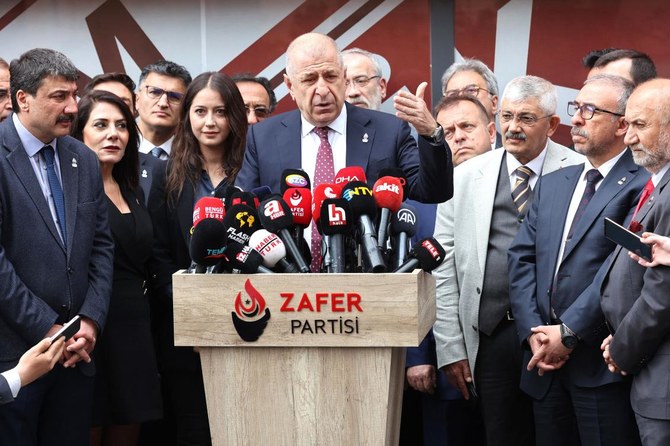
“We have decided to support Mr. Kilicdaroglu in the second round of the presidential elections,” Ozdag said at a news conference in Ankara alongside Kilicdaroglu.
The endorsement could counter-balance one that Erdogan received on Monday from Sinan Ogan, the presidential candidate of the far-right alliance led by the Victory Party.
Ogan came in third with 5.2 percent of the presidential vote, behind Erdogan with 49.5 percent and Kilicdaroglu with 44.9 percent.
The race for endorsements from the right reflects the larger-than-expected support for nationalists on May 14. Analysts say many remain undecided, holding a possible key to victory in the runoff.
Ozdag said that his party and Kilicdaroglu agreed on a plan to send back migrants within a year “in line with international law and human rights.”
Ozdag said he held similar talks with Erdogan’s AK Party (AKP) but decided not to endorse him because their plans did not involve repatriating migrants.
Erdogan’s strong showing in the initial vote confounded pollsters who had said Kilicdaroglu led opinion polls.
His ruling AKP’s coalition won a majority in parliament, giving Erdogan another edge in one of Turkiye’s most consequential elections ever. Erdogan has said a vote for him in the runoff is a vote for stability.
Last week, Kilicdaroglu, head of the Republican People’s Party (CHP) and candidate of a six-party alliance, sharpened his tone and vowed to repatriate all migrants once elected.
Turkiye is the world’s largest host of refugees.
Kilicdaroglu has also pledged to roll back much of Erdogan’s sweeping changes to Turkish domestic, foreign and economic policies, including reversing an unorthodox economic program to address a cost-of-living crisis.
Ozdag is a former deputy leader of the nationalist MHP, which is in Erdogan’s alliance. He later joined the IYI Party, which is in Kilicdaroglu’s alliance, before being ousted and founding the Victory Party in 2021.

Turkiye anti-immigrant party leader backs Erdogan’s challenger in runoff
Short Url
https://arab.news/vsxvk
Turkiye anti-immigrant party leader backs Erdogan’s challenger in runoff
- Umit Ozdag, head of the nationalist Victory Party, received 2.2 percent support in the May 14 parliamentary vote
- The endorsement could counter-balance one that Erdogan received on Monday from Sinan Ogan
Algeria parliament to vote on law declaring French colonization ‘state crime’
ALGERIA: Algeria’s parliament is set to vote on Wednesday on a law declaring France’s colonization of the country a “state crime,” and demanding an apology and reparations.
The vote comes as the two countries are embroiled in a major diplomatic crisis, and analysts say that while Algeria’s move is largely symbolic, it could still be politically significant.
The bill states that France holds “legal responsibility for its colonial past in Algeria and the tragedies it caused,” according to a draft seen by AFP.
The proposed law “is a sovereign act,” parliament speaker Brahim Boughali was quoted by the APS state news agency as saying.
It represents “a clear message, both internally and externally, that Algeria’s national memory is neither erasable nor negotiable,” he added.
France’s colonization of Algeria from 1830 until 1962 remains a sore spot in relations between the two countries.
French rule over Algeria was marked by mass killings and large-scale deportations, all the way to the bloody war of independence from 1954-1962.
Algeria says the war killed 1.5 million people, while French historians put the death toll lower at 500,000 in total, 400,000 of them Algerian.
French President Emmanuel Macron has previously acknowledged the colonization of Algeria as a “crime against humanity,” but has stopped short of offering an apology.
Asked last week about the vote, French foreign ministry spokesman Pascal Confavreux said he would not comment on “political debates taking place in foreign countries.”
Hosni Kitouni, a researcher in colonial history at the University of Exeter in the UK, said that “legally, this law has no international scope and therefore is not binding for France.”
But “its political and symbolic significance is important: it marks a rupture in the relationship with France in terms of memory,” he said.
The vote comes as the two countries are embroiled in a major diplomatic crisis, and analysts say that while Algeria’s move is largely symbolic, it could still be politically significant.
The bill states that France holds “legal responsibility for its colonial past in Algeria and the tragedies it caused,” according to a draft seen by AFP.
The proposed law “is a sovereign act,” parliament speaker Brahim Boughali was quoted by the APS state news agency as saying.
It represents “a clear message, both internally and externally, that Algeria’s national memory is neither erasable nor negotiable,” he added.
France’s colonization of Algeria from 1830 until 1962 remains a sore spot in relations between the two countries.
French rule over Algeria was marked by mass killings and large-scale deportations, all the way to the bloody war of independence from 1954-1962.
Algeria says the war killed 1.5 million people, while French historians put the death toll lower at 500,000 in total, 400,000 of them Algerian.
French President Emmanuel Macron has previously acknowledged the colonization of Algeria as a “crime against humanity,” but has stopped short of offering an apology.
Asked last week about the vote, French foreign ministry spokesman Pascal Confavreux said he would not comment on “political debates taking place in foreign countries.”
Hosni Kitouni, a researcher in colonial history at the University of Exeter in the UK, said that “legally, this law has no international scope and therefore is not binding for France.”
But “its political and symbolic significance is important: it marks a rupture in the relationship with France in terms of memory,” he said.
© 2025 SAUDI RESEARCH & PUBLISHING COMPANY, All Rights Reserved And subject to Terms of Use Agreement.



