

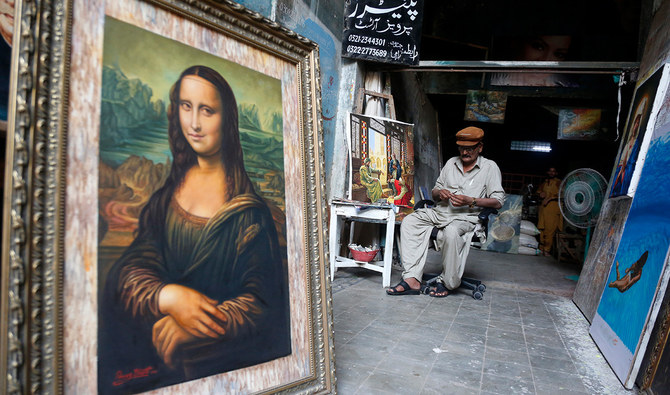

KARACHI: He was one of Karachi’s best known cinema billboard painters, creating, by hand, giant film promotions for theaters starting in the 1970s, dubbed the golden age of Pakistani cinema.
Today, Pervez Bhatti, 69, spends his time sitting in a congested corridor of Karachi’s iconic but crumbling Nigar Cinema, making portraits and landscapes, as the venerable art of the hand-painted film billboard has all but faded away.
Bhatti, who belongs to a Christain family from Sialkot in Pakistan’s Punjab province, began immortalizing legends of the silver screen at age 17. For more than five decades after, he painted movie billboards, inspired by studio handouts featuring stars ranging, over time, from Mohammad Ali to Shaan Shahid.
“I first started working in 1971 at the Kumar Cinema,” Bhatti told Arab News, naming, arguably, Karachi’s oldest movie theatre.
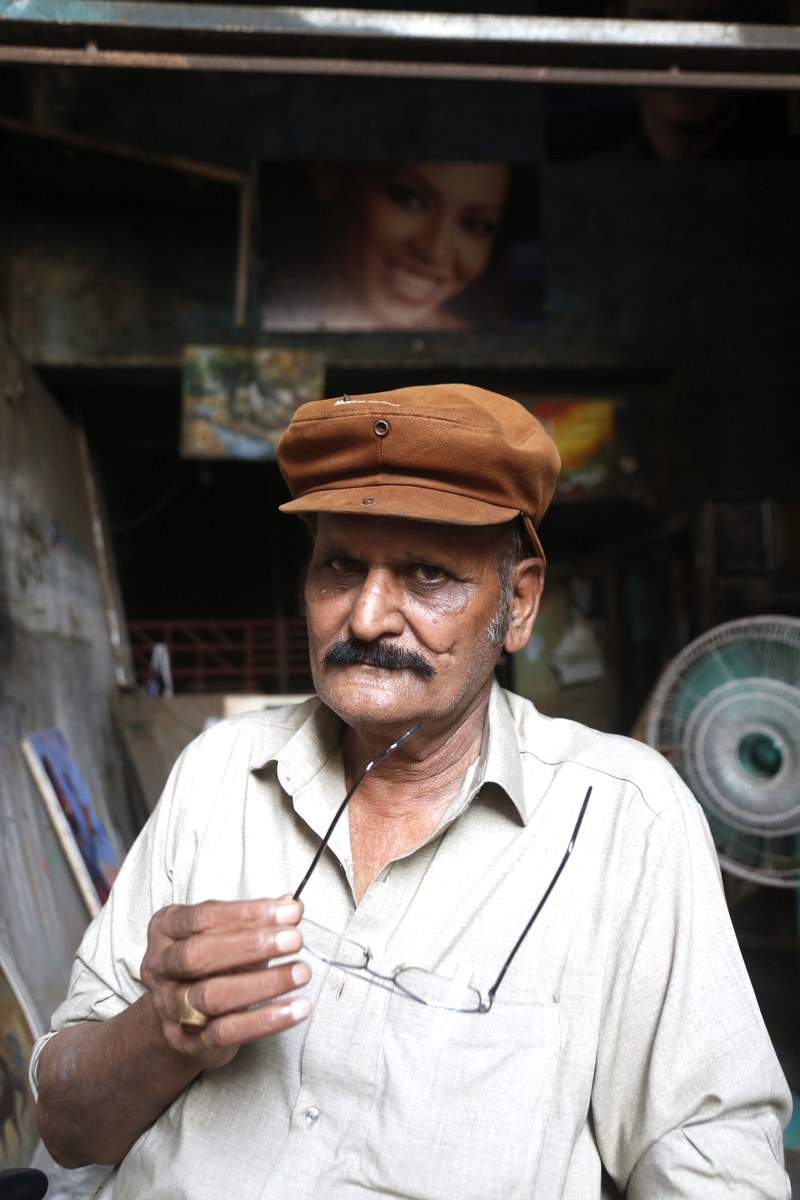
The photo taken on May 22, 2023, shows Pervez Bhatti, a Pakistani veteran billboard painter at his studio in Karachi, Pakistan. (AN photo by S.A. Babar)
“All those [cinemas] have been demolished now. But I began from there.”
Most of his fellow illustrators have either passed away or bid farewell to the profession, all but destroyed by the arrival of computer-generated banners.
Meanwhile, Bhatti continues to paint from his spot inside Nigar cinema, choosing to stay close to the place where he started his career as an artist almost 50 years ago.
The journey began with Bhatti learning first how to do pencil drawings and then going on within three years to painting larger than life film billboards in watercolors for Nigar and several other cinemas across the city, including the famous Capri.
“If there was a fighting scene in the movie or if someone was standing with a gun, we had to create a picture of him, we had to show actions through the figure’s expressions, whether he was a terrorist or a hero. That’s how we used to work,” Bhatti remembered.
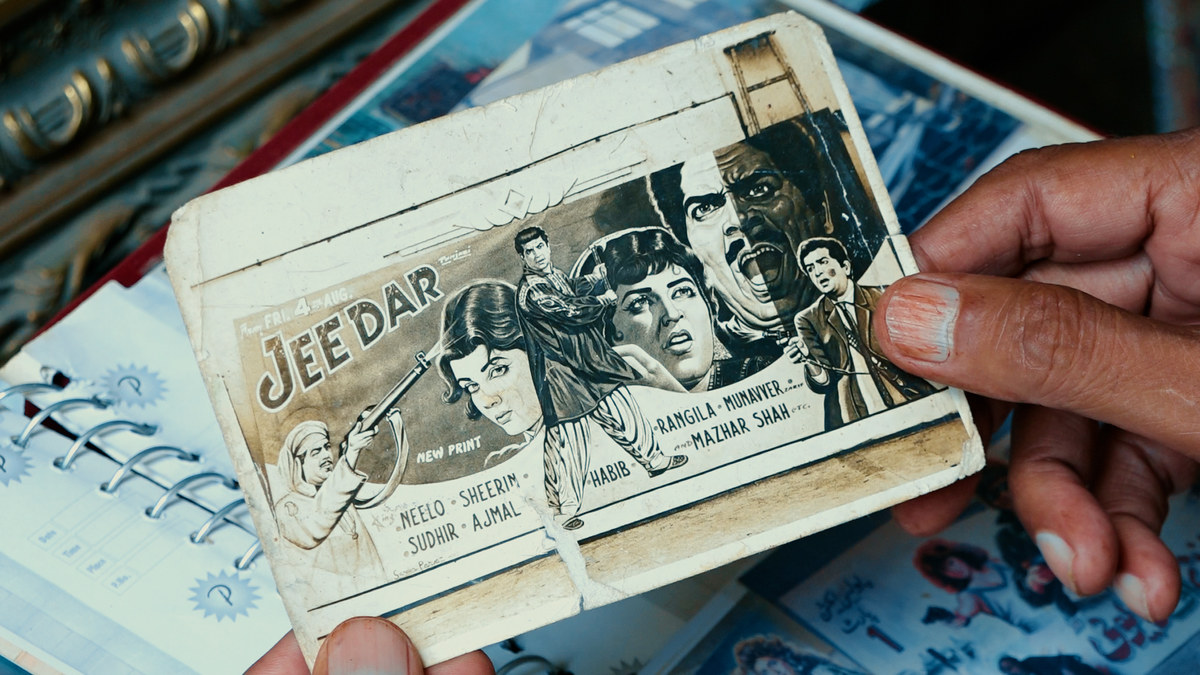
The photo taken on May 22, 2023, shows Pervez Bhatti showing a photograph of a billboard he painted for the Pakistani film "Jeedar" at his studio in Karachi, Pakistan. (AN Photo)
At the time, black and white photographs were shared with the painters by cinema owners but the billboards had to be in colour.
“We approached black-and-white pictures with an open mind,” he said. “We would apply shades according to our calculations, touch them up, and add highlights.”
Bhatti said he had painted countless billboards and movie posters but the ones he remembered and cherished most include for the black and white film "Wehshi Jatt," released in 1975, and starring the legendary Sultan Rahi with his famous gandasa, or battle axe, as well as "Maula Jatt," a 1979 super hit action musical in which Rahi portraying the iconic character of Maula Jatt and Mustafa Qureshi his notorious adversary, Noori Naat.
But despite his love for creating action film posters, Bhatti's best loved work is for Aina, a 1977 Pakistani romantic drama film starring Nadeem and Shabnam, considered one of the most successful films in the history of Pakistani cinema, and the longest-running at cinemas.
With a sparkle in his eye, the artist said the hand-painted billboards used to be so “attractive” that they hooked audiences into theaters, acting as abridged portends of the delights to come.
“They would book tickets and watch movies because our work was so captivating,” he said.

The photo taken on May 22, 2023, shows artwork by Pervez Bhatti, a Pakistani veteran billboard painter at his studio in Karachi, Pakistan. (AN photo by S.A. Babar)
“At that time, cinemas and films were so popular that anyone hosting guests would bring them to the [cinemas] and make them watch the films ... There used to be a lot of hustle and bustle here, and a beautiful atmosphere.”
In recent years, as digitally drawn, mass-produced movie posters became the norm, Bhatti struggled to keep the art form from dying, though he acknowledged today that “the golden age” of Pakistani cinema was long over.
Censorship that started under the military regime of General Zia-ul-Haq in the late seventies and eighties and an on-off ban on movies from archrival India, whose film industry is wildly popular in Pakistan, led to a decline in the number of films made and the culture of visiting cinemas.
“With the arrival of mobile phones, everyone started having access to entertainment on their devices, so the trend of going to cinemas started declining,” the artist said.
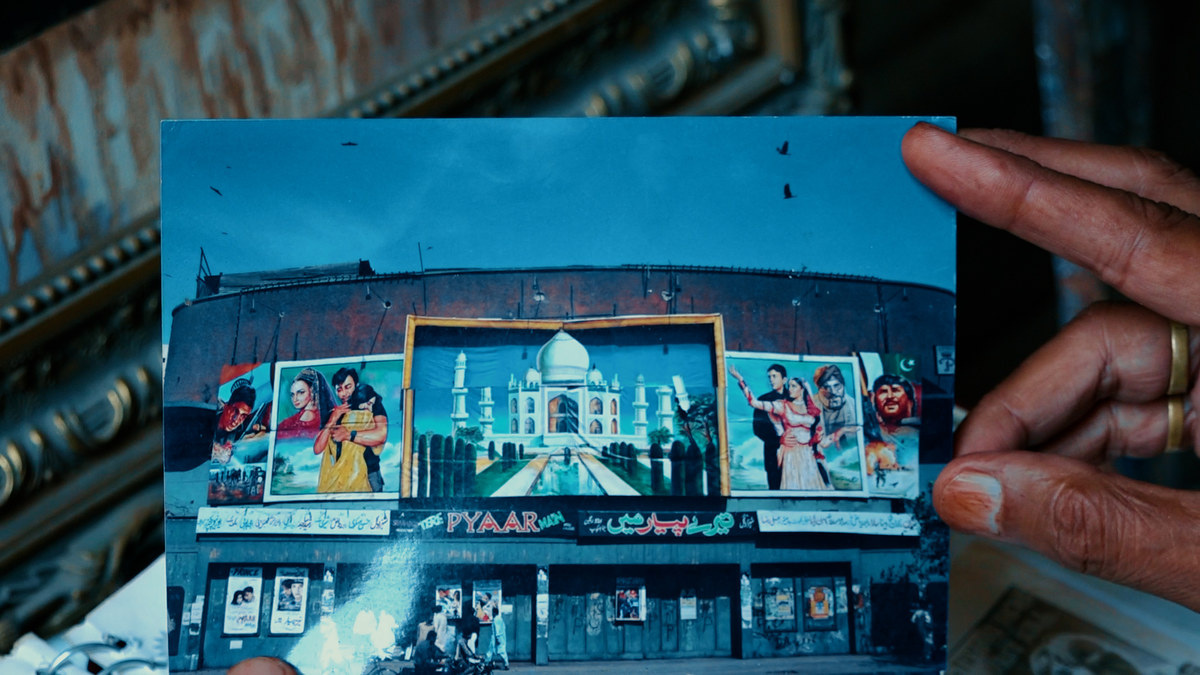
The photo taken on May 22, 2023, shows a snapshot of billboards of Pakistani films painted by Pervez Bhatti, a Pakistani veteran billboard painter at his studio in Karachi, Pakistan. (AN photo)
Now, Bhatti carries on painting, but not billboards, and is grateful to have found a good clientele and means of livelihood. But he said he missed the quick feedback he would receive when his cinema hoardings went up on display.
“When people looked at the hoardings, they used to come and say, ‘What wonderful work you have done, Ustad [Master] Pervez,’ which used to fill my heart with happiness,” he said, as he worked on a reproduction of the Mona Lisa at his spot in his corner of Nigar Cinema.
Bhatti professed to feeling sad knowing that he was among the last people who had tried to perpetuate an extinct art. But he said he had no regrets.
“No matter which part of Pakistan I go to, my mind and my heart always remains at Nigar,” Bhatti said, his voice breaking.
“And whenever I return to Karachi from another city, I feel at peace when I sit here because I have served for a long part of my life here ...
I express gratitude to my Lord to this day that I have not disassociated myself from cinema.”


