

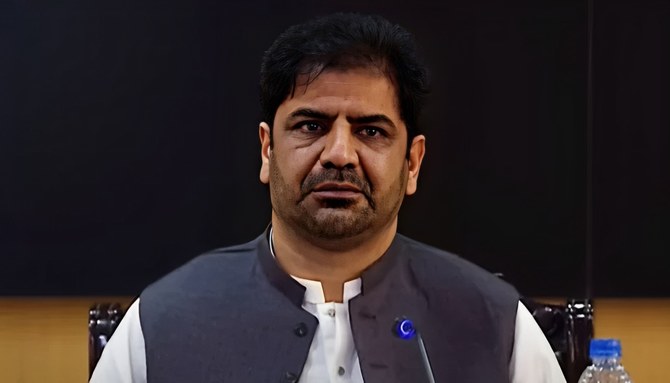
Baloch separatist leader speaks to media from custody, urges militants to open talks with Pakistani state

Baloch National Army's ex-leader Gulzar Imam during a press conference in Quetta, Pakistan, on May 23, 2023. (Photo courtesy: @PTVNewsLive/YouTube)
Short Url
Updated 23 May 2023
Follow

Baloch separatist leader speaks to media from custody, urges militants to open talks with Pakistani state

  • Pakistan’s armed forces announced the arrest of the top leader of Baloch National Army in April this year
  • PM Sharif appreciates the country’s intelligence setup for capturing Gulzar Imam in a complex operation

QUETTA: Pakistani authorities on Tuesday brought a top Baloch separatist commander accused of carrying out lethal attacks on security forces and government installations in the southwestern Balochistan province in front of the media, where he urged members of other armed groups to give up violence against the state.

The army’s media wing, ISPR, announced the arrest of Gulzar Imam, also known as Shambay, the founder of the banned Baloch National Army (BNA), after a “carefully planned and meticulously executed operation” in April this year.

The BNA is among several armed factions operating in Balochistan, which shares a porous border with Iran and Afghanistan, and has been the scene of a low-level insurgency by Baloch nationalists for around two decades. The separatists say they are fighting what they see as the unfair exploitation of the province’s wealth by the federation. The Pakistani state denies it.

“The path I had selected to secure the rights of the Baloch nation was wrong because the insurgency in Balochistan damaged the Baloch nation and took it back to the Stone Age,” the BNA leader, who joined the armed insurgency about 15 years ago, told the media in Quetta city. “I am urging other separatist groups and fighters to come forward for talks with the state because the war is not a solution.”

He was accompanied by Balochistan’s home minister, Mir Zia Langau, and Senator Prince Agha Umar Ahmadzai.

“Today, Balochistan is facing a myriad of issues, and we are all responsible for this,” he continued. “Now we have to do something about the damage. I hope the state will give us a chance to correct our mistakes, and I apologize to all those who lost their loved ones because of me.”

Prime Minister Shahbaz Sharif congratulated the law enforcement institutions and intelligence agencies for capturing the wanted militant leader.

“Congratulations to Pakistan for nabbing one of the most high-profile militant leaders, the founder and head of BNA: Gulzar Imam Shambay,” he wrote in a Twitter post. “My appreciation to the security forces for their untiring efforts to restore peace. [Director-General Inter-Services Intelligence] deserves the nation’s highest commendation for carrying out, with great sophistication, the first of its kind and the most complex intelligence operations involving various geographical locations.”

Sharif expressed optimism that Balochistan would soon be more peaceful and prosperous.


Speaking to Arab News, Abdul Basit, a researcher at the S. Rajaratnam School of International Studies in Singapore, said there was a deadlock in the battlefield of Balochistan since it was difficult for Pakistan to impose a military solution, and the Baloch insurgents could not win against the army as well.

“Only a genuine political dialogue addressing the genuine grievances of the ordinary Baloch can provide a viable solution and bring an end to the insurgency in Balochistan,” he said.


Pakistan president meets UAE counterpart, explores trade, investment opportunities

Updated 27 January 2026
Follow

Pakistan president meets UAE counterpart, explores trade, investment opportunities

  • Asif Ali Zardari is in UAE on four-day visit to strengthen bilateral ties, review bilateral cooperation
  • Both sides discuss regional, international developments, reaffirm commitment to promote peace

ISLAMABAD: President Asif Ali Zardari met his UAE counterpart Sheikh Mohammed bin Zayed Al-Nahyan in Abu Dhabi on Tuesday during which both sides explored new opportunities in trade, investment, energy and other sectors, Zardari's office said. 

Zardari arrived in Abu Dhabi on Monday evening with a high-level delegation on a four-day official visit to the UAE to review trade, economic and security cooperation. 

"The leaders discussed ways to further deepen the longstanding and brotherly relations between Pakistan and the UAE," a statement from Zardari's office said about his meeting with the UAE president. 

"They reviewed the full spectrum of bilateral cooperation and explored new opportunities in trade, investment, energy, infrastructure, technology, and people-to-people exchanges, highlighting the significant potential for expanding economic and strategic partnership.

Zardari highlighted the significance of Al-Nayhan's visit to Pakistan last month, the statement said, expressing appreciation for the UAE's continued support for strengthening bilateral ties.

It said both sides also exchanged views on a range of regional and international developments, reaffirming their commitment to promoting peace, stability and sustainable development.

The meeting was also attended by Pakistan's First Lady Aseefa Bhutto-Zardari, the Pakistani president's son Bilawal Bhutto-Zardari, who is also the chairman of the Pakistan Peoples Party, Interior Minister Mohsin Naqvi and Pakistan's ambassador to the UAE. 

ZARDARI MEETS AD PORTS CEO

Zardari earlier met AD Ports Group CEO Captain Mohamed Juma Al-Shamisi to discuss the group's investment initiatives in Karachi. 

"Both sides agreed that the expansion and modernization of port infrastructure would strengthen trade flows and support Pakistan’s broader economic development and country’s seaborne trade," the President's Secretariat said in a statement.

It added that Zardari described the AD Ports Group's long-term investment and expanding role in Pakistan's maritime and logistics sector as a key pillar of Pakistan–UAE economic cooperation.

Pakistan and the UAE maintain close political and economic relations, with Abu Dhabi playing a pivotal role in supporting Islamabad during periods of financial stress through deposits, oil facilities and investment commitments. 

The UAE is Pakistan's third-largest trading partner, after China and the United States, and a key destination for Pakistani exports, particularly food, textiles and construction services.

The Gulf state is also home to more than 1.5 million Pakistani expatriates, one of the largest overseas Pakistani communities in the world, who contribute billions of dollars annually in remittances, a crucial source of foreign exchange for Pakistan’s economy.

Beyond trade and labor ties, Pakistan and the UAE have steadily expanded defense and security cooperation over the years, including military training, joint exercises and collaboration in counter-terrorism and regional security matters.