

Israeli defense chief says military has more than doubled strikes on Iranian targets in Syria

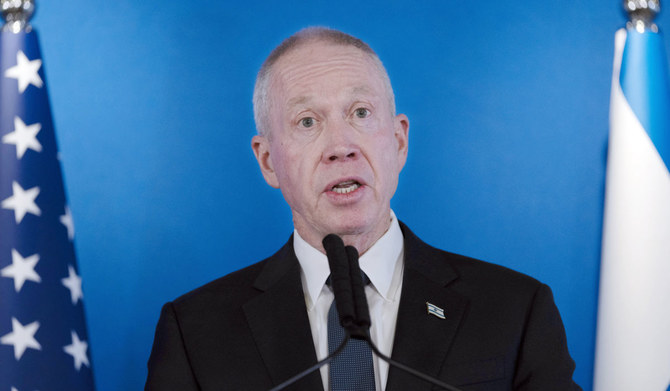
Israeli Defense Minister Yoav Gallant. (AP)
Short Url
Updated 23 May 2023
Follow

Israeli defense chief says military has more than doubled strikes on Iranian targets in Syria

  • Israel considers Iran to be its greatest enemy, citing its calls for Israel’s destruction and its support for anti-Israel militant groups across the region

JERUSALEM: Israel’s defense minister Monday said that Israel’s new government has greatly increased the number of strikes on Iranian targets since taking office late last year.
Yoav Gallant did not provide an exact number of airstrikes. But the address, delivered at a security conference, marked rare public comments on Israeli military activity in Syria.
“Since I took office, the number of Israeli strikes against the Iranians in Syria have doubled,” Gallant said.
“As part of this campaign, we are working methodically to strike the Iranian intelligence capabilities in Syria,” he said. “These strikes inflict significant damage to the attempts by the Revolutionary Guard to establish a foothold a few kilometers from the Israeli border.”
Gallant also accused Iran of converting civilian ships into military vessels armed with weapons such as drones, missiles and intelligence-gathering capabilities. He said Iran hopes to station these ships at long distances from Iran.
“Iran aims to expand its reach to the Indian Ocean, the Red Sea and even the shores of the Mediterranean,” he said. “This is a structured plan designed to threaten trade and flight routes — both military and civilian — and to create a permanent threat in the maritime arena.”
Israel considers Iran to be its greatest enemy, citing its calls for Israel’s destruction and its support for anti-Israel militant groups across the region. It also accuses Iran of trying to develop a nuclear bomb — a charge Iran denies.
Israeli officials have acknowledged carrying out hundreds of strikes on Iranian targets in neighboring Syria — where Iran has sent advisers and forces to assist President Bashar Assad in a 12-year civil war. But officials have given few details over the years and almost never comment on specific operations.


Hezbollah accepts resignation of senior security official Wafiq Safa amid restructuring

Updated 4 sec ago
Follow

Hezbollah accepts resignation of senior security official Wafiq Safa amid restructuring

  • Safa survived an Israeli assassination attempt in October 2024
  • A source said “the resignation and its acceptance were part of an internal restructuring move“

BEIRUT: Lebanon’s Hezbollah accepted the resignation of senior security official Wafiq Safa on Friday, the first time an official of his rank has stepped down, sources familiar with the group’s thinking told Reuters.
Safa, who heads Hezbollah’s liaison and coordination unit responsible for working with Lebanese security agencies, survived an Israeli assassination attempt in October 2024.
A source said “the resignation and its acceptance were part of an internal restructuring move” ⁠following losses Hezbollah sustained in last year’s war with Israel, adding that southern commander Hussein Abdullah was appointed to replace Safa.
Israel and Lebanon agreed to a US-brokered ceasefire in 2024 to end more than a year of cross-border fire between Israel and Hezbollah, ⁠which had culminated in Israeli strikes that severely weakened the Iran-backed militant group. Since then, the sides have traded accusations of ceasefire violations.
Lebanon has faced growing pressure from the US and Israel to disarm Hezbollah, and its leaders fear that Israel could dramatically escalate strikes across the battered country to push Lebanon’s leaders to confiscate Hezbollah’s arsenal more quickly.
Hezbollah has fought numerous conflicts with Israel since ⁠it was founded by Iran’s Revolutionary Guards in 1982. It kept its arms after the end of Lebanon’s 1975-1990 civil war, using them against Israeli troops who occupied the south until 2000.
Safa, whom Middle East media reports said was born in 1960, oversaw negotiations that led to a 2008 deal in which Hezbollah exchanged the bodies of Israeli soldiers captured in 2006 for Lebanese prisoners in Israel. The 2006 incident triggered a 34-day war with Israel.