

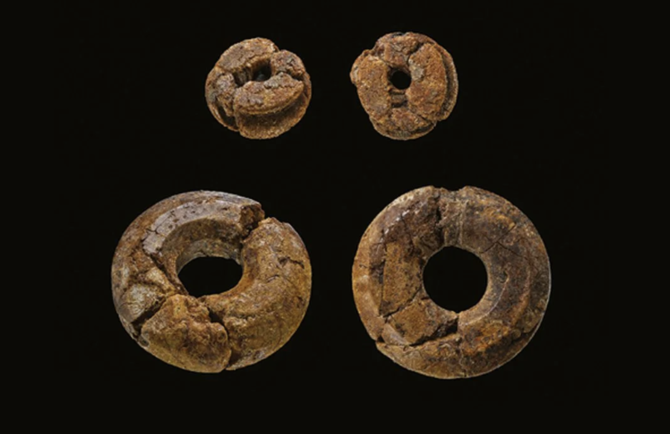
Ancient amber beads found in Iraq suggest Bronze Age trade between Europe and Middle East

Archaeologists studying ancient amber beads discovered more than 100 years ago have said they indicate the possibility of Bronze Age trade between northern Europe and the Middle East. (J. Lipták, Munich)
Short Url
Updated 22 May 2023
Follow

Ancient amber beads found in Iraq suggest Bronze Age trade between Europe and Middle East

  • Chemical analysis found the beads were amber with a “distinctive Baltic shoulder” signature

LONDON: Archaeologists studying ancient amber beads discovered more than 100 years ago have said they indicate the possibility of Bronze Age trade between northern Europe and the Middle East.

Excavations carried out in 1914 by Germany’s Royal Museum in Berlin and the Oriental Society dug out the beads from under the ruins of the “Great Ziggurat of Assur,” a temple tower in what is today northern Iraq and where Assyrian kings were buried around 3,800 years ago.

According to experts, the structure was commissioned around 1800 B.C. by King Shamshi-Adad I who conquered and ruled over lands which make up swathes of modern-day Syria and eastern Turkiye.

After chemical analysis found the beads were amber with a “distinctive Baltic shoulder” signature, modern researchers concluded the amber was gathered along the Baltic coast, nearly 2,000 miles from ancient Mesopotamia, in findings published in the journal Acta Archaeologica.

They said this points to the possibility that they were taken to the Middle East by nobles from a northern-central European culture.

The German researchers say the Unetice culture, a proto-civilization that thrived in lands in what is today Germany, Poland, Slovakia, and Czechia and dominated the amber trade, may have taken the beads to ancient Assyria “as part of a chain of trade and cultural exchange,” The Times newspaper reported.


Musk’s X to open source new algorithm in seven days

Updated 11 January 2026
Follow

Musk’s X to open source new algorithm in seven days

Elon Musk said on Saturday that social media platform X ​will open its new algorithm, including all code for organic and advertising post recommendations, to the public in seven days.
“This ‌will be ‌repeated ‌every ⁠4 ​weeks, ‌with comprehensive developer notes, to help you understand what changed,” he said in his X post.
Earlier this week, the European ⁠Commission decided to extend a ‌retention order sent ‍to ‍X last year, which ‍related to algorithms and dissemination of illegal content, prolonging it to the end ​of 2026, spokesperson Thomas Regnier told reporters on ⁠Thursday.
In July 2025, Paris prosecutors investigated the social media platform for suspected algorithmic bias and fraudulent data extraction, which Musk’s X called a “politically-motivated criminal investigation” that threatens its users’ free ‌speech.