



QUETTA: Prime Minister Shehbaz Sharif on Monday inaugurated the 34th National Games of Pakistan in the country’s southwestern Balochistan province, marking the return of the mega sports event to the violence-marred province after 19 years.
Despite being Pakistan’s largest province in terms of land mass, Balochistan is the South Asian country’s most sparsely populated and economically backward region. It has for decades been the scene of a low-level insurgency by separatist groups who seek independence from the state, accusing it of exploiting Balochistan’s mineral wealth to the disadvantage of the region’s locals. Successive Pakistani governments have denied the charge.
Over the decades, Pakistan’s powerful military has undertaken several military operations and targeted interventions to quell resistance by armed militias. Pakistani security forces have been the main focus of the militants, but in recent years they have also targeted Chinese interests, given Beijing’s increasing economic footprint in the region.
“Today is a very blessed day because the National Games have returned to Quetta after 19 years,” Prime Minister Shehbaz Sharif said in his speech after inaugurating the event, lauding the sports department and law enforcement agencies for safely hosting the competition.
“Our athletes have very much potential, they have many capabilities and you can ensure Pakistan’s name shines.”
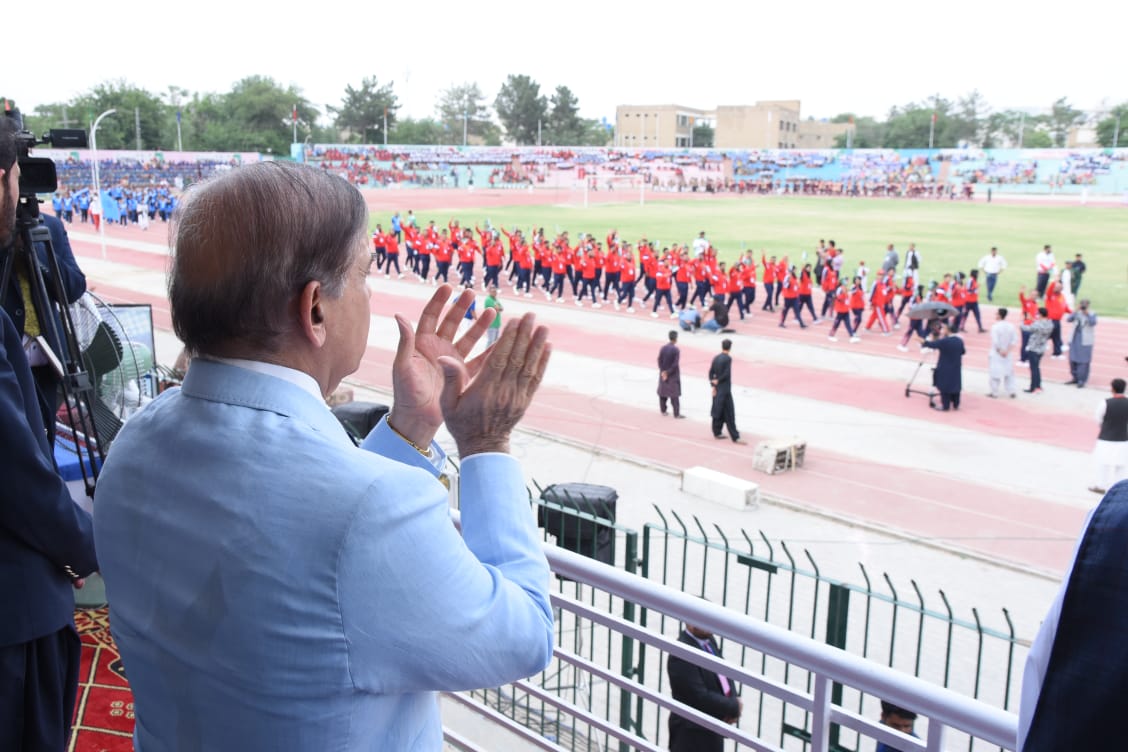
Pakistan Prime Minister Shehbaz Sharif inspects the March Past during the opening ceremony of the 34th National Games in Quetta on May 22, 2023. (Photo courtesy: Prime Minister's Office)
The National Games of Pakistan comprise various disciplines in which sportsmen from different provinces and departments of Pakistan compete. The games are organized by the Pakistan Sports Board, Pakistan Olympic Association, and the host province.
This year, the Sports Department of Balochistan is hosting the National Games in two phases. The first phase of the event kicked off on May 12, 2023, with mostly warm-up matches. Matches for the next phase will take place from May 23-29.
“We have been organizing 32 events in the 34th National Games and 22 matches are exclusively set for female athletes,” Muhammad Ishaque Jamali, Sports Secretary Balochistan, told Arab News, adding that the event was held in two phases due to security concerns.
Many sportspersons Arab News spoke to expressed satisfaction with the security arrangements at the event.
“We are very much optimistic that WAPDA will win the event because in the entire event, we showed our best, whether it was hockey or football,” Zahid Arif, 38, a sportsman from Lahore representing the basketball team of the Water and Power Development Authority (WAPDA), a utility-based public company, told Arab News.
Former Pakistan field hockey team captain, Shakeel Abbasi, hoped the event would bring more sports opportunities for the young people of Baloch.
“The youth in Balochistan are very much sports-loving and there should be first-class sports academies for them which would polish the players to participate in national and international sports events,” Abbasi, who has represented Pakistan thrice at the Olympics, told Arab News.
Hamza Shafqat, Balochistan’s secretary of information, said around 10,000 personnel had been deputed to ensure the security of the players and the national event.
“Unfortunately, Balochistan missed its last two turns for hosting the mega sports event,” Shafqat said, “and due to security issues, the events were shifted to other provinces.”


