

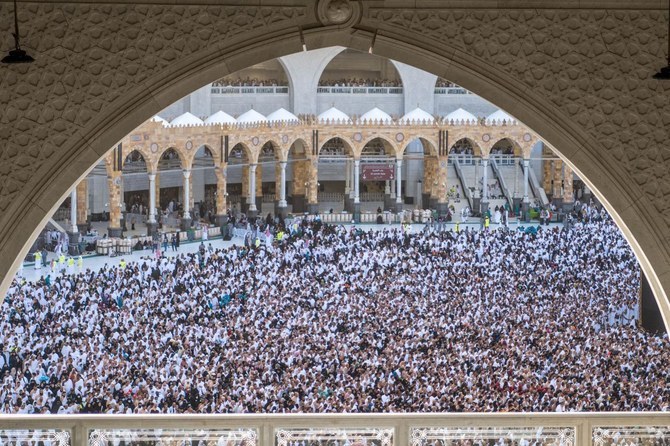
Mataf expansion at Makkah's Grand Mosque receives royal approval to be named Saudi Riwaq

Mataf expansion was fully developed under kings Fahd, Abdullah, and Salman of Saudi Arabia. (Supplied)
Short Url
Updated 22 May 2023
Follow

Mataf expansion at Makkah's Grand Mosque receives royal approval to be named Saudi Riwaq

  • Announcement was made by Dr. Abdulrahman Al-Sudais, president of General Presidency for Affairs of Two Holy Mosques
  • Saudi Riwaq consists of four floors and can accommodate a total of 287,000 worshippers or 107,000 pilgrims per hour

MAKKAH: The Mataf expansion at the Grand Mosque in Makkah has received royal approval to be named The Saudi Riwaq.

The announcement was made by Dr. Abdulrahman Al-Sudais, president of the General Presidency for the Affairs of the Two Holy Mosques.

He said: “The Saudi Riwaq, which includes the Mataf expansion project behind the Abbasid courtyard, surrounding the Holy Kaaba’s courtyard, was established when King Abdulaziz, the founder of Saudi Arabia, ordered the expansion of the Grand Mosque to accommodate the increasing numbers of pilgrims.”
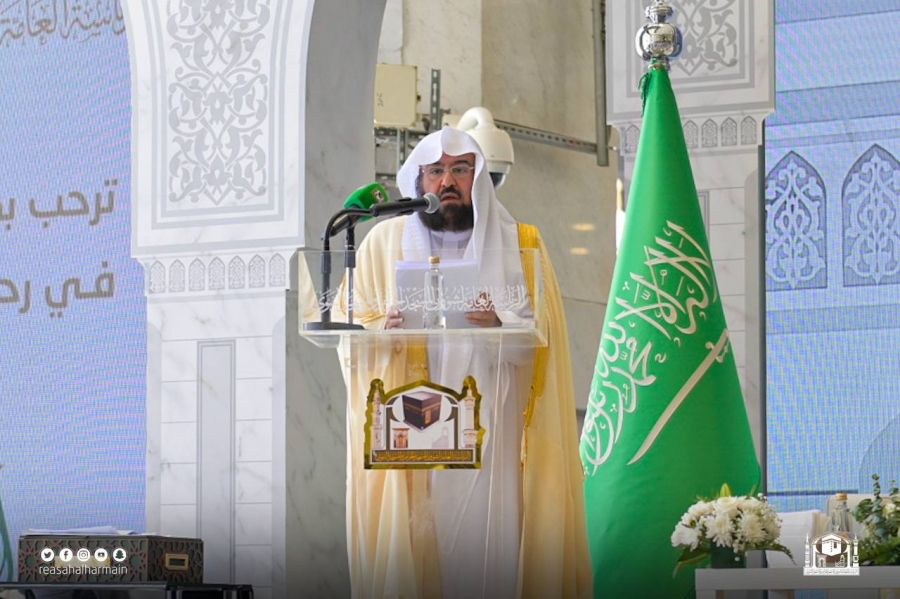


Dr. Abdulrahman Al-Sudais, president of the General Presidency for the Affairs of the Two Holy Mosques

Al-Sudais noted that the project began during the reign of King Saud in 1955 and continued during the reigns of King Faisal and King Khalid, before being fully developed under kings Fahd, Abdullah, and Salman.

“The Saudi Riwaq consists of four floors and can accommodate a total of 287,000 worshippers, or 107,000 pilgrims per hour,” he added. And more high-quality space had been created for worshippers.

“The heat-resistant marbles in Mataf also created a historical shift in the movement of circumambulation. It had a significant impact on the comfort of the circumambulation and the smoothness of the movement.

“Anyone who sees what the Grand Mosque was like before the (establishment of the) Saudi state and how it is today will see that what has been accomplished in these few years could not have been possible without the grace of Allah, the great care, and the unlimited support of the kings of the Kingdom,” Al-Sudais said.

Saudi Grand Mufti Sheikh Abdulaziz Al-Asheikh thanked the General Presidency for the Affairs of the Two Holy Mosques for its efforts.


Saudi deputy FM attends OIC ministers’ meeting on Somalia situation

Updated 11 January 2026
Follow

Saudi deputy FM attends OIC ministers’ meeting on Somalia situation

JEDDAH: Saudi Arabia Vice Minister of Foreign Affairs Waleed Elkhereiji has reaffirmed the Kingdom’s full support for Somalia’s sovereignty, unity and territorial integrity, while strongly rejecting any actions that undermine the country’s stability.

Speaking at an extraordinary meeting of foreign ministers from member states of the Organization of Islamic Cooperation, Elkhereiji condemned the declaration of mutual recognition between Israeli occupation authorities and the Somaliland region, describing it as a unilateral separatist move that violated international law, the UN Charter and the OIC Charter.

He stressed the Kingdom’s categorical rejection of any attempts to impose parallel entities that contradict Somalia’s unity and territorial integrity, or that seek to divide or diminish its sovereignty. Elkhereiji also reiterated Saudi Arabia’s support for Somalia’s legitimate state institutions and its commitment to preserving the country’s stability and the security of its people.

Elkhereiji called on the OIC and its member states to adopt a firm and unified Islamic position rejecting any recognition of, or engagement with, separatist entities in Somalia. He urged coordinated action in international forums to affirm Somalia’s unity and prevent what he described as dangerous precedents that could threaten the sovereignty of OIC member states.

He further called for holding the Israeli entity fully responsible for any political or security consequences resulting from such actions, and for rejecting any cooperation arising from the declaration of mutual recognition.

During the meeting, he also reiterated the Kingdom’s position on the Palestinian cause, emphasizing its centrality and Saudi Arabia’s support for efforts to secure a ceasefire in the Gaza Strip. He said this would enable the Palestinian people to exercise their right to self-determination and establish an independent state along the 1967 borders, with East Jerusalem as its capital.