

Bangladesh struggles to pay for fuel imports as dollar crisis worsens — letters

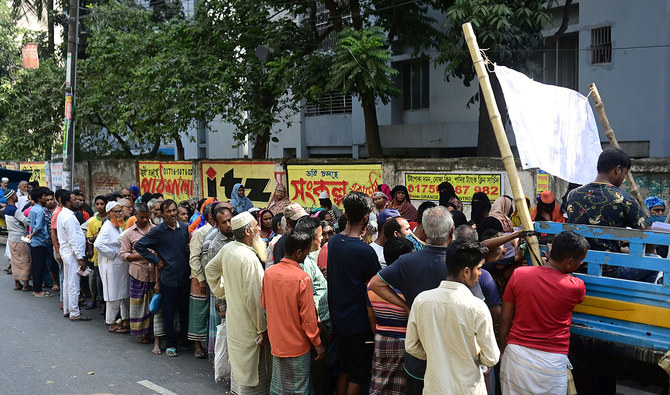
People wait in queue to buy food at subsidised price fixed by the government in Dhaka on November 17, 2022. (Photo courtesy: AFP)
Short Url
Updated 22 May 2023
Follow

Bangladesh struggles to pay for fuel imports as dollar crisis worsens — letters

  • In January, the International Monetary Fund approved loans of $4.7 billion for Bangladesh
  • Others in South Asia, such as Sri Lanka and Pakistan, also sought or received funds this year

DHAKA: Bangladesh is struggling to pay for imported fuel because of a dollar shortage, letters reviewed by Reuters show, with the state petroleum company owing more than $300 million as it faces an “alarming decrease in fuel reserves.”

All import and marketing of fuel in the country of nearly 170 million people is controlled by Bangladesh Petroleum Corp. (BPC), which has asked the government to permit domestic commercial banks to settle dues with India in rupees.

The South Asian nation’s dollar reserves have shrunk more than a third since Russia’s invasion of Ukraine in February last year to stand at a seven-year low of $30.18 billion by May 17.

Heavily reliant on energy imports, Bangladesh is grappling with power cuts resulting from a fuel shortage that have badly hurt its exports-oriented garments industry.

“Due to a shortage of foreign currency/dollars in the domestic market and the central bank not meeting demand for US dollars, commercial banks are unable to pay for imports on time,” BPC told the power ministry in a May 9 letter reviewed by Reuters.

That followed a warning in a letter in April that said, “If it is not possible to import fuel according to the import schedule prepared for May, supply may be disrupted throughout the country with an alarming decrease in fuel reserves.”

The ministry, BPC and the central bank did not immediately respond to telephone calls to seek comment.

BPC imports 500,000 tons of refined oil and 100,000 tons of crude oil every month.

The April letter said several fuel suppliers had either sent fewer cargoes than scheduled or threatened to halt supplies.

Creditors included Unipec, the trading arm of China’s state-owned Sinopec, Vitol, ENOC, Indian Oil Corp. Ltd. (IOC), PetroChina and Indonesia’s BSP, it said.

“Several companies are threatening to stop supplies while others are sending fewer cargoes than planned,” said a BPC source who sought anonymity to speak on a sensitive issue.

BPC will have to pay $41.1 million this year for diesel to India’s Numaligarh Refinery Ltd, majority owned by Oil India Ltd, while IOC is owed $147.2 million for diesel and jet fuel, the May letter showed.

BPC asked the government to allow Bangladesh’s nationalized commercial banks to settle dues with Indian companies in rupees.

In September, Reuters reported that State Bank of India had asked exporters to avoid settling deals with Bangladesh in dollars and other major currencies as its reserves fell, favoring instead the taka and rupee currencies.

For years, Bangladesh’s $416-billion economy has been one of the world’s fastest growing, but rising prices of energy and food because of the war have inflated its import bill and the current account deficit.

In January, the International Monetary Fund approved loans of $4.7 billion for Bangladesh. Others in South Asia, such as Sri Lanka and Pakistan, have also sought or received IMF funds this year.


Bangladesh sends record 750,000 workers to Saudi Arabia in 2025

Updated 56 min 35 sec ago
Follow

Bangladesh sends record 750,000 workers to Saudi Arabia in 2025

  • Latest data shows 16% surge of Bangladeshis going to the Kingdom compared to 2024
  • Bangladesh authorities are working on sending more skilled workers to Saudi Arabia

DHAKA: Bangladesh sent over 750,000 workers to Saudi Arabia in 2025, marking the highest overseas deployment to a single country on record, its labor bureau said on Friday.

Around 3.5 million Bangladeshis live and work in Saudi Arabia, sending home more than $5 billion every year. They have been joining the Saudi labor market since the 1970s and are the largest expatriate group in the Kingdom.

Last year, Saudi Arabia retained its spot as the top destination for Bangladeshi workers, with more than two-thirds of over 1.1 million who went abroad in 2025 choosing the Kingdom.

“More than 750,000 Bangladeshi migrants went to Saudi Arabia last year,” Ashraf Hossain, additional director-general at the Bureau of Manpower, Employment and Training, told Arab News.

“So far, it’s the highest number for Bangladesh, in terms of sending migrants to Saudi Arabia or any other particular country in a single year.”

The latest data also showed a 16 percent increase from 2024, when about 628,000 went to the Kingdom for work, adding to the largest diaspora community outside Bangladesh.

Authorities have focused on sending more skilled workers to Saudi Arabia in recent years, after the Kingdom launched in 2023 its Skill Verification Program in Bangladesh, which aims to advance the professional competence of employees in the Saudi labor market.

Bangladesh has also increased the number of certification centers, allowing more candidates to be verified by Saudi authorities.

“Our focus is now on increasing safe, skilled and regular migration. Skilled manpower export to Saudi Arabia has increased in the last year … more than one-third of the migrants who went to Saudi Arabia did so under the Skill Verification Program by the Saudi agency Takamol,” Hossain said.

“Just three to four months ago, we had only been to certify 1,000 skilled workers per month. But now, we can conduct tests with 28 (Saudi-approved) centers across the country, which can certify around 60,000 skilled workforces (monthly) for the Kingdom’s labor market.”

On Thursday, the BMET began to provide training in mining, as Bangladesh aims to also start sending skilled workers for the sector in Saudi Arabia.

“There are huge demands for skilled mining workers in Saudi Arabia as it’s an oil-rich country,” Hossain said.

“We are … trying to produce truly skilled workers for the Saudi labor market.”

In October, Saudi Arabia and Bangladesh signed a new employment agreement, which enhances worker protection, wage payments, as well as welfare and health services.

It also opens more opportunities in construction and major Vision 2030 projects, which may create up to 300,000 new jobs for Bangladeshi workers in 2026.