

Yemeni riyal falls to 1,320 to dollar as president calls for financial aid

A man receives bands of Yemeni riyal banknotes at the Houthi-run Central Bank of Yemen in Sanaa, Yemen June 30, 2021. (REUTERS)
Short Url
Updated 21 May 2023
Follow

Yemeni riyal falls to 1,320 to dollar as president calls for financial aid

  • A $1 billion cash injection into the central bank by Saudi Arabia earlier this year supported the Yemeni riyal for months, allowing the Yemeni government to pay for food and fuel imports
  • We hope for a collective Arab movement, working alongside our brothers in the coalition, to put an end to the egregious Houthi violations of international law

AL-MUKALLA: Yemen’s currency hit a new low against the US dollar on Saturday, a day after the Yemeni Presidential Leadership Council’s head appealed to Arab leaders in Jeddah to support his government’s reforms to stabilize the faltering economy.

Money traders in government-controlled areas said that the Yemeni riyal fell to 1,320 to the dollar for the first time since the beginning of this year, after more than a year of stability.

The riyal hovered around 1,200 against the dollar since the formation of the presidential council in April last year and the return of government duties to Aden, the country’s interim capital.
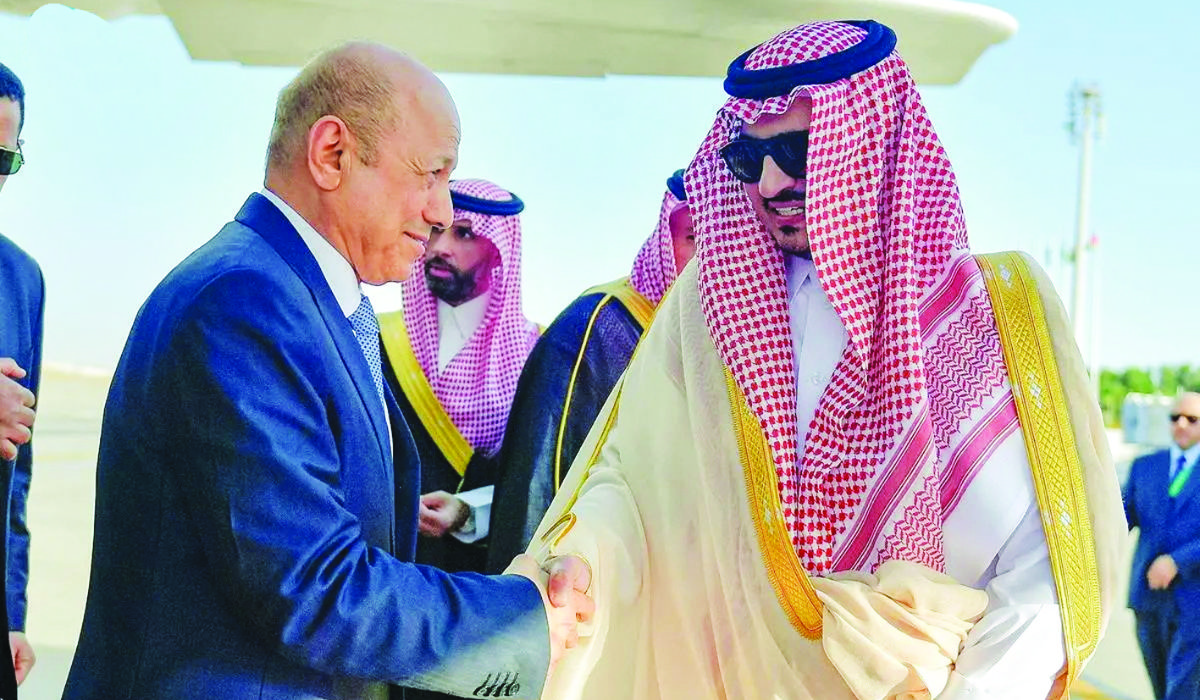


Rashad Al-Alimi, Yemen’s Presidential Leadership Council’s head, urged Arab leaders at the Arab League summit in Jeddah to support the internationally recognized body in ending the Houthi coup, implementing economic reform, and ending interventions in Yemen’s affairs. (SPA)

The riyal, however, began to decline last week as international efforts to achieve peace in Yemen reached a deadlock, reaching 1,300 per dollar before dropping further to 1,320 per dollar. In early 2015, the Yemeni riyal sold at 250 against the dollar.

The Yemeni government’s efforts to stem the devaluation of the riyal, which included shutting down unlicensed exchange firms, providing oil and goods importers with dollars, suspending the internal transfer system between exchange shops known as hawala, and restricting the smuggling of foreign currencies out of the country, have largely failed.

The riyal reached a record low of 1,400 to the dollar in October 2019 despite the central bank closing 60 non-compliant exchange shops and businesses.

The Yemeni central bank cautioned Yemenis last week against retaining their money in local exchange firms’ accounts, stating that these firms’ activities are buying and selling currency, not opening accounts.

“The central bank confirms to the public that the activity of exchange companies and facilities is limited by law to buying and selling foreign currency and money transfers, and punitive measures will be taken against infringing organizations,” the central bank said.

Yemenis say that they are encouraged to keep their money with exchange banks because they have adequate cash, offer better services such as utility payments, and are open most of the day. In contrast, private and state banks in Yemen are suffering from acute liquidity shortages and offer less appealing services.

A $1 billion cash injection into the central bank by Saudi Arabia earlier this year supported the Yemeni riyal for months, allowing the Yemeni government to pay for food and fuel imports while also covering a significant drop in revenue to the public treasury as a result of Houthi drone and missile attacks on oil facilities in the southern provinces of Shabwa and Hadramout.

The depreciation of the Yemeni riyal occurred as the head of the presidential council, Rashad Al-Alimi, urged Arab leaders meeting in Jeddah on Friday to support the internationally recognized council in ending the Iran-backed Houthis’ coup, implementing economic reform, and ending Iran’s intervention in the country’s affairs.

He expressed hope that current Saudi and Omani efforts would lead to the renewal of the UN-brokered truce and reaching peace.

“We hope for a collective Arab movement, working alongside our brothers in the coalition, to put an end to the egregious (Houthi) violations of international law, to support the Yemeni government’s efforts to revive the economy and improve basic services, to support life-saving humanitarian interventions, and to support the initiatives of brothers and friends to restart the political process,” Al-Alimi told the summit.

Similarly, a Yemeni government official told Arab News on Saturday that the Yemeni government was seeking financial assistance for the central bank, the public budget, and the purchase of fuel for public power plants.

“We want support for the central bank, the state’s general budget in view of the halt in oil exports, and an improvement in services, particularly the energy sector, which drains more than $3 million per day from government coffers,” the official, who requested anonymity, said.


Refugees, migrants in Lebanon find rare sanctuary from Israeli strikes in Beirut church 

Updated 07 March 2026
Follow

Refugees, migrants in Lebanon find rare sanctuary from Israeli strikes in Beirut church 

  • Beirut church offers safe haven for displaced migrants, refugees
  • Many refugees lived through 2024 war, but are now more vulnerable

BEIRUT: When Israeli strikes began pummelling Beirut’s southern suburbs early on Monday, Sudanese refugee Ridina Muhammad and her family ​had no choice but to flee home on foot, eventually reaching the only shelter that would accept them: a church.
Eight months pregnant, Muhammad, 32, walked with her husband and three children for hours in the dark streets until they found a car to take them to the St. Joseph Tabaris Parish, which has opened its doors to refugees and migrants.
They are among 300,000 people displaced across Lebanon this week by heavy Israeli strikes, launched in response to a rocket and drone attackinto Israel by the Lebanese armed group Hezbollah.
Just 100,000 of the displaced are in government shelters. Others are staying ‌with relatives ‌or sleeping in the streets. But migrants and refugees say government ​shelters ‌were ⁠never an option ​for ⁠them, saying they were turned away during the last war between Hezbollah and Israel.
Muhammad’s oldest daughter, now seven, stopped speaking after the 2024 war.
This time, they are even more vulnerable: their home was destroyed in this week’s strikes and Muhammad is due to give birth at the end of the month.
“I don’t know if there’s a doctor or not, but I’m really scared about it because I haven’t prepared any clothes for the baby, nor arranged a hospital, and I don’t know where to go,” she told ⁠Reuters as her younger daughter leaned against her pregnant belly.
Muhammad ‌said she was registered with the United Nations’ refugee agency (UNHCR) ‌but had not received support.
“Us, as refugees, why did we ​register with the UN, if they are not ‌helping us in the most difficult times?” she said.
Dalal Harb, a spokesperson for UNHCR ‌Lebanon, said the agency had mobilized but reaching everyone immediately was extremely challenging given the scale and speed of displacement. The UNHCR operation in Lebanon is currently only around 14 percent funded, she said.
The Jesuit Refugee Service (JRS), which helped the church host displaced in 2024, is doing so again.
Michael Petro, JRS’ Emergency Shelter Director, said the church was ‌full within the first day of strikes, with 140 people from South Sudan, Ethiopia, Bangladesh, and other countries sheltering there.
“There are many, many more ⁠people coming than there ⁠were in 2024, and we have fewer and fewer places to put them,” he said.
Petro said he was told weeks ago that government shelters would be open to migrants if war erupted.
But when the strikes began and even Lebanese struggled to find shelter, the policy seemed to change, he said.
“We’re hearing from hotlines up to government officials and ministries that migrants are not welcome,” Petro said.
Lebanon’s Minister for Social Affairs Haneen Sayyed did not respond to a request for comment. On Thursday, Sayyed said Beirut shelters were full.
When Israeli strikes began, Othman Yahyeh Dawood, a 41-year-old Sudanese man, put his two young sons on his motorcycle.
They drove 75 kilometers (46 miles) from the southern Lebanese town of Nabatieh to St. Joseph’s, where they had sheltered in 2024.
“I know the area ​is safe and there are people who ​will welcome us,” he said.
“We don’t know where to go; there’s war there (in the south), war here (in Beirut), war in Sudan, and nowhere else to go,” he said.