Three soldiers killed in attack on security check-post in Pakistan’s Balochistan 

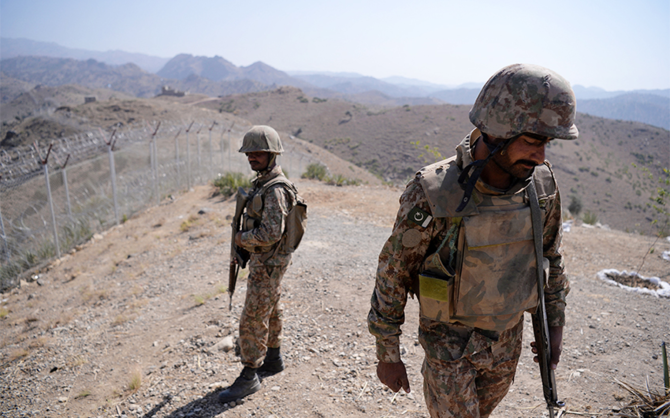
Pakistani soldiers patrol next to a newly fenced border fencing along Afghan border at Kitton Orchard Post in northwest Pakistan on October 18, 2017. (AFP/File)
Short Url
Updated 20 May 2023
Follow

Three soldiers killed in attack on security check-post in Pakistan’s Balochistan 

  • Security forces have identified a militant hideout in the nearby mountains, launched an operation 
  • On Friday, a suicide attack targeted a political leader and a cop was shot dead in the same province 

ISLAMABAD: Three soldiers were killed in an attack on a security forces’ check-post in southwest Pakistan, the Pakistani military said on Saturday, the latest in a string of attacks in the Balochistan province. 

The militants targeted the check-post in Marget area of the province early Saturday morning, according to the Inter-Services Public Relations (ISPR), the military’s media wing. 

The post had recently been established to help check extortion attempts targeting coal mines in the vicinity. 

“Troops on the post retaliated readily to the fire raid thereby, pushing back the terrorists. However, in the ensuing heavy exchange of fire three soldiers embraced shahadat (martyrdom),” the ISPR said in a statement. 

The exchange of fire left one militant dead, it added. 

Security forces have identified the militants’ hideout in nearby mountains in the rugged area and launched a sanitization operation in the vicinity, according to the statement. 

“Currently, the operation is progressing well and security forces are maintaining pressure to deny terrorists escape from the area,” the ISPR added. 

The attack came a day suicide attack on top leader of a prominent Pakistani religious party, Jamaat-e-Islami (JI), in Balochistan’s Zhob district. JI chief Sirajul Haq survived the attack, though at least seven people were injured in the explosion, a JI member confirmed on Friday. 

Also on Friday, a policeman guarding a team of anti-polio vaccinators was gunned down in the same province. 

No group has so far claimed responsibility for the recent attacks in Balochistan, Pakistan’s largest province in terms of area, which has long been the site of a low-level insurgency by separatist groups who seek independence from the central government in Islamabad. 

The separatists say they are fighting what they see as unfair exploitation of the province’s wealth by the federation. The Pakistani state denies it. 

Earlier this month, six soldiers and a civilian were killed in a militant attack on a paramilitary compound in Balochistan. 

Pakistan forces retook the Frontier Corps (FC) paramilitary camp in Muslim Bagh area of Balochistan, killing six assailants and rescuing three families taken hostage at a residential block after more than 24 hours. 


Pakistan to begin first phase of Hajj 2026 trainings from today

Updated 31 December 2025
Follow

Pakistan to begin first phase of Hajj 2026 trainings from today

  • Training programs to be held in phases across Pakistan till February, says religion ministry
  • Saudi Arabia allocated Pakistan a total quota of 179,210 pilgrims for Hajj 2026

ISLAMABAD: Pakistan’s religious affairs ministry has said that it will begin the first phase of mandatory Hajj 2026 training for pilgrims intending to perform the pilgrimage from today, Thursday.

The one-day Hajj training programs will be held in phases across the country at the tehsil level until February. The ministry directed intending pilgrims to bring their original identity cards and the computerized receipt of their Hajj application to attend the training sessions.

“Pilgrims should attend the one-day training program according to their scheduled date,” Pakistan’s Ministry of Religious Affairs (MoRA) said in a statement.

The ministry said training schedules are being shared through the government’s Pak Hajj 2026 mobile application as well as via SMS. It added that details of the schedule are also available on its website.

According to the ministry, training programs will be held in Abbottabad on Jan. 2; Ghotki, Thatta and Kotli on Jan. 3; and Tando Muhammad Khan and Khairpur on Jan. 4.

Hajj training sessions will be held in Rawalakot, Badin and Naushahro Feroze on Jan. 5, while pilgrims in Fateh Jang, Dadu and Tharparkar will receive the training on Jan. 6.

The ministry said training programs will be conducted in Umerkot and Larkana on Jan. 7, followed by sessions in Mirpurkhas, Shahdadkot and Mansehra on Jan. 8.

Pakistan’s religious affairs ministry has previously said these trainings will be conducted by experienced trainers and scholars using multimedia.

It said the training has been made mandatory to ensure that intending pilgrims are fully aware of Hajj rituals and administrative procedures.

Saudi Arabia has allocated Pakistan a quota of 179,210 pilgrims for Hajj 2026, of which around 118,000 seats have been reserved under the government scheme, while the remainder will be allocated to private tour operators.

Under Pakistan’s Hajj scheme, the estimated cost of the government package ranges from Rs1,150,000 to Rs1,250,000 ($4,049.93 to $4,236), subject to final agreements with service providers.