Pakistan’s defense minister says people tried in military courts will reserve right to appeal

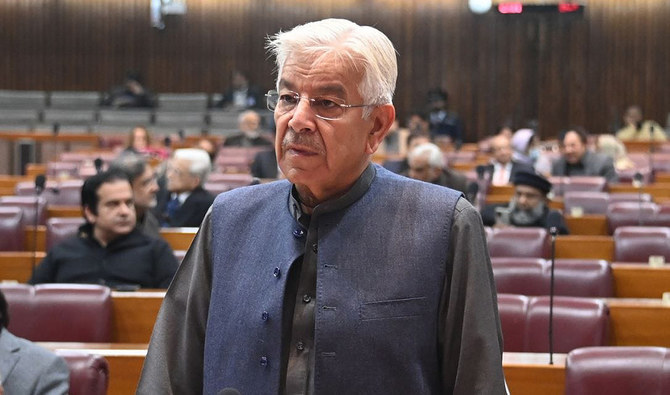
This photo, taken on January 31, 2023, shows Pakistani Defense Minister Khawaja Asif addressing the National Assembly of Pakistan in Islamabad. (Photo courtesy: Twitter/NAofPakistan)
Short Url
Updated 20 May 2023
Follow

Pakistan’s defense minister says people tried in military courts will reserve right to appeal

  • Khawaja Asif says the violent protests that broke out after ex-PM Khan’s arrest amounted to ‘war’ against the state
  • Khan was arrested on graft charges on May 9, causing violent protests in which people torched military properties

ISLAMABAD: Pakistan’s defense minister Khawaja Asif said on Friday people who indulged in violent protests after former prime minister Imran Khan’s arrest and torched military installations would have the right to appeal the verdict after being tried in military courts.

The minister’s statement was quoted by the state-owned Associated Press of Pakistan (APP) news agency after he gave interview to a Middle Eastern news channel.

Asif said some of the top political leaders in the country had faced incarcerations in the past, but their party supporters and activists had refrained from extreme violence.

“Such actions are tantamount to waging a war against Pakistan,” the APP quoted him as saying in an interview with Al Jazeera. “Those who attacked military installations, military bases and residences of military personnel, their trials will be held under military courts according to the procedure given in the constitution.”

He added that those who were tried by the military authorities would still “have the right to appeal to the high courts and the Supreme Court.”

“My leader [Nawaz Sharif] and many people of my political party were arrested, but we never did politics of violence,” he continued. “We have never attacked military and civilian installations on arrests.”

Asif acknowledged there were political difference between the government and ex-PM Khan’s party.

“But that does not mean that government and public properties should be attacked,” he added.

The former prime minister was arrested on corruption charges from a court in Islamabad on May 9. Within the next few hours, protests broke out in different parts of the country, with people carrying Khan’s party flags storming government building, including military properties, and setting them alight.

The government and the country’s powerful army believe the demonstrations were planned and organized.

Khan and his top party leaders have condemned the vandalism, though they continue to face a tough political situation.


Pakistan’s space agency says country will witness first supermoon of 2026 on Saturday

Updated 3 sec ago
Follow

Pakistan’s space agency says country will witness first supermoon of 2026 on Saturday

  • The supermoon will coincide with the Quadrantid meteor shower, which peaks in early January
  • The space agency says no further supermoon will occur until a new cycle begins in Nov. 2026

ISLAMABAD: Pakistan will witness the first supermoon of 2026 on Saturday evening, a rare celestial event that will coincide with the Quadrantid meteor shower, which is active in early January, the country’s space agency said Friday.

The Jan. 3 supermoon will be the last in a cycle that began in October 2025, while also marking the first supermoon of the new year. Supermoons occur when a full moon coincides with the Moon’s closest approach to Earth, making it appear larger and brighter than usual.

“The January 3 supermoon, traditionally known as the Wolf Moon, marks the final supermoon of the ongoing cycle began in October 2025,” Pakistan’s national space agency, SUPARCO, said in a statement, adding that it also “simultaneously represents the first supermoon of 2026.”

The agency said the supermoon would rise in Pakistan at 5:51 p.m. local time on Jan. 3 and remain visible through the nights of Jan. 3 and Jan. 4, with illumination reaching 99.8 percent.

According to SUPARCO, the Moon will be at a distance of about 362,312 kilometers (225,130 miles) from Earth during the event, making it appear six to seven percent larger and up to 10 percent brighter than a typical full moon.
The astronomical significance of the event will be enhanced by its timing.

“The supermoon of Jan 3 offers an early highlight among the year’s celestial events such as coinciding with the peak activity of the Quadrantid meteor shower during the same time period,” the statement said.

SUPARCO noted that supermoons usually occur in clusters of three to four consecutive events and said the current cycle would conclude with Friday’s phenomenon.

“The next supermoon cycle starts in November 2026,” the agency said, adding that there would be no further supermoon after this until the end of 2026.