

Political plot thickens as Lahore court voids denotification of over 70 Imran Khan party MPs

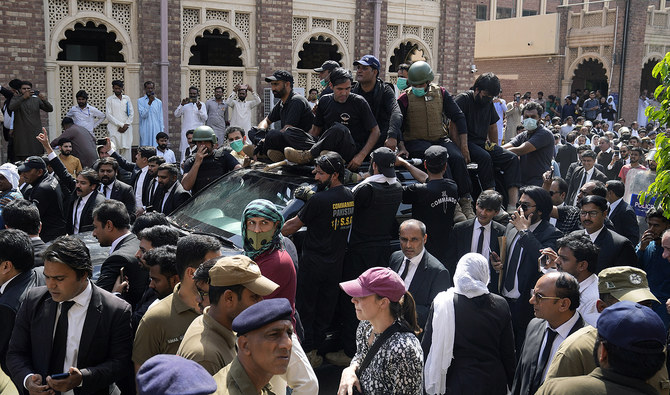
Security escort a vehicle carrying Pakistan's former Prime Minister Imran Khan as he arrives at the Lahore High Court in Lahore, Pakistan on May 15, 2023. (Photo courtesy: AP)
Short Url
Updated 19 May 2023
Follow

Political plot thickens as Lahore court voids denotification of over 70 Imran Khan party MPs

  • Court order paves way for the lawmakers’ return to parliament, poses challenge for government of PM Sharif
  • Lahore High Court’s decision adds a new twist to the ongoing political tug-of-war in the South Asian country

ISLAMABAD: The Lahore High Court (LHC) on Friday declared the denotification of more than 70 lawmakers of former prime minister Imran Khan’s party void, paving the way for their return to parliament and posing a challenge for the coalition government of Prime Minister Shehbaz Sharif.

Khan’s Pakistan Tehreek-e-Insaf (PTI) party had quit the National Assembly en masse soon after he was driven from power in a parliamentary no-trust vote last April, but Speaker Raja Pervaiz Ashraf, a Sharif ally, said he needed to individually verify if the lawmakers were resigning of their own accord.

In a surprise move in January, Ashraf accepted the long pending resignations of more than 70 PTI lawmakers and Pakistan’s election regulator subsequently denotified them, virtually wiping out the presence of Khan’s party from parliament.

PTI lawmakers later decided to withdraw the resignations and filed petitions against their denotification in the LHC, which today, Friday, declared the denotification of 72 parliamentarians of Khan’s party null and void, Pakistan’s Geo News channel reported.

“They had withdrawn their resignations, therefore, the speaker does not have any right to denotify them. The Election Commission of Pakistan’s denotification after the speaker’s decision was also challenged in this case,” Barrister Ali Zafar, a senior lawyer representing the PTI, told reporters in Lahore.

“The court has just announced the verdicts, petitions have been accepted which would mean that the speaker’s and the Election Commission of Pakistan’s notifications to denotify PTI members from the National Assembly have been declared void.”

Zafar said the court had also issued directives for the speaker to make a decision after individually verifying the resignations.

“Now our MNAs will appear before the speaker... will withdraw their resignations by appearing before [the speaker] during the inquiry,” Zafar added.

The ECP had announced by-elections on some of these parliamentary seats in March, but later postponed them.

The LHC’s decision to declare the denotification of PTI lawmakers void adds a new twist to the ongoing political tug-of-war in the South Asian country, where Khan, arguably the nation’s most popular politician, is squarely pitted against the Sharif government and the all-powerful army.

It remains to be seen whether Khan will direct his party’s lawmakers to return to parliamentary politics.

Analysts say the PTI, which initially threatened the en masse resignations to force early general elections, now wants to maintain its presence in the national legislature so it can be part of the consultative process for the appointment of the interim setup ahead of the general elections later this year. The party is eying the leader of the opposition slot, who has a direct say in choosing the interim government.


Pakistan joins regional talks on Afghanistan in Iran as Kabul stays away

Updated 6 sec ago
Follow

Pakistan joins regional talks on Afghanistan in Iran as Kabul stays away

  • China, Pakistan, Pakistan, Tajikistan, Uzbekistan, Turkmenistan all joined talks organized by Iran, as did Russia
  • Afghanistan was invited but decided not to attend, Taliban-led government was tight-lipped on the reasons

TEHRAN, Iran: Afghanistan’s neighbors met in Iran and agreed to deepen regional coordination to address political, economic and security challenges, as well as calling for sanctions on Afghanistan to be lifted. 

The only absent party? Afghanistan itself.

China, Pakistan, Pakistan, Tajikistan, Uzbekistan and Turkmenistan all joined the talks organized by Iran, as did Russia, according to a statement released after the meeting on Sunday.

Afghanistan was invited but decided not to attend. Its Taliban-led government was tight-lipped on the reasons, with the foreign ministry saying only that it would not participate because Afghanistan “currently maintains active engagement with regional countries through existing regional organizations and formats, and has made good progress in this regard.”

The statement from the talks in Iran stressed the importance of maintaining economic and trade ties with Afghanistan to improve living conditions and called for the country’s integration into regional political and economic processes.

The Taliban were isolated after they retook power in Afghanistan in August 2021, but in the past year, they have developed diplomatic ties. They now raise several billion dollars every year in tax revenues to keep the lights on.

However, Afghanistan is still struggling economically. Millions rely on aid for survival, and the struggling economy has been further impacted by the international community not recognizing the Taliban government’s seizure of power in the wake of the chaotic withdrawal of US-led troops in 2021. Natural disasters and the flow of Afghans fleeing Pakistan under pressure to return home have underlined Afghanistan’s reliance on foreign aid to meet essential needs.

The countries at the talks also voiced security concerns and pledged cooperation in combating terrorism, drug trafficking and human smuggling, while opposing any foreign military presence in Afghanistan. They underscored the responsibility of the international community to lift sanctions and release Afghanistan’s frozen assets, and urged international organizations to support the dignified return of Afghan refugees from neighboring countries.

The participants backed efforts to reduce tensions between Afghanistan and Pakistan, which have been particularly strained, with border clashes between the two sides killing dozens of civilians, soldiers and suspected militants and wounding hundreds more.

The violence followed explosions in Kabul on Oct. 9 that Afghan authorities blamed on Pakistan. A Qatar-mediated ceasefire has largely held since October, although there have been limited border clashes. The two sides failed to reach an overall agreement in November despite three rounds of peace talks.

Asif Durrani, Pakistan’s former special representative for Afghanistan, said the Taliban government’s decision to skip the meeting reflected a “lack of political maturity.” 

Writing on X, Durrani said the move reinforced concerns that the Taliban were unwilling to negotiate, instead adopting an “I don’t accept” stance that he said would do little to resolve serious regional problems.

Mohammad Sadiq, the current Pakistani special representative for Afghanistan who attended the talks, wrote on X that the Afghan people had already suffered enough and deserved better.

Only an Afghanistan that does not harbor militants would inspire confidence among neighboring and regional countries to engage meaningfully with Kabul and help unlock the country’s economic and connectivity potential, he wrote.

Participants agreed to hold the next meeting of foreign ministers of Afghanistan’s neighboring countries as soon as possible in Ashgabat, Turkmenistan, and welcomed Pakistan’s offer to host the next round of special envoys’ talks in Islamabad in March.

Iran’s foreign ministry spokesman, Esmail Baghaei, on Sunday said that the meeting had not been held for about two years and marked the first such gathering attended by special envoys on Afghanistan from neighboring countries as well as Russia. Russia and Uzbekistan sent the special envoys of their presidents, while Pakistan was represented by a delegate from the prime minister’s office.

Landlocked Afghanistan is sandwiched between the Middle East, Central Asia, and South Asia, making it strategically located for energy-rich and energy-hungry nations.