Emirati artist Almaha Jaralla’s latest exhibition heads back in time 

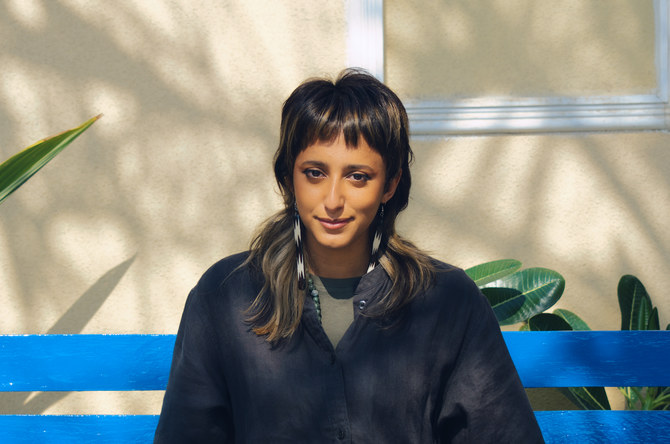
Emirati painter Almaha Jaralla's latest exhibition, “Seham,” runs until Sept. 1. (Supplied)
Short Url
Updated 20 May 2023
Follow

Emirati artist Almaha Jaralla’s latest exhibition heads back in time 

  • The Emirati artist’s latest exhibition was inspired by photographs her great-aunt took in Abu Dhabi in the Eighties 

DUBAI: “Make yourself at home” isn’t an invitation you’d normally associate with an art gallery. But that’s exactly the atmosphere Emirati painter Almaha Jaralla wanted to evoke with her latest exhibition, “Seham,” which runs until Sept. 1 at Dubai’s Tabari Art Space. The exhibition hosts an old-fashioned majlis, decorated with floral wallpaper, and visitors are welcome to take a seat.  

“When you go to a gallery show, you feel a bit tense. (It’s often) very cold, like a white cube space,” Jaralla tells Arab News. “We wanted to break that and make it an actual majlis. On opening night, it felt like a family gathering. Everyone was sitting on the chairs, and it did make it feel more home-y and relaxed.”   


Almaha Jaralla, Old Corniche 1 Seham, 2023. (Supplied)

Surrounding the majlis is a group of Jaralla’s figurative paintings, based on snapshots taken in the Eighties by a special family member, the eponymous Seham, who is the aunt of Jaralla’s father. Her name means ‘arrows’ in Arabic, and that gives a hint about her character. “She’s resilient and always there for everyone,” explains Jaralla. “We all love her, but we’re scared of her at the same time because she’s very serious.” 

Using a Fuji camera, Seham captured and archived various shots of life in Abu Dhabi, where Jaralla was raised, as well as close family moments, from beach trips to birthday parties. Going through the images with Seham got Jaralla thinking. “I wanted to understand my dad’s generation — but from the women’s side,” she says. 

She spoke with female family members, including her great-grandmother, whose experiences were about simpler times — with more face-to-face interaction — that required a dose of creativity.  


Almaha Jaralla, BTB. (Supplied)

“They used to go out as a group a lot. Because of the limited number of places to go, they would create their own places. They would just take their Land Cruiser and drive around,” says Jaralla. “It’s changed now. Now, we know all about what my cousins are doing through Instagram.”    

One of the places that Jaralla’s family ‘created’ through their outings is a remote area called Al-Shelaylah, today a beach, between Dubai and Abu Dhabi. “They just saw it and set up tents there,” she says. “They were trying to discover the (country).”  

Jaralla also depicts children playing at the sea, uncles barbecuing, and aunties strolling along the now-demolished old corniche of Abu Dhabi. Her paintings, she explains, are “a study of family dynamics of the Eighties, and the change of landscape and environment.”  
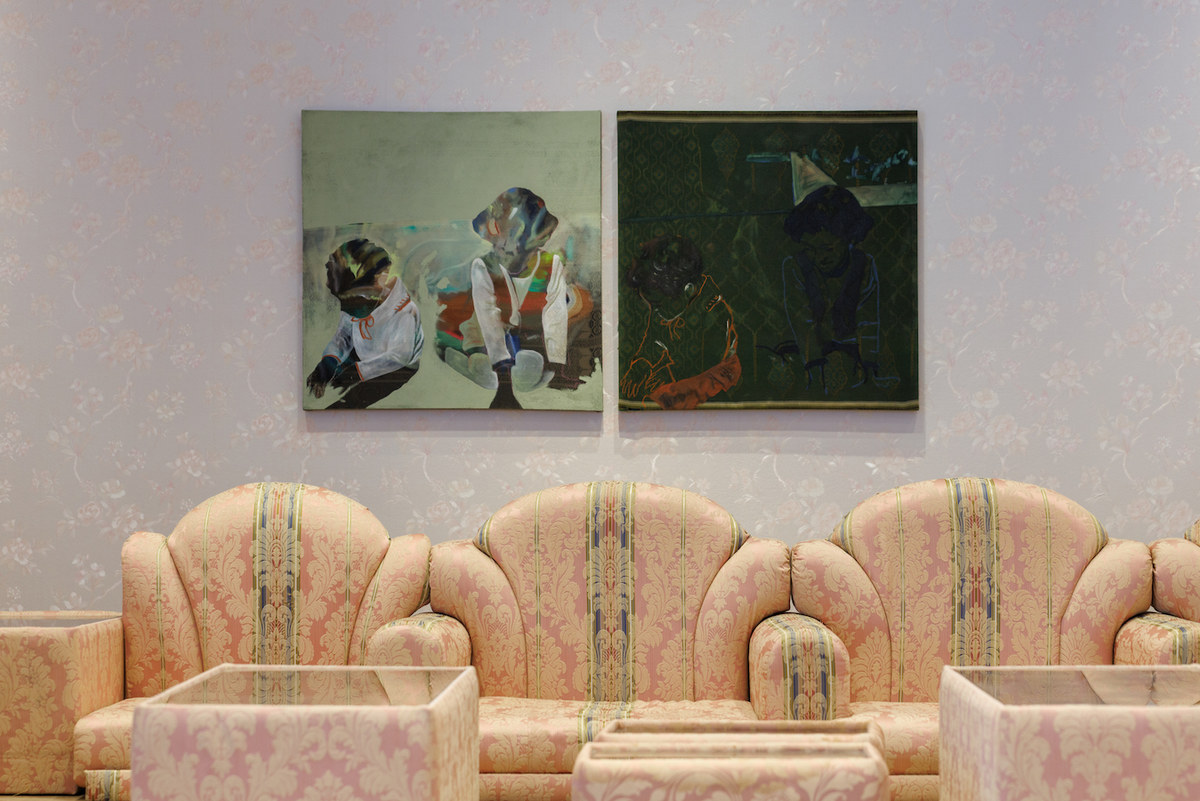


Jaralla's “Seham” exhibition runs until Sept. 1 at Dubai’s Tabari Art Space. (Supplied)

Jaralla was born in the Nineties and remembers how busy Abu Dhabi was — the traffic, the noise, and the construction. In 2006, when she was around 10 years old, she had a sudden realization when crossing Al-Maqta Bridge. It was built in 1968, three years prior to the unification of the UAE. To put that in historical context, 1968 was the year that civil rights icon Martin Luther King Jr. was assassinated, NASA’s Apollo 8 space mission was launched, anti-Vietnam war protests escalated in the Western world, and violent riots (a ‘cultural revolution’) swept across France.  

In one of her paintings, she portrays the bridge in an isolated, purple-colored mode from a bird’s eye view. “In 2006, we moved out of the suburbs. That was the first time we crossed Al-Maqta Bridge and I remember it very clearly: I saw the water and was like, ‘Woah, we live on an island,’“ she recalls. “We moved to the desert and it was a huge shift. That’s why the bridge is very important, historically, to a lot of people. It started the construction of the city itself and connected the mainland to the islands.” 

Most of Jaralla’s evocative images are painted in light colors with faded faces. At times, the color scheme emulates the reddish and blueish filter of Seham’s old snapshots. While Jaralla didn’t feel nostalgic when creating the work, she admits it was a cathartic experience.  

“It was really emotional,” she says. “There are a lot of lost ones. Seeing these kids being moms now. . . I wanted to understand what happened and I would sit with my family and talk. It can get very emotional, seeing people change.”  


Kawthar Al-Atiyah: ‘My paintings speak first to the body, then to the mind’ 

Updated 19 December 2025
Follow

Kawthar Al-Atiyah: ‘My paintings speak first to the body, then to the mind’ 

  • The Saudi artist discusses her creative process and her responsibility to ‘represent Saudi culture’ 

RIYADH: Contemporary Saudi artist Kawthar Al-Atiyah uses painting, sculpture and immersive material experimentation to create her deeply personal works. And those works focus on one recurring question: What does emotion look like when it becomes physical?  

“My practice begins with the body as a site of memory — its weight, its tension, its quiet shifts,” Al-Atiyah tells Arab News. “Emotion is never abstract to me. It lives in texture, in light, in the way material breathes.”  

This philosophy shapes the immersive surfaces she creates, which often seem suspended between presence and absence. “There is a moment when the body stops being flesh and becomes presence, something felt rather than seen,” she says. “I try to capture that threshold.”  

Al-Atiyah, a graduate of Princess Nourah bint Abdulrahman University, has steadily built an international profile for herself. Her participation in VOLTA Art Fair at Art Basel in Switzerland, MENART Fair in Paris, and exhibitions in the Gulf and Europe have positioned her as a leading Saudi voice in contemporary art.  

Showing abroad has shaped her understanding of how audiences engage with vulnerability. “Across countries and cultures, viewers reacted to my work in ways that revealed their own memories,” she says. “It affirmed my belief that the primary language of human beings is emotion. My paintings speak first to the body, then to the mind.” 

Al-Atiyah says her creative process begins long before paint touches canvas. Instead of sketching, she constructs physical environments made of materials including camel bone, raw cotton, transparent fabrics, and fragments of carpet.  

“When a concept arrives, I build it in real space,” she says. “I sculpt atmosphere, objects, light and emotion before I sculpt paint.  

“I layer color the way the body stores experience,” she continues. “Some layers stay buried, others resurface unexpectedly. I stop only when the internal rhythm feels resolved.”  

This sensitivity to the unseen has drawn attention from international institutions. Forbes Middle East included her among the 100 Most Influential Women in the Arab World in 2024 and selected several of her pieces for exhibition.  

“One of the works was privately owned, yet they insisted on showing it,” she says. “For me, that was a strong sign of trust and recognition. It affirmed my responsibility to represent Saudi culture with honesty and depth.”  

Her recent year-long exhibition at Ithra deepened her understanding of how regional audiences interpret her work.  

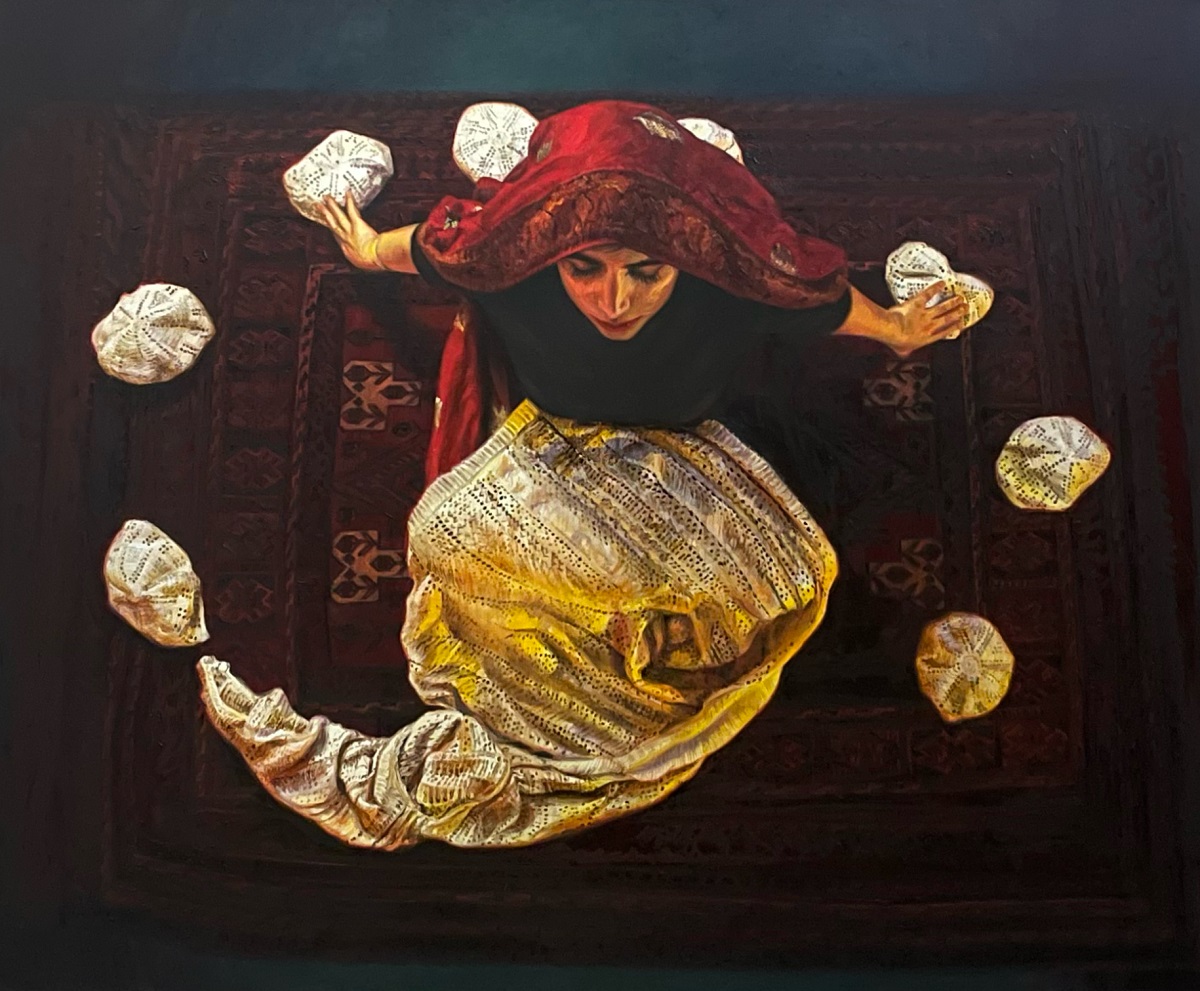
'Veil of Light.' (Supplied) 

“In the Gulf, people respond strongly to embodied memory,” she says. “They see themselves in the quiet tensions of the piece, perhaps because we share similar cultural rhythms.”  

A documentary is now in production exploring her process, offering viewers a rare look into the preparatory world that precedes each canvas.  

“People usually see the final work. But the emotional architecture built before the painting is where the story truly begins,” she explains.  

Beyond her own practice, Al-Atiyah is committed to art education through her work with Misk Art Institute. “Teaching is a dialogue,” she says. “I do not focus on technique alone. I teach students to develop intuition, to trust their senses, to translate internal experiences into honest visual language.”  

 'Jamalensan.' (Supplied) 

She believes that artists should be emotionally aware as well as technically skilled. “I want them to connect deeply with themselves so that what they create resonates beyond personal expression and becomes part of a cultural conversation,” she explains.  

In Saudi Arabia’s rapidly growing art scene, Al-Atiyah sees her role as both storyteller and facilitator.  

“Art is not decoration, it is a language,” she says. “If my work helps someone remember something they have forgotten or feel something they have buried, then I have done what I set out to do.”