



KARACHI: The next time a militant attack takes place in Pakistan’s southern Sindh province, the assailants may be in for a surprise. Rather than an armed law enforcer, the attacker may have to contend with something far more intimidating and ferocious: an attack dog.
Four law enforcers and one civilian were killed when Pakistani Taliban militants stormed a tightly guarded police compound in the country’s southern port city of Karachi in February. A gunbattle raged for several hours as security forces went floor-to-floor, chasing the militants.
The incident, unfortunate as it was, got Sindh Police thinking and helped them come up with an ingenuine way to tackle militants: using attack dogs as first responders.
“Previously, we [Sindh Police] only had sniffer dogs but after the KPO [Karachi Police Office] attack, our Inspector General of Police introduced the policy to purchase aggressive dogs and utilize them,” Irfan Mukhtar Bhutto, senior superintendent of police (SSP) of the Special Security Branch, told Arab News.
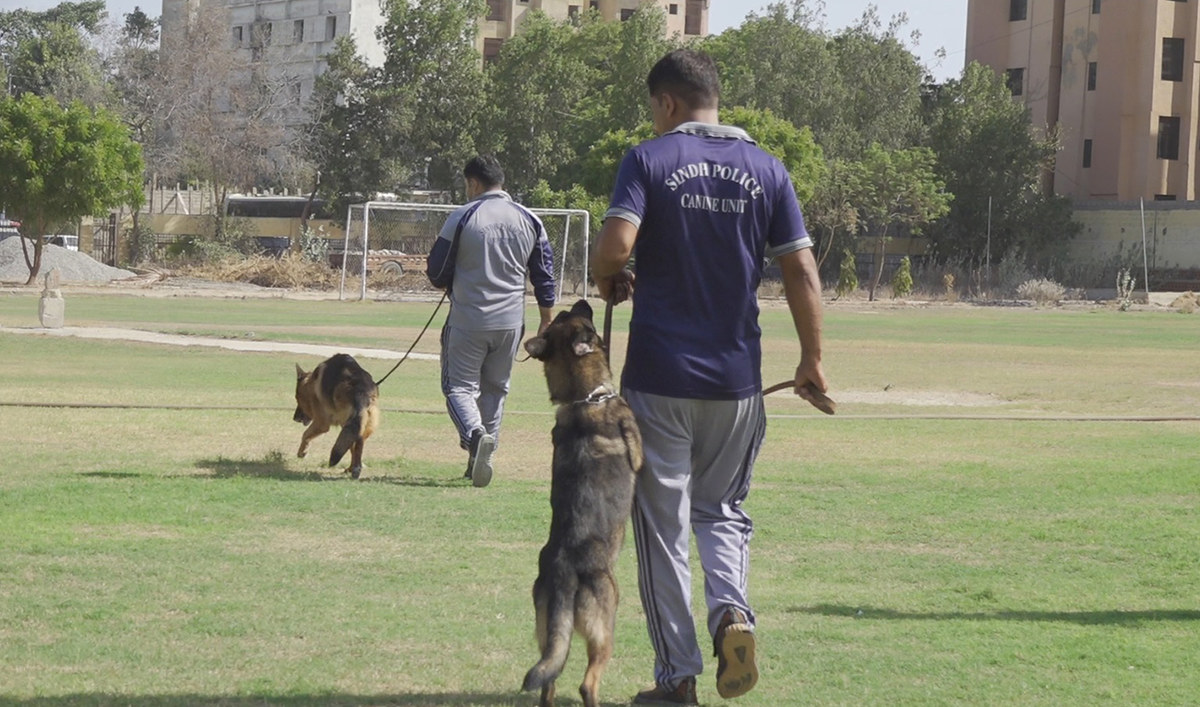
The still image taken from a video shows attack dogs during training at the Sindh police canine unit in Karachi, Pakistan on May 19, 2023. (AN Photo)
The Special Security Branch of Sindh Police handles counterterrorism and security operations.
“We have purchased Rottweiler dogs, Alsatians [German Shepherds], and Belgian Shepherds,” Bhutto said, adding that while Sindh Police’s Canine Unit currently has 37 dogs, they intend to buy an additional 150 more.
The attack dog may be the first responder to an attack but won’t certainly be the only one heading into combat.
“If a terrorist attacks, we will release our dog first [to attack him] with a sniper who will hit the terrorist,” Bhutto explained.
So how are the dogs selected?
“Just as we select soldiers, we also choose dogs based on their wisdom, capabilities, sharpness of mind, activeness, and intelligence,” Shahzeb Khan, an instructor at Sindh Police’s Canine Unit, told Arab News.
The first step involves building a relationship with the dog, Khan says, adding that once the dogs reciprocate that love, they are introduced to obedience training and later, to technical training. Each dog has a trainer, or handler, who is responsible for its food, grooming, bathing, and other activities.
The training, though, can not only be tricky but also dangerous.
“Undoubtedly, it is a challenging task to establish a framework for an animal, to make it obedient, especially when dealing with these ferocious creatures that have aggression embedded in their psychology,” Khan said.
He added that while training a “war dog,” a trainer has to act as an attacker and a target, which results in sustaining injuries often.
The dogs are trained in a way that allows them to tap into their effective sense of smell and hearing to neutralize the target, Khan said.
“Different buildings consist of various rooms, and we are unaware of the exact location or hiding spots of our enemies,” Khan said. “However, these [dogs] can detect their presence using their [sense of] hearing and smell. They will stealthily launch an attack at that precise location,” he explained.
Khan, however, admitted that a dog can’t protect itself like a human and that a canine’s life and response depend upon the handler on duty with it.
“If he [the dog] is advancing to protect us, it is our duty to ensure its protection and provide it with support at the back,” he said.
“They have one thing in mind: the owner has given an order, and we have to complete the task.”


