TUNIS: Tunisian journalists on Thursday protested against “repressive” anti-terror laws they say are being used to intimidate the media after a broadcaster was jailed for five years earlier this week.
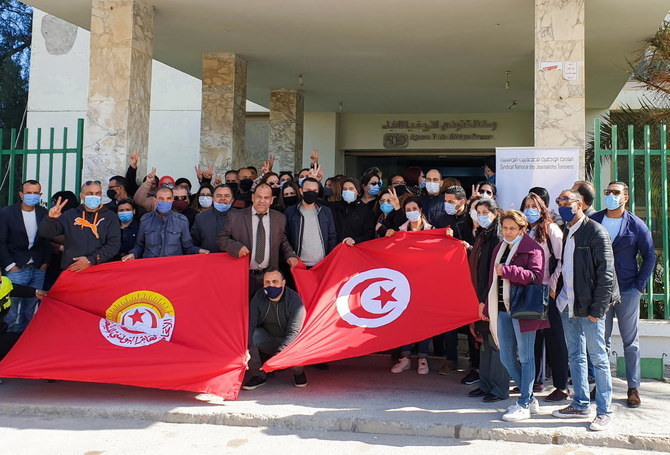
Dozens of protesters gathered in front of the national union of journalists’ headquarters in the capital Tunis, chanting: “We are journalists, not terrorists” and “Freedom for the Tunisian press.”
The rally follows a court’s use of anti-terrorism laws on Tuesday to increase to five years a jail term handed to Khalima Guesmi, a journalist Mosaique FM radio station, after he appealed a one-year sentence delivered in November.
Guesmi was found guilty of having intentionally disclosed “information relating to operations of interception, infiltration, audiovisual surveillance or data collection,” his lawyer said after the latest ruling.
“There is a frank and clear (political) orientation toward lockdown and repression, which targets disobedient media,” said Mahdi Jlassi, president of the journalists’ union.
“We are once again raising the alarm against the rollback of freedoms in this country and the legal proceedings targeting journalists, lawyers and trade unionists, and other people for comments, articles, or even a song.”
On Monday, two Tunisian students were detained after posting a satirical song on social media that criticized police and laws against drug use.
Around 20 journalists are currently being prosecuted for their work, Jlassi added.
Several local and international rights groups and trade unions on Tuesday warned “against the seriousness of the repressive direction of the current authorities” and called on activists and civil society “to mobilize to defend freedoms and human rights.”
These groups have criticized the decline in civic freedoms in Tunisia since President Kais Saied launched a sweeping power grab on July 25, 2021.

Tunisian journalists protest anti-terror laws
https://arab.news/4yved
Tunisian journalists protest anti-terror laws
- Dozens of protesters gathered in front of the national union of journalists' headquarters in the capital Tunis, chanting: "We are journalists, not terrorists"
- On Monday, two Tunisian students were detained after posting a satirical song on social media that criticised police and laws against drug use
Israeli journalists warn of media crackdown as UK billionaire prepares Channel 13 sale
- The Union of Journalists in Israel has condemned the transaction as “an unlawful deal”
LONDON: Israeli journalists and media unions have voiced serious concern over a proposed sale of a major stake in Israel’s Channel 13, warning that the move could deal a devastating blow to independent journalism in the country amid a broader campaign to reshape the media landscape ahead of elections.
According to The Guardian, British billionaire Sir Leonard Blavatnik is preparing to sell a 15 percent stake in Channel 13, one of Israel’s few mainstream channels critical of Prime Minister Benjamin Netanyahu, to telecom tycoon Patrick Drahi, a French-Israeli businessman who already owns media outlets perceived as sympathetic to the current government.
Journalists and free press advocates said the sale risked consolidating pro-government influence in a media environment already under pressure from financial sanctions, lawsuits, and regulatory threats.
The Union of Journalists in Israel has condemned the transaction as “an unlawful deal,” describing it as part of a broader “master plan to capture the media” ahead of the country’s scheduled elections.
Channel 13 has aired critical coverage of Netanyahu in recent years, including reporting on his corruption cases.
Drahi’s reported acquisition would make him a significant stakeholder at a time when Blavatnik is pulling back after years of financial losses, reported The Guardian.
Although the stake falls within the legal threshold for media ownership, critics argued that Drahi’s financial power as the only investor currently willing to inject funds would give him de facto control of editorial direction.
“While Patrick Drahi is only buying 15 percent, our fear is that by buying 15 percent, he gets 100 percent hold of the policy of the channel,” Anat Saragusti, a senior official at the Union of Journalists, told The Guardian. “It’s a lose-lose for the Israeli public, in terms of freedom of speech and diversity of opinions.”
A separate offer from a group of liberal Israeli tech entrepreneurs, reportedly valued at up to $120 million over three years, was also on the table, but ultimately rejected. A spokesperson for Blavatnik’s Access Industries insisted there was no political influence behind the deal and that Drahi’s bid was “the stronger, faster option” of the two.
“Any suggestion that the preferred offer has been selected for political reasons is entirely false,” the spokesperson said, adding that the transaction would allow Channel 13 to invest in high-quality content and digital innovation.
The Netanyahu government has come under growing scrutiny for actions seen as hostile to independent media, including imposing sanctions on the newspaper Haaretz and initiating defamation lawsuits against investigative reporters. The prime minister is also on trial for alleged efforts to trade regulatory favors for favorable press coverage, one of several corruption charges he faces.
“If Channel 13 falls, this would be the end of the free press in Israel,” Saragusti warned. “It’s the tipping point.”


