CESENA, Italy: Rescue workers searched Thursday for people still trapped by floodwaters in northeast Italy as more residents were evacuated after downpours which killed nine people and devastated homes and farms.
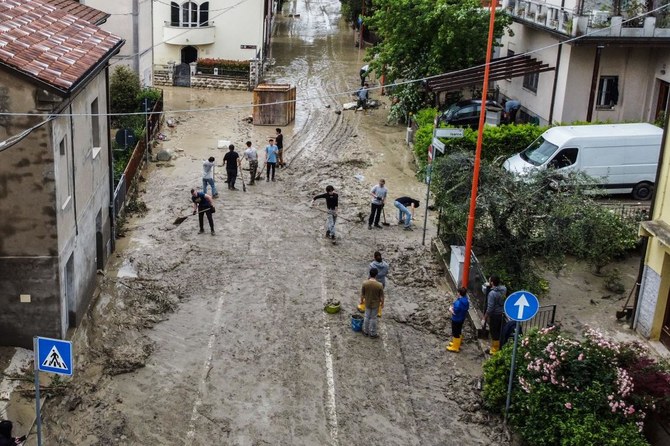
Residents waded through dirty water or reclaimed what they could from sodden houses in towns across the wealthy Emilia Romagna region, famed for its historic cities and prized gastronomy.
As mammoth clean-up efforts got underway in some areas, authorities said electricity had been partly restored, but some 27,000 people were still in the dark.
Nearly two dozen rivers and streams flooded across the southeast of the low-lying region following heavy rain earlier this week, submerging entire neighborhoods and farmland, and damaging 400 roads.
Agricultural lobby Coldiretti said Thursday that more than 5,000 farms were under water, with drowned animals and tens of thousands of hectares of vineyards, fruit trees, vegetables and grain flooded.
As the water receded, residents were left cleaning homes and streets thick with mud and filled with debris.
“I’ve lived here since 1979, I’ve seen floods go by, but I’ve never seen anything like that,” Edoardo Amadori, a resident of the city of Cesena, told AFP on Wednesday.
Some of the over 10,000 people evacuated were being allowed to return home, though authorities in Ravenna issued an immediate evacuation order early Thursday morning for three more villages threatened by floods.
The mayor of Ravenna, Michele De Pascale, announced that residents of about a half dozen towns could return, but warned them “to exercise the utmost caution.”
Cracks in river embankments still posed a risk to other areas, which were being closely monitored, he said.
The dead included a couple believed to have been hit by a wall of water as they went to check on their aromatic herb farm.
The body of the woman, in her 60s, was pulled 20 kilometers (12.5 miles) by rushing waters to the beach in Cesenatico, according to SkyTG24.
There was little significant rainfall on Thursday and only light rain expected Friday, though authorities said the high level alert for rivers remained.
Two people died in the same region earlier this month after two days of almost continuous rain.
“We had an estimated two billion (euros) of damages two weeks ago... the ground no longer absorbs anything,” Stefano Bonaccini, president of the Emilia Romagna region, told La7 television channel late Wednesday.
“When we have six months of rain in 36 hours, falling where there had already been record rain two weeks ago, there is no territory that can hold out.”
On Thursday Bonaccini compared the floods to the earthquake that hit the region on May 20, 2012, almost 11 years ago to the day.
Fixing the damage would be “a gigantic undertaking,” he said, and the region launched a fundraising effort.
Bonaccini said Ferrari, the luxury carmaker whose Maranello base is not far from the flooded areas, had pledged one million euros.
The flooding caused the cancelation of Sunday’s Formula One Emilia Romagna Grand Prix in Imola.
Italy’s armed forces and the coast guard joined the rescue effort, deploying helicopters to lift desperate residents from their homes and inflatable boats to reach houses surrounded on all sides by water.
Pope Francis offered his prayers for those affected and thanked everyone on the ground helping those hit by the “shocking disaster.”
Agriculture Minister Francesco Lollobrigida said Wednesday that the government could not yet quantify the overall damage to the region while vast areas were still flooded.


![]()

Fresh rescue efforts as Italy counts cost of deadly floods
Short Url
https://arab.news/9hv46
Fresh rescue efforts as Italy counts cost of deadly floods
- Residents waded through dirty water or reclaimed what they could from sodden houses in towns across the wealthy Emilia Romagna region
- As mammoth clean-up efforts got underway in some areas, authorities said electricity had been partly restored, but some 27,000 people were still in the dark


Latest updates




© 2026 SAUDI RESEARCH & PUBLISHING COMPANY, All Rights Reserved And subject to Terms of Use Agreement.