

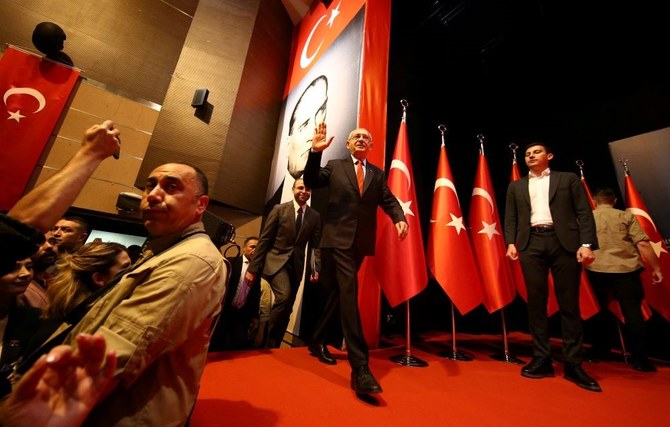
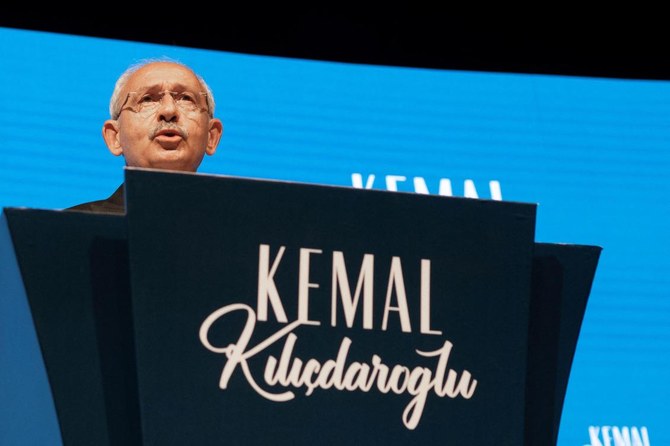

ANKARA: Turkish opposition leader Kemal Kilicdaroglu on Thursday switched his focus to the refugee issue as he delivered one of the most “nationalistic” speeches of his presidential campaign.
How this anti-refugee sentiment resonates with voters remains to be seen.
Kilicdaroglu’s speech, intending to win nationalistic voters from his rival Recep Tayyip Erdogan, is being widely seen as an attempt to scapegoat refugees for some of Turkiye’s deeply rooted problems.
“We received the message from our voters. Some did not go to vote, some voted in reaction to us, and others voted for Erdogan but were not convinced,” he said before adding that if elected, he will send refugees back to their homeland.
“Our women won’t be able to walk in the streets on their own. If Erdogan wins, he will bring another 10 million refugees,” Kilicdaroglu said.
Turkiye is home to about 4.5 million Syrian refugees, according to official figures.
Interior Minister Suleyman Soylu said in a televised interview on Wednesday that the government will not make Turkiye a refugee depot, but added that “the Syrians are our brothers and we cannot send them to death.”
The Turkish government is planning to build 240,000 houses for more than 1 million Syrians expected to move to the region.
In a video released by Kilicdaroglu on Wednesday, he said: “We will not abandon our homeland with this mentality that has brought 10 million irregular refugees to us.”
In the first round of presidential elections, Kilicdaroglu secured 44.96 percent of the votes, while the incumbent Erdogan received 49.4 percent.
The opposition, in a move to increase its vote share, is trying to court the voter base of Sinan Ogan, the third presidential campaigner whose ultranationalist and anti-refugee agenda won him 5.2 percent of the votes in the first round.
Sinem Adar, an associate at the Center for Applied Turkiye Studies in Berlin, told Arab News that the “tone and style” of Kilicdaroglu’s latest statement may be aimed at forging an alliance with Ogan ahead of the May 28 presidential runoff.
“The results of the parliamentary elections showed once again that nationalistic discourse has increased its public visibility and presence,” she said. “But one thing is mostly ignored: Both the government and the opposition think the same over the repatriation of refugees.”
Adar said the Turkish government is seeking an agreement with the Assad regime to prepare the ground for a repatriation plan.
Millions of Syrians in Turkiye have been targeted by xenophobic rhetoric across the political divide in recent years.
Some observers in Ankara claim that Ogan has been offered the post of immigration minister if Kilicdaroglu wins, but there has been no official confirmation.
Omar Kadkoy, a project manager who works on migration at the Economic Policy Research Foundation of Turkiye, told Arab News that the results of the first round have forced Kilicdaroglu to strengthen his nationalist rhetoric and appeal to Ogan and his base.
“The cheapest way is inflating the number of asylum seekers and refugees,” he said.
However, Kadkoy said that the number of Syrians under temporary protection — the largest group of forcibly displaced migrants in the country — has declined steadily from 3.7 million to 3.4 million since 2021.
Almost 60,000 Syrians left Turkiye after the devastating February earthquakes, defense chief Hulusi Akar recently announced.
Kadkoy said it is unclear if Kilicdaroglu’s promises will deliver victory in the presidential runoff.
“It will a bumpy and long ride for him. If he secures the presidency, then comes Assad whose maximalist position on Turkiye is unlikely to change,” Kadkoy said.
“Kilicdaroglu needs more than a couple of videos on Twitter to deliver on his populist promises.”
Turkiye’s government is holding high-level talks with Damascus, which wants a commitment from Ankara to withdraw its military presence in northern Syria.


