

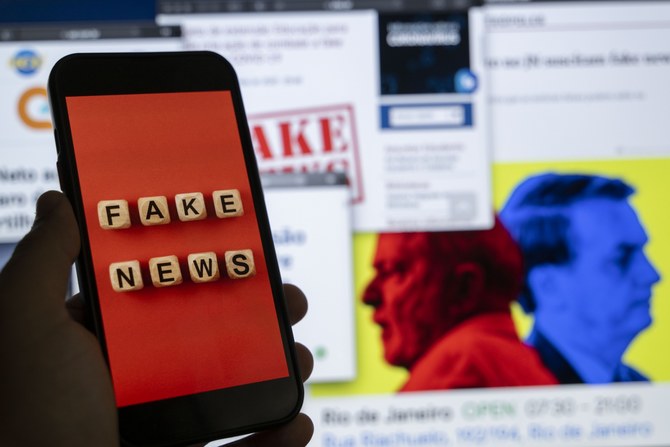
China shuts 100,000 fake news social media accounts, ramps up content cleanup

Fake news identified covered international current affairs. (AFP/File)
Short Url
Updated 18 May 2023
Follow

China shuts 100,000 fake news social media accounts, ramps up content cleanup

  • Cleanup in the last month targeted misrepresentations of news anchors and media agencies
  • The campaign by Cyberspace Administration of China focuses on social media handles sharing 'fake news'

LONDON: China has intensified efforts to clean up the internet from false news and rumors, closing more than 100,000 online accounts over the past month that misrepresented news anchors and media agencies, its cyberspace regulator said.

The Cyberspace Administration of China (CAC) launched a special campaign to clean up online information, focusing on social media accounts that disseminate "fake news" and impersonate state-controlled media.

The regulator said it had wiped 107,000 accounts of counterfeit news units and news anchors and 835,000 pieces of fake news information since April 6.

The cleanup comes as China and countries across the globe grapple with an onslaught of fake news coverage online, with many implementing laws to punish culprits.

News dissemination on Chinese social media, however, is already heavily controlled, with platforms like the Twitter-like Weibo favoring topic hashtags produced by state media, while censoring hashtags on issues or incidents considered sensitive by Beijing, even if they go viral.

The CAC said its review found accounts that had disguised themselves as authoritative news media by falsifying news studio scenes and imitating professional news presenters, using artificial intelligence (AI) to create anchors to mislead the public.

Fake news identified covered hot topics such as social incidents and international current affairs, according to a statement the CAC posted on Monday on its website.

China's government has regularly ordered sweeping measures to scrub the internet of material and language it deemed inappropriate, offensive and a threat to the public and businesses.

Recently, the CAC vowed to crack down on malicious online comments that damage the reputation of businesses and entrepreneurs.

Nascent generative AI technology like ChatGPT has introduced another layer of caution. China recently arrested a man in Gansu province for allegedly using ChatGPT to generate a fake story about a train crash.


EU warns Meta it must open up WhatsApp to rival AI chatbots

Updated 09 February 2026
Follow

EU warns Meta it must open up WhatsApp to rival AI chatbots

  • The EU executive on Monday told Meta to give rival chatbots access to WhatsApp after an antitrust probe found the US giant to be in breach of the bloc’s competition rules

BRUSSELS: The EU executive on Monday told Meta to give rival chatbots access to WhatsApp after an antitrust probe found the US giant to be in breach of the bloc’s competition rules.
The European Commission said a change in Meta’s terms had “effectively” barred third-party artificial intelligence assistants from connecting to customers via the messaging platform since January.
Competition chief Teresa Ribera said the EU was “considering quickly imposing interim measures on Meta, to preserve access for competitors to WhatsApp while the investigation is ongoing, and avoid Meta’s new policy irreparably harming competition in Europe.”
The EU executive, which is in charge of competition policy, sent Meta a warning known as a “statement of objections,” a formal step in antitrust probes.
Meta now has a chance to reply and defend itself. Monday’s step does not prejudge the outcome of the probe, the commission said.
The tech giant rejected the commission’s preliminary findings.
“The facts are that there is no reason for the EU to intervene,” a Meta spokesperson said.
“There are many AI options and people can use them from app stores, operating systems, devices, websites, and industry partnerships. The commission’s logic incorrectly assumes the WhatsApp Business API is a key distribution channel for these chatbots,” the spokesperson said.
Opened in December, the EU probe marks the latest attempt by the 27-nation bloc to rein in Big Tech, many of whom are based in the United States, in the face of strong pushback by the government of US President Donald Trump.
- Meta in the firing line -
The investigation covers the European Economic Area (EEA), made up of the bloc’s 27 states, Iceland, Liechtenstein and Norway — with the exception of Italy, which opened a separate investigation into Meta in July.
The commission said that Meta is “likely to be dominant” in the EEA for consumer messaging apps, notably through WhatsApp, and accused Meta of “abusing this dominant position by refusing access” to competitors.
“We cannot allow dominant tech companies to illegally leverage their dominance to give themselves an unfair advantage,” Ribera said in a statement.
There is no legal deadline for concluding an antitrust probe.
Meta is already under investigation under different laws in the European Union.
EU regulators are also investigating its platforms Facebook and Instagram over fears they are not doing enough to tackle the risk of social media addiction for children.
The company also appealed a 200-million-euro fine imposed last year by the commission under the online competition law, the Digital Markets Act.
That case focused on its policy asking users to choose between an ad-free subscription and a free, ad-supported service, and Brussels and Meta remain in discussions over finding an alternative that would address the EU’s concerns.