

65 US Congress members write to Secretary Blinken, raise concern over human rights in Pakistan

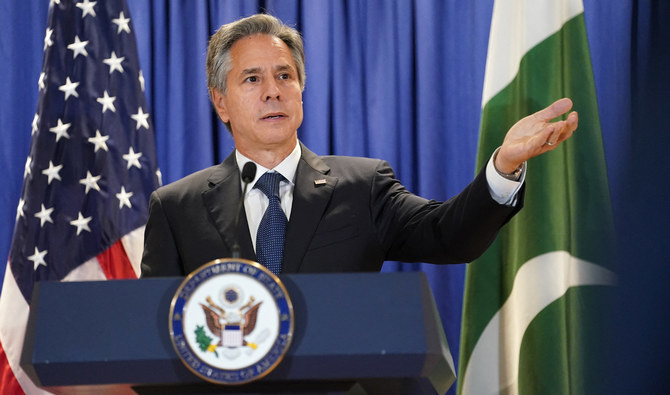
US Secretary of State Antony Blinken speaks after his meeting with Pakistan's Foreign Minister Bilawal Bhutto-Zardari at the State Department in Washington, DC, September 26, 2022. (AFP/File)
Short Url
Updated 18 May 2023
Follow

65 US Congress members write to Secretary Blinken, raise concern over human rights in Pakistan

  • In a bipartisan letter to Secretary Blinken, American politicians want their government to build diplomatic pressure on Pakistan
  • Over 65 members of Congress say protesters in Pakistan should be able to assert their rights in a peaceful and non-violent manner

ISLAMABAD: Over 65 members of US Congress have written a bipartisan letter to Secretary Antony Blinken, announced the Pakistan-American Political Action Committee (PAKPAC) on Thursday, to raise concern over the state of democracy and human rights in Pakistan over the past few months.

While the text of the letter does not explicitly mention the government crackdown on former prime minister Imran Khan’s Pakistan Tehreek-e-Insaf (PTI) party, it asks the administration in Washington to use “diplomatic tools” to push the Pakistani authorities to uphold democratic values, human rights and rule of law.

Pakistan’s coalition administration has periodically arrested PTI leaders since the downfall of Khan’s administration in a parliamentary vote of no-confidence last year in April. The ex-premier attributed his ouster from power to an international conspiracy hatched against him by officials of the Biden administration in Washington, though the US has frequently denied the allegation.

“Over the past several months, we have become increasingly concerned by the blanket bans on demonstrations and deaths of several prominent critics of the government,” said the letter. “We ask for your help pressuring the Government of Pakistan to ensure protesters can assert their demands in a peaceful and non-violent way, free from harassment, intimidation, and arbitrary detention.”

“As both Democrats and Republicans who care about the bilateral relationship [with Pakistan], we are concerned that violence and increased political tension could spiral into a deteriorating security situation in Pakistan,” it added.


The members of Congress urged Secretary Blinken to use all diplomatic tools, “including calls, visits, and public statements,” to address the ongoing situation in Pakistan.

“Supporting democracy in Pakistan is in the national interest of the United States,” they maintained.

The PAKPAC commended the Congress members who signed the letters and said Khan’s arrest on corruption charges last week had thrown “the nation into chaos” and brought out “millions to the streets in protests.

“The alarming turn of events has sparked immense concern among the Pakistani-American community,” it said in a statement, “and amplified the urgency for immediate action to protect democratic institutions, independent judiciary, freedom of press and human rights in Pakistan.”

It added the letter to Secretary Blinken highlighted the need for the US “to push Pakistan to curb democratic backsliding while also advocating for robust measures to protect human rights, freedom of speech, press freedom, and the rule of law.”


Pakistan rice exports slump 40% as India’s return hits pricing power

Updated 24 February 2026
Follow

Pakistan rice exports slump 40% as India’s return hits pricing power

  • Statistics show non-Basmati shipments have fallen over 50 percent in July-January period
  • Government offers 9 percent tax drawback on premium Basmati exports to support sector

ISLAMABAD: Pakistan’s rice exports fell 40.5 percent to $1.31 billion in the first seven months of the fiscal year, official data showed on Tuesday, as India’s return to the global market squeezed Islamabad’s market share and pricing power.

According to the Pakistan Bureau of Statistics (PBS), non-Basmati exports dropped 50.8 percent to $827.8 million, with volumes falling to 2.0 million tons from 3.15 million tons a year ago. Basmati exports declined 6.62 percent to $477.7 million, with volumes easing to 436,484 tons from 487,278 tons.

The Ministry of National Food Security told a parliamentary committee in two separate meetings in December and January that India’s re-entry into the global rice market was a key factor behind the decline, saying increased Indian supplies had made Pakistani rice less competitive.

Officials told lawmakers that India benefits from free trade agreements and provides substantial support to its rice sector, putting additional pressure on Pakistani exporters.

In response, the Ministry of Commerce last month issued a notification under the “Drawback of Local Taxes and Levies for Rice Order, 2026,” allowing a rebate of 9 percent of the free-on-board (FOB) value for Basmati exports priced above $750 per metric ton.

The government said the measure, announced on January 23, aims to ease liquidity pressures on exporters and improve competitiveness.

While PBS data for July-January shows a 40.5 percent decline, figures from the Federal Board of Revenue (FBR) for July-December show an even steeper 47 percent drop to $973 million from $1.82 billion in the same period last year, reflecting a deficit of over $800 million.

Industry representatives say they are now focusing on market diversification to counter the slowdown.

“Currently Basmati is mainly exported to Middle East and EU. Non-Basmati is exported to Philippines, Indonesia, Malaysia and African countries,” Malik Faisal Jahangir, chairman of the Pakistan Rice Exporters Association, told Arab News last week.

“For the new markets for our non-basmati rice exports, we are looking to increase our volumes to China, Philippines, Indonesia and Bangladesh,” he added.