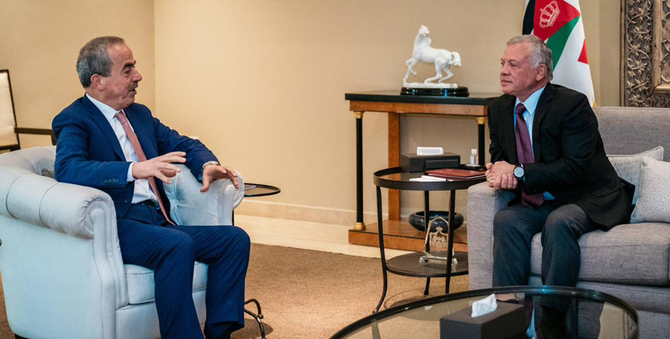
Jordan’s King Abdullah II urges ‘close cooperation’ to address challenges facing Arab countries

King Abdullah II of Jordan is interviewed by Ghassan Charbel, editor-in-chief of Asharq Al-Awsat newspaper. (Supplied)
Short Url
Updated 21 May 2023
Follow

Jordan’s King Abdullah II urges ‘close cooperation’ to address challenges facing Arab countries

  • Tells Asharq Al-Awsat deepening economic cooperation could open avenues of hope for region’s youth
  • Expresses pride in witnessing the “inspiring example” of reforms and developments in Saudi Arabia

RIYADH: King Abdullah II of Jordan has expressed confidence in the success of the upcoming Arab League summit in Jeddah, anticipating the start of a new phase of Arab action based on a solid foundation of economic cooperation that benefits all parties.

During an interview with Ghassan Charbel, editor-in-chief of the Asharq Al-Awsat newspaper, King Abdullah emphasized the need to address political challenges facing Arab nations, the foremost of which being the Palestinian cause.

He stressed the importance of establishing an independent Palestinian state, with East Jerusalem as its capital, based on the 1967 borders.

“I am confident that the efforts of Crown Prince Mohammed bin Salman have laid the groundwork for a successful summit, as everyone is committed to its success,” said King Abdullah.

“What further strengthens my belief in its success is the conviction we have witnessed in recent months regarding the need to establish pan-Arab relations based on solid economic cooperation, ensuring tangible benefits for our people.

“This would fortify our cooperation against occasional political divergences.”

The Arab world faces a breadth of shared challenges regarding the environment, governance and development, which King Abdullah says will require greater regional collaboration to address.

“Our countries face a range of challenges that necessitate close and profound cooperation, driven by mutual benefit,” he said.

“These challenges include stimulating and developing the economy to create employment opportunities for future generations, advancing governance and reforms, combating corruption, addressing refugee and water issues, as well as illicit drugs, enhancing education and healthcare services, and tackling environmental concerns.”
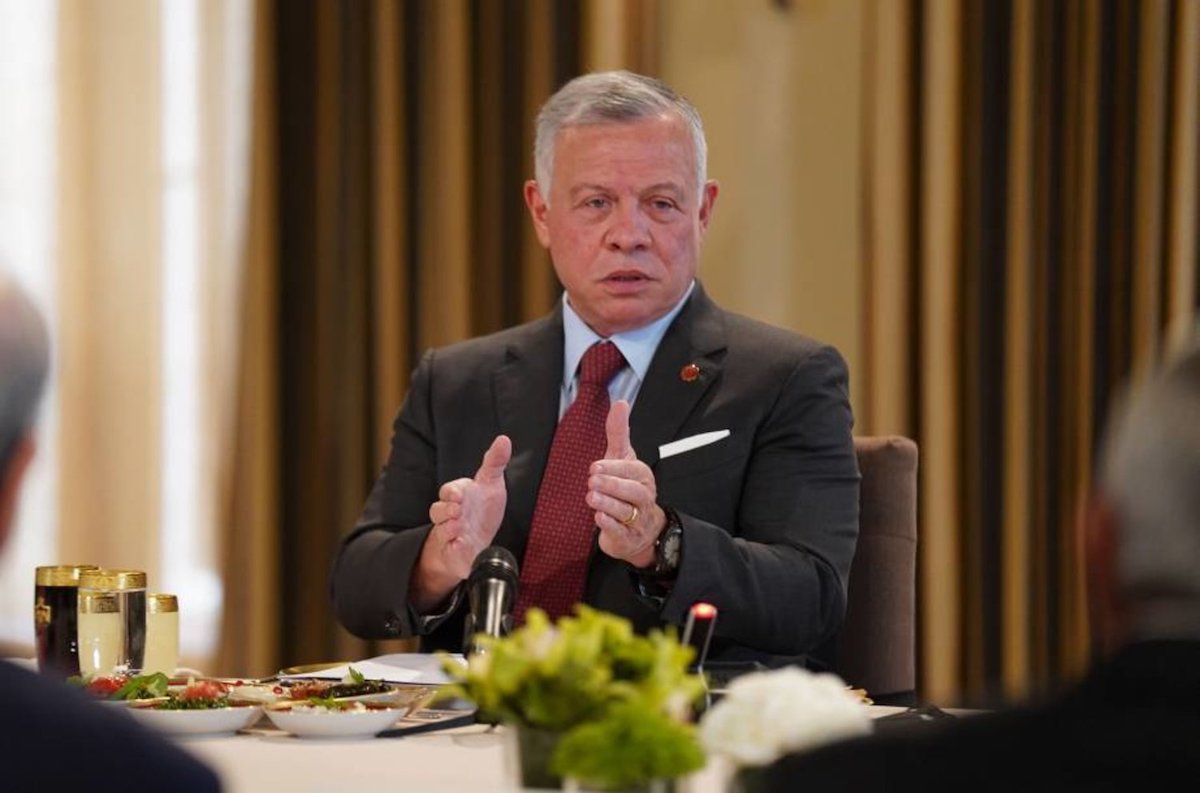


Jordan’s King Abdullah II. (The Royal Hashemite Court)

In particular, King Abdullah emphasized how deepening economic cooperation could open avenues of hope for the region’s youth and provide a solid foundation for stability and prosperity.

With collaborative effort and effective planning, he said it is possible to improve regional standards of living, which have suffered as a result of conflicts and tensions.

King Abdullah affirmed the strategic and historical nature of mutual ties between Jordan and Saudi Arabia, built on the principles of cooperation, consultation and pursuing stability through responsible policies.

He also highlighted his excellent relations with King Salman and Crown Prince Mohammed bin Salman and expressed pride in witnessing the reforms and developments underway in Saudi Arabia, viewing the Kingdom’s endeavors as an inspiring example for other nations to follow.
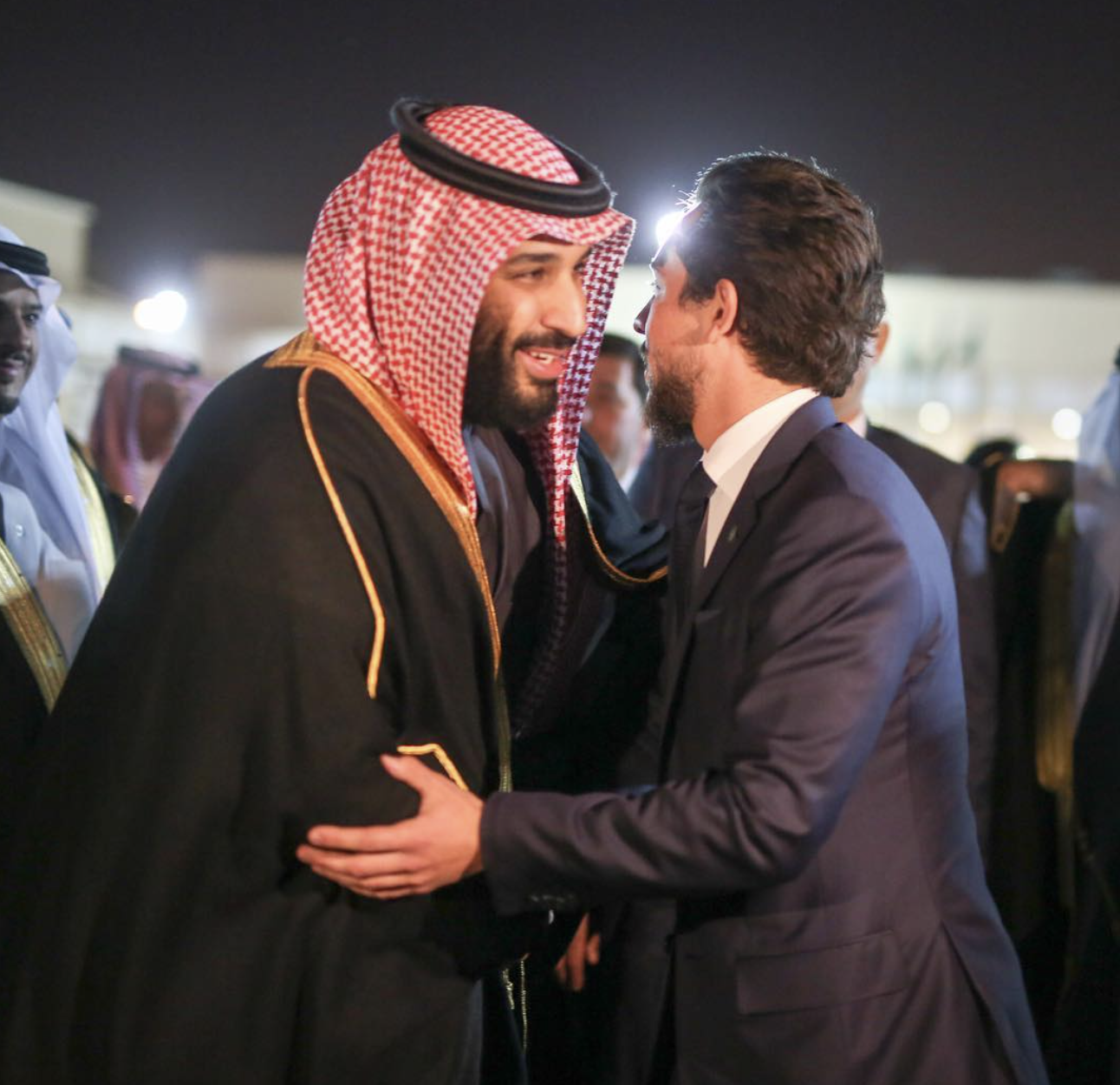


Saudi Arabia’s Crown Prince Mohammed bin Salman embraces Jordan’s Crown Prince Hussein. (Crown Prince Hussein)

Embracing economic modernization, leveraging technology and engaging youth in the process, together with promoting culture, tourism and the arts, has positive impacts not only for the respective nation, but also for the surrounding region, he said.

Highlighting the friendship and cooperation between the Saudi crown prince and Crown Prince Hussein of Jordan, King Abdullah said: “The aspirations, capabilities and hopes of this generation of Arab youth promise a brighter future for our countries.”

In his concluding remarks, King Abdullah said he hopes the region will enjoy further opportunities to realize its collective potential, serve the development project and open avenues for prosperity and stability that serve the public interest.


Spain highlights importance of Gaza reconstruction

Palestinian prime minister, Mohammed Mustafa, and the Spanish foreign minister, Jose Manuel Albares. (AP)
Updated 02 January 2026
Follow

Spain highlights importance of Gaza reconstruction

  • Spain officially recognized Palestine as a state in May 2024, in a coordinated move alongside Ireland and Norway

RAMALLAH: The Palestinian prime minister, Mohammed Mustafa, and the Spanish foreign minister, Jose Manuel Albares, on Friday discussed the latest developments in the West Bank and Gaza Strip.
During their telephone conversation they emphasized the need to intensify international efforts to end the Israeli occupation and halt attacks and settler violence, and to secure the release of Palestinian funds held by Israeli authorities.
They affirmed the importance of ongoing efforts relating to plans for the reconstruction of Gaza, and Europe’s significant role in this process. Mustafa and Albares highlighted the need to unify Palestinian institutions in Gaza with those in the West Bank, with the aim of establishing a Palestinian state in line with international resolutions, including last year’s New York Declaration.
They also discussed coordination between their countries, and the strengthening of Spain’s political, diplomatic and financial support for Palestine, and Mustafa thanked Spain for its ongoing support.
Spain officially recognized Palestine as a state in May 2024, in a coordinated move alongside Ireland and Norway. Estephan Salameh, the Palestinian finance and planning minister, is set to visit Spain this month to discuss enhanced cooperation, particularly in the areas of development and reconstruction. Meanwhile, Israel continues operating in the occupied West Bank.
The Palestinian Prisoners media office said on Friday that Israel carried out numerous raids across the territory, including the major cities of Ramallah and Hebron, according to The Associated Press.
Nearly 50 people were detained, following the arrest of at least 50 other Palestinians on Thursday, most of those in the Ramallah area.
As 2026 begins, the shaky 12-week-old ceasefire between Israel and Hamas has largely ended large-scale Israeli bombardment of Gaza. 
But Palestinians are still being killed by Israeli fire, especially along the so-called Yellow Line that delineates areas under Israeli control, and the humanitarian crisis is compounded by frequent winter rains and colder temperatures.
On Friday, American actor and film producer Angelina Jolie visited the Rafah border crossing between Egypt and the Gaza Strip. 
The only crossing between the territory and a country other than Israel, it remains closed despite Palestinian requests to reopen it to people and aid.
Jolie met with members of the Red Crescent on the Egyptian side of the Rafah border crossing and then visited a hospital in the nearby city of Arish to speak with Palestinian patients on Friday, according to Egyptian officials.
Aid groups say not enough shelter materials are getting into Gaza during the truce.