

Gazans amid the rubble of homes flattened by fighting

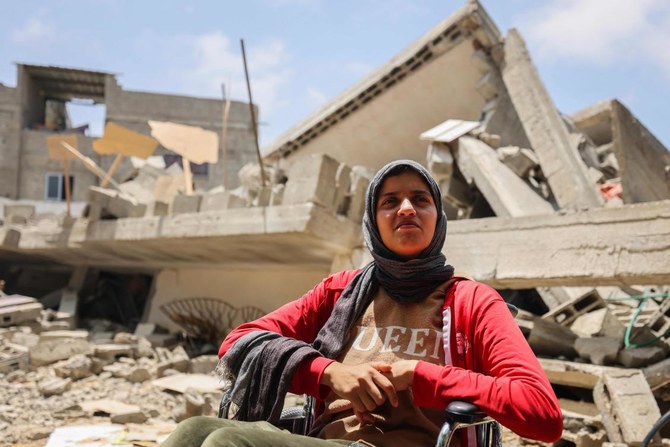
A picture taken on May 15, 2023, shows a member of the Palestinian Nabhan family sitting in a wheelchair atop the rubble of their house, in Beit Lahya in the northern Gaza Strip. (AFP)
Short Url
Updated 16 May 2023
Follow

Gazans amid the rubble of homes flattened by fighting

  • Dozens of homes were destroyed during five days of fighting, which erupted when the Israeli military launched deadly strikes on top militants

GAZA: After her house was levelled by an Israeli strike, Najah Nabhan wonders what will become of her and dozens of relatives left homeless by the latest fighting to hit Gaza.
“I’d barely reached the street, then the house was bombed,” said Nabhan, standing next to a mangled heap of concrete slabs and breeze blocks that had been the family home.
Dozens of homes were destroyed during five days of fighting, which erupted when the Israeli military launched deadly strikes on top militants from the Islamic Jihad militant group.
Nabhan, 56, has been trying to care for her children and grandchildren, many of whom have disabilities, since they were left homeless on Saturday.
“I borrow clothes from the neighbors for them. I didn’t take anything with me,” she said, in the Bir Al-Najeh neighborhood of northern Gaza.
The family said they were warned in a phone call from the Israeli military that a strike was imminent, but the army did not detail why it targeted the house when asked by AFP.
In total, 103 homes were completely destroyed and 140 severely damaged in the fighting, the United Nations said Tuesday, citing officials in Gaza.
Belal Nabhan, 35, earns just 10 shekels ($2.70) a day selling parsley in the market, and said he remains in a state of shock.
“People were screaming and we ran away... now 45 people are staying here, where will they go? They need shelter,” he said, indicating relatives resting beside the rubble.
Israel and Palestinian militants in Gaza, which is ruled by Islamist group Hamas, have fought multiple wars in recent years.
The ruins of past conflicts — such as a three-day escalation in August which killed 49 Gazans — are dotted across the densely populated Palestinian territory.
With Gaza’s poverty rate at 53 percent, according to the Palestinian Central Bureau of Statistics, few people can afford to rebuild their homes.

In Deir Al-Balah in central Gaza, children clambered atop a huge mound of concrete and rebar flattened by Israeli bombardment.
In the tightly-packed neighborhood, Mohammed Zidan’s home escaped a direct hit but the blast was so powerful it blew out the walls.
“Because you want to strike one person, you don’t need to destroy a whole apartment complex,” said the 29-year-old.
“I’m a young man, living in my house, with my children in my home. I’m focusing on my work. What’s my fault, that you make me pay the price?“
As Zidan stepped over the remains of his bedroom on Monday, Palestinians elsewhere were commemorating the Nakba, or catastrophe.
It marks the expulsion of hundreds of thousands of Palestinians from their homes, in the war which erupted when Israel was created in 1948.
“We will stay living the life of the Nakba, continuously,” said Zidan, who has taken to sleeping on the street behind his home.
The Israeli military did not immediately respond to an enquiry from AFP on why it targeted the neighborhood.
A fragile cease-fire has largely held since late Saturday, ending the repeated rounds of Israeli strikes and volleys of rocket fire launched by Palestinian militants.
The fighting killed 33 people in Gaza, including children as well as militants, and two civilians in Israel.
Sitting in a donated wheelchair in Bir Al-Najeh, Haneen Nabhan said she fainted when she heard her home was destroyed.
“I used to take medicine, but the medicine’s in the rubble,” she said.
“All my dreams were in the house, and my dreams are gone.”


First responders enter devastated Aleppo neighborhood after days of deadly fighting

Updated 12 January 2026
Follow

First responders enter devastated Aleppo neighborhood after days of deadly fighting

  • The US-backed SDF, which have played a key role in combating the Daesh group in large swaths of eastern Syria, are the largest force yet to be absorbed into Syria’s national army

ALEPPO, Syria: First responders on Sunday entered a contested neighborhood in Syria’ s northern city of Aleppo after days of deadly clashes between government forces and Kurdish-led forces. Syrian state media said the military was deployed in large numbers.
The clashes broke out Tuesday in the predominantly Kurdish neighborhoods of Sheikh Maqsoud, Achrafieh and Bani Zaid after the government and the Syrian Democratic Forces, the main Kurdish-led force in the country, failed to make progress on how to merge the SDF into the national army. Security forces captured Achrafieh and Bani Zaid.
The fighting between the two sides was the most intense since the fall of then-President Bashar Assad to insurgents in December 2024. At least 23 people were killed in five days of clashes and more than 140,000 were displaced amid shelling and drone strikes.
The US-backed SDF, which have played a key role in combating the Daesh group in large swaths of eastern Syria, are the largest force yet to be absorbed into Syria’s national army. Some of the factions that make up the army, however, were previously Turkish-backed insurgent groups that have a long history of clashing with Kurdish forces.
The Kurdish fighters have now evacuated from the Sheikh Maqsoud neighborhood to northeastern Syria, which is under the control of the SDF. However, they said in a statement they will continue to fight now that the wounded and civilians have been evacuated, in what they called a “partial ceasefire.”
The neighborhood appeared calm Sunday. The United Nations said it was trying to dispatch more convoys to the neighborhoods with food, fuel, blankets and other urgent supplies.
Government security forces brought journalists to tour the devastated area, showing them the damaged Khalid Al-Fajer Hospital and a military position belonging to the SDF’s security forces that government forces had targeted.
The SDF statement accused the government of targeting the hospital “dozens of times” before patients were evacuated. Damascus accused the Kurdish-led group of using the hospital and other civilian facilities as military positions.
On one street, Syrian Red Crescent first responders spoke to a resident surrounded by charred cars and badly damaged residential buildings.
Some residents told The Associated Press that SDF forces did not allow their cars through checkpoints to leave.
“We lived a night of horror. I still cannot believe that I am right here standing on my own two feet,” said Ahmad Shaikho. “So far the situation has been calm. There hasn’t been any gunfire.”
Syrian Civil Defense first responders have been disarming improvised mines that they say were left by the Kurdish forces as booby traps.
Residents who fled are not being allowed back into the neighborhood until all the mines are cleared. Some were reminded of the displacement during Syria’s long civil war.
“I want to go back to my home, I beg you,” said Hoda Alnasiri.