

Pakistan slashes price of petrol by Rs12 per liter to provide ‘maximum relief’ to masses

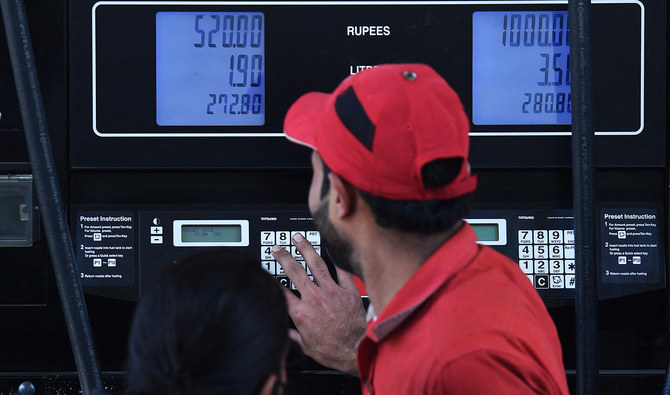
An employee of a petrol station fills the tank of a customer in Karachi on February 16, 2023. (Photo courtesy: AFP/File)
Short Url
Updated 16 May 2023
Follow

Pakistan slashes price of petrol by Rs12 per liter to provide ‘maximum relief’ to masses

  • After latest price cut, petrol is now being sold for Rs270 per liter, High Speed Diesel for Rs258 per liter
  • Finance Minister Ishaq Dar urges transporters to pass on impact of price cut to customers by reducing fares

KARACHI: Pakistan's Finance Minister Ishaq Dar announced the government's decision to slash the price of petrol by Rs12 per liter and High Speed Diesel (HSD) by Rs30 per liter on Monday, saying that the measure was taken to provide "maximum relief" to the masses amid declining prices of petroleum products in the international market.

Fuel and energy prices in Pakistan soared over the past one year as the South Asian country took tough fiscal measures in hopes of reviving a stalled $6.5 billion loan program of the International Monetary Fund (IMF). For a staff-level agreement to take place between the two sides which would unlock $1.1 billion in funds for Pakistan, the IMF asked Islamabad to scrap subsidies worth billions of rupees on fuel and energy, and raise taxes.

Subsequently, inflation increased to a historic high of 36.4 percent in Pakistan in April 2023, the highest since 1964. Weekly inflation reported an increase of 48.2 percent during the week ended on May 11, 2023 on an annual basis, according to the Pakistan Bureau of Statistics.

In a brief televised address, Dar said after the latest price reduction, petrol would cost Rs270 per liter, while HSD, kerosene and Light Diesel Oil would cost Rs258, Rs164.07, and Rs152.68 per liter respectively.    

“Prime Minister Shehbaz Sharif and his government tried to provide maximum relief to the public on the basis of price changes [of petroleum products] in the international market," the finance minister said.

Dar requested transporters and departments utilizing diesel to pass on the impact of the price cut to the public by lowering their fares so that all income segments of the society could benefit from the price reduction. 

The government's move to slash prices of petroleum products also comes at a time when Pakistan's import of petroleum products has decreased by 48% on an annual basis and 22% on a month-on-month basis during April 2023. 

Oil imports declined by 48% to 1.07 million tons during April 2023 as compared to 2.05 million tons during April 2022, according to a research report released by Pakistan's largest securities brokerage company, Arif Habib Limited, on Monday. 

Imports of Mogas, HSD, and crude oil decreased by 24%, 57%, and 43% respectively on an annual basis while RLNG imports also declined by 33% and 11% on an annual and monthly basis to 1.8 million tons during April 2023.


ADB, Pakistan sign over $300 million agreements to undertake climate resilience initiatives

Updated 30 December 2025
Follow

ADB, Pakistan sign over $300 million agreements to undertake climate resilience initiatives

  • Pakistan ranks among nations most vulnerable to climate change and has seen erratic changes in weather patterns
  • The projects in Sindh and Punjab will restore nature-based coastal defenses and enhance agricultural productivity

ISLAMABAD: The Pakistani government and the Asian Development Bank (ADB) have signed more than $300 million agreements to undertake two major climate resilience initiatives, Pakistan’s Press Information Department (PID) said on Tuesday.

The projects include the Sindh Coastal Resilience Sector Project (SCRP), valued at Rs50.5 billion ($180.5 million), and the Punjab Climate-Resilient and Low-Carbon Agriculture Mechanization Project (PCRLCAMP), totaling Rs34.7 billion ($124 million).

Pakistan ranks among nations most vulnerable to climate change and has seen erratic changes in its weather patterns. In 2022, monsoon floods killed over 1,700 people, displaced another 33 million and caused over $30 billion losses, while another 1,037 people were killed in floods this year.

The South Asian country is ramping up climate resilience efforts, with support from the ADB and World Bank, and investing in climate-resilient infrastructure, particularly in vulnerable areas.

“Both sides expressed their commitment to effectively utilize the financing for successful and timely completion of the two initiatives,” the PID said in a statement.

The Sindh Coastal Resilience Project (SCRP) will promote integrated water resources and flood risk management, restore nature-based coastal defenses, and strengthen institutional and community capacity for strategic action planning, directly benefiting over 3.8 million people in Thatta, Sujawal, and Badin districts, according to ADB.

The Punjab project will enhance agricultural productivity and climate resilience across 30 districts, improving small farmers’ access to climate-smart machinery, introducing circular agriculture practices to reduce residue burning, establishing testing and training facilities, and empowering 15,000 women through skills development and livelihood diversification.

Earlier this month, the ADB also approved $381 million in financing for Pakistan’s Punjab province to modernize agriculture and strengthen education and health services, including concessional loans and grants for farm mechanization, Science, Technology, Engineering and Mathematics (STEM) education, and nursing sector reforms.