

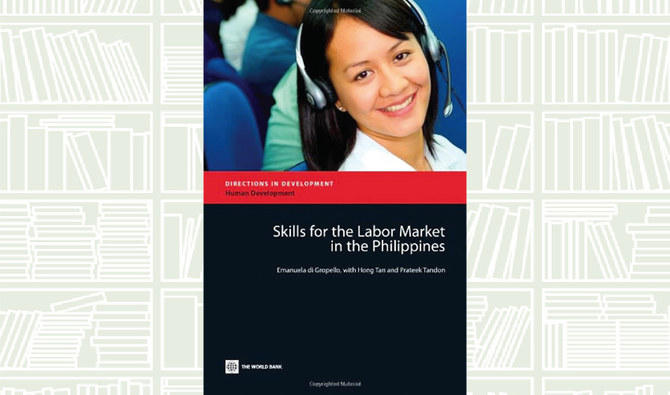
What We Are Reading Today: Skills for the Labor Market in the Philippines

Short Url
Updated 15 May 2023
Follow

What We Are Reading Today: Skills for the Labor Market in the Philippines

Authors: Emanuela Di Gropello, Hong Tan & Prateek Tandon 

The Philippine economy has experienced overall growth over the last 20 years, but the growth of the manufacturing sector has been sluggish, and the country has lost innovation capacity.

Regaining momentum will depend on many factors, but skills have a key role to play in supporting the growing service sector, improving the competitiveness of the manufacturing sector, and enhancing the long-term ability of the country to innovate and adapt and assimilate new technologies.

“Skills for the Labor Market in the Philippines” analyzes the functional skills with which workers need to be equipped to be employable and support firms’ competitiveness and productivity, and evaluates the role of the education and training system in providing these skills.


What We Are Reading Today: Shame: The Politics and Power of an Emotion

Updated 23 December 2025
Follow

What We Are Reading Today: Shame: The Politics and Power of an Emotion

Author: David Keen

Today, we are caught in a shame spiral—a vortex of mutual shaming that pervades everything from politics to social media. We are shamed for our looks, our culture, our ethnicity, our sexuality, our poverty, our wrongdoings, our politics. But what is the point of all this shaming and countershaming? Does it work? And if so, for whom?

In Shame, David Keen explores the function of modern shaming, paying particular attention to how shame is instrumentalized and weaponized. Keen points out that there is usually someone who offers an escape from shame—and that many of those who make this offer have been piling on shame in the first place. Self-interested manipulations of shame, Keen argues, are central to understanding phenomena as wide-ranging as consumerism, violent crime, populist politics, and even war and genocide. Shame is political as well as personal. To break out of our current cycle of shame and shaming, and to understand the harm that shame can do, we must recognize the ways that shame is being made to serve political and economic purposes.

Keen also traces the rise of leaders on both sides of the Atlantic who possess a dangerous shamelessness, and he asks how shame and shamelessness can both be damaging.