

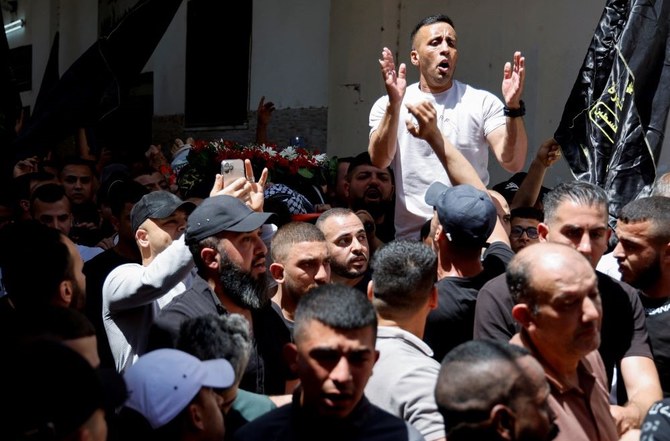

RAMALLAH: Israeli forces shot and killed a 22-year-old Palestinian man during a raid in the city of Nablus on Monday as people prepared to mark the 75th anniversary of the Nakba.
The Palestinians said the Israel Defense Forces killed Saleh Sabra in the Askar camp, east of Nablus.
Palestinian President Mahmoud Abbas, meanwhile, led Monday’s UN commemoration of the Nakba.
The anniversary is particularly bitter after five days of Israeli airstrikes in the Gaza Strip wrecked dozens of houses and left hundreds homeless.
The Nakba commemorations recall the estimated 700,000 Palestinians who fled or were forced from their homes in 1948.
Palestinian Prime Minister Mohammed Shtayyeh said Abbas would present the story of the victims of the Nakba on behalf of 14 million Palestinians in the West Bank, Israel, the Gaza Strip, diaspora camps, the US, Europe and beyond.
In Ramallah, a march was organized from the mausoleum of late President Yasser Arafat toward the city center. Officials and representatives of popular institutions, civil society organizations and national factions took part.
The flag of Palestine, black flags and the keys to return were raised.
Elsewhere across other Palestinian towns and cities on Monday, warning sirens were sounded, and people stopped what they were doing for 75 seconds at 1 p.m. to mark the start of the commemorations.
Palestinian school pupils raised the flag of Palestine, banners, and the keys to their ancestors’ homes amid the chanting of national anthems, highlighing the painful memory and its grave effects.
Students at the Israeli Tel Aviv University in Israel marked the anniversary with the participation of Arab students and political leaders.
The Palestinian Post announced the issuance of a postage stamp, documenting the anniversary and the great price incurred by the Palestinian people.
Shtayyeh pointed out that the Nakba is a crime extending over 75 years, and the Palestinian people still pay the bill for Israeli aggression.
He called on states, governments, international bodies and courts to stop excluding Israel from enforcing international and humanitarian law.
He demanded that Israel be held accountable for war crimes and crimes against humanity that it continues to commit against the Palestinian people.
He pointed out that the Palestinian people were alone in their suffering, as the world not only marginalized their tragedy but also provided support for establishing the state of Israel.
“Every dunam of land that Israel confiscates is a dunam of land that Palestine loses, and every liter of water that Israel steals is a liter of water that we lose … Israel was built on our land, we are the owners of the land, the indigenous people, and (it was) we who gave this land its name,” he said.
The deputy head of Fatah, Mahmoud Al-Aloul, said the struggle would continue, and the Palestinian people are ready to pay a heavy price and would not accept anything less than their freedom, independence, and absolute and undiminished rights.
“We have been living for 75 years in pain and grief from the suffering of displacement in all parts of the Earth, and after all these years, the UN comes to recognize the Nakba.
“The massacres are not limited to 1948. They continue and do not stop,” he added.
Mohammed Baraka, head of the Higher Follow-up Committee for Arabs in Israel, said: “We are not just numbers but rather witnesses to the identity of the homeland that Israel tried to assassinate, and witnesses to the attempts to capture the place — and we will return, as we are the owners of the country.”
For the first time since 1948, the UN was commemorating the Nakba with an official event at the international body’s headquarters in New York, where a special high-level meeting was organized.
Records of the UN Relief and Works Agency for Palestine Refugees indicate that the number of refugees registered with it in December 2020 amounted to about 6.4 million Palestinians, of whom about 2 million are in the West Bank and Gaza Strip.
According to the Palestinian Central Bureau of Statistics, about 28.4 percent of the refugees registered with UNRWA live in 58 official camps affiliated with it.
They are distributed among 10 camps in Jordan, nine in Syria, 12 in Lebanon, 19 in the West Bank, and eight in the Gaza Strip.
Sireen Jabarin, a Palestinian political activist from Umm Al-Fahem city in Israel, took part in a photo exhibition in Haifa on Monday on the Nakba.
“We are fighting for the right of return for Palestinians from the diaspora,” Jabarin told Arab News, adding that Palestinians living in Israel are interested in explaining their narrative about the tragedy 75 years ago to their children and grandchildren, so that the Palestinian struggle will be remembered for generations.


