Thailand’s opposition wins big election victory, challenging army-backed conservative establishment

1 / 2
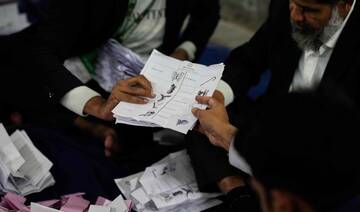
Pheu Thai's prime ministerial candidate, Paetongtarn Shinawatra, daughter of former Prime Minister Thaksin Shinawatra, speaks to the media, after the polling stations closed, on the day of the general elections in Bangkok, Thailand, May 14, 2023. (REUTERS)
2 / 2
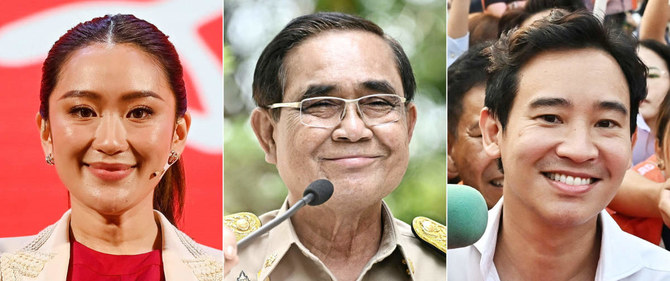
12This combination of file pictures created on May 12, 2023 shows (L) Paetongtarn Shinawatra attending the Pheu Thai party's annual meeting in Bangkok on April 24, 2022, (C) Thailand's Prime Minister Prayut Chan-O-Cha after chairing the National Rice Policy and Administration Committee at Government House in Bangkok on March 20, 2023, and (R) Move Forward Party leader Pita Limjaroenrat arriving for the first day of the constituencies candidates registration for the general election in Bangkok on April 3, 2023. (AFP)
Short Url
Updated 15 May 2023
Follow

Thailand’s opposition wins big election victory, challenging army-backed conservative establishment

  • Move Forward leader Pita Limjaroenrat, a 42-year-old former executive of a ride-hailing app, described the outcome as “sensational” and vowed to stay true to his party’s values when forming a government

BANGKOK: Thailand’s main opposition parties easily bested other contenders with virtually all the votes counted from Sunday’s general election, fulfilling many voters’ hopes that the balloting would serve as a pivotal chance for change nine years after incumbent Prime Minister Prayuth Chan-ocha first came to power in a 2014 coup.
With 99 percent of the votes counted by early Monday morning, the junior opposition Move Forward Party had eked out a small edge over the favored Pheu Thai Party, whose leaders earlier in the night conceded they might not finish on top.
The winner of Sunday’s vote is not assured the right to form the new government. A joint session of the 500-seat House of Representatives will be held with the 250-member Senate in July to select the new prime minister, a process widely seen as undemocratic because the Senators were appointed by the military rather than elected but vote along with Sunday’s winning lawmakers.
Sunday’s voter turnout was about 39.5 million, or 75 percent of registered voters.
The maverick Move Forward Party captured just over 24 percent of the popular vote for the House of Representatives’ 400 constituency seats and an almost 36 percent share of the vote for seats allocated in a separate nationwide ballot for the 100 members elected by proportional representation.
Pheu Thai Party lagged slightly behind with just over 23 percent for the constituency seats and about a 27 percent share for the party list.
The tally of constituency votes gave Move Forward 113 House seats and Pheu Thai 112, according to the Election Commission, which did not give a projection for party list seats.
Prayuth’s United Thai Nation Party held the fifth spot in the constituency vote with almost 9 percent of the total, but it placed third in the party-preference tally with close to 12 percent. Its constituency vote gave it 23 House seats.
The three parties were considered before the vote to the most likely to head a new government. Paetongtarn Shinawatra, 36-year-old daughter of the former billionaire populist Prime Minister Thaksin Shinawatra, had been favored in opinion polls to be chosen the country’s next leader.
Move Forward’s leader, 42-year=old businessman Pita Limjaroenrat, now seems as likely a prospect.
Prayuth had been blamed for a stuttering economy, shortcomings in addressing the pandemic and thwarting democratic reforms, a particular sore point with younger voters.
The returns were a good sign for democratization, said Saowanee T. Alexander, a professor at Ubon Ratchathani University in northeastern Thailand.
“This is people saying that we want change ... They are saying that they could no longer take it. The people are very frustrated. They want change, and they could achieve it,” she said.
Move Forward outperformed even optimistic projections, and the party appeared poised to capture all, or almost all, 33 House seats in the capital Bangkok.
Along with Pheu Thai, it campaigned for reform of the military and the monarchy. But Move Forward put those issues closer to the heart of its platform, earning a more radical reputation.
Its outspoken support for minor reforms of the monarchy, while winning younger voters, antagonized conservatives to whom the royal institution is sacrosanct.
Pheu Thai is the latest in a string of parties linked to former Prime Minister Thaksin, who was ousted as prime minister by an army coup in 2006. Pheu Thai candidate Paetongtarn is his daughter. The government of her aunt, Yingluck Shinawatra, who became prime minister in 2011, was toppled in the coup led by Prayuth.
Pheu Thai won the most seats in the last election in 2019, but its archrival, the military-backed Palang Pracharath Party, succeeded in cobbling together a coalition with Prayuth as prime minister. It relied on unanimous support from the Senate, whose members were appointed by the military government after Prayuth’s coup and share its conservative outlook.
Ubon University’s Alexander cautioned that the current situation remains “very unpredictable,” and that the Election Commission could unilaterally affect the results. In the past, it has used its authority to disqualify opposition parties or otherwise cripple challenges to the conservative establishment.
Move Forward’s Pita would be a possible target for what the opposition, from bitter experience, calls dirty tricks. A candidate from the military-backed Palang Pracharath Party last week filed a complaint with the Election Commission and the National Anti-Corruption Commission, charging that Pita had failed to list a stock shareholding on a statutory declaration of his assets. Pita denied any wrongdoing, and the accusation hinges on a minor technical point.
However, the leader of the Future Forward Party, the forerunner of Move Forward, lost his seat in Parliament on similar technical grounds, and his party ended up being dissolved. It had also been seen as a radical challenge to the military-backed royalist establishment.


Tarique Rahman-led BNP set to form Bangladesh’s next government after major election win

Updated 13 February 2026
Follow

Tarique Rahman-led BNP set to form Bangladesh’s next government after major election win

  • Jamaat-e-Islami, banned during Hasina’s government, won 68 seats
  • Majority of Bangladeshis endorsed sweeping reforms in national referendum

DHAKA: The Bangladesh Nationalist Party, led by Tarique Rahman, is set to form the country’s next government after securing a more than two-thirds majority in the first elections since a student-led uprising in 2024 ousted ex-prime minister, Sheikh Hasina.

The BNP has won at least 209 seats out of the 299 contested, according to the latest election results released by the Election Commission on Friday, paving the way for Rahman to become the country’s next prime minister.

Jamaat-e-Islami, banned during Hasina’s 15 years in power, has registered its best performance yet, winning at least 68 seats and emerging as the main opposition party.

The National Citizen Party, which was born out of the 2024 protests, was in third place with six seats, including for its leader Nahid Islam, while Hasina’s Awami League was barred from participating in the elections.

The majority of Bangladeshis also reportedly voted “yes” in a national referendum on the “July National Charter” that was held alongside the general vote on Thursday.

Named after the month when the uprising that toppled Hasina began, the charter is aimed at achieving sweeping democratic reforms to prevent authoritarian administrations, including term limits for premiers, stronger presidential powers and greater judicial independence, while also proposing increased representation of women in parliament.

The BNP-led government is likely to follow the commitments made under the charter, said Prof. A.S.M. Amanullah, vice chancellor of the National University in Dhaka, adding that the implementation of the July charter was also included in the party’s election manifesto that covers reform of the state and rebuilding of the economy.

“Mr. Tarique Rahman is a highly trained politician, highly sensitive politician, and he takes decisions based on facts. I believe he prepared himself to run this country locally and play a role internationally,” Amanullah told Arab News.

Rahman is the son of former Prime Minister Khaleda Zia and former President Ziaur Rahman. He returned to Bangladesh late last year after nearly two decades of self-imposed exile in the UK, and assumed BNP’s leadership days later, following his mother’s death from a prolonged illness.

In an interview with Arab News earlier this week, the 60-year-old pledged to pursue accountability for the former leadership and meet the political and economic expectations of the youth movement that brought about the change.

The new government is likely to be a mix of young and old politicians, Amanullah said, with Jemaat-e-Islami set to balance out the BNP’s rule.

“This is a very good size of opposition to press the issues or to challenge the government on different issues, different policies and decisions of the government. I’m hopeful about Jemaat,” he said.

“The way the people voted for these major two parties, the BNP and Jemaat, I think if they could work jointly, Bangladesh should see a stable political situation in the near future.”

Mohiuddin Ahmad, a political analyst and researcher, described Jemaat-e-Islami as “the most organized party” in Bangladesh and that it would therefore play an “instrumental” role as the opposition party.

Voter turnout averaged 59.44 percent, the EC said, with many Bangladeshis considering this week’s vote as their first “free and fair” election after more than 17 years.

“Such a result of an election we haven’t actually experienced before,” Muhiuddin Iqbal, a history student at Dhaka University, told Arab News.

“The festive feeling has not gone yet, so we’re very much excited about it and hopeful for the future.”