

UK religious leaders join campaign for Afghan pilot’s asylum claim

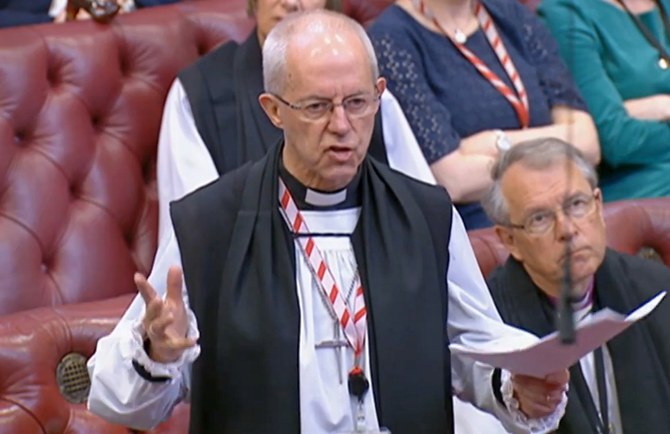
The Church of England's most senior cleric, Justin Welby, on Wednesday renewed his attacks on the UK government's highly contentious plans to send asylum-seekers to Rwanda, branding them "morally unacceptable". (AFP)
Short Url
Updated 14 May 2023
Follow

UK religious leaders join campaign for Afghan pilot’s asylum claim

  • Senior Christian, Muslim, Sikh, Jewish figures demand safe routes after pilot threatened with deportation
  • Pilot, who flew combat missions against Taliban, has written to PM Rishi Sunak in bid to remain in Britain

London: Religious leaders in the UK have joined a campaign calling for a former Afghan Air Force pilot to be granted asylum in Britain.

It comes in the wake of criticism of the government by Archbishop of Canterbury Justin Welby, who called its immigration policy “morally unacceptable and politically impractical” earlier this week.

The pilot, whose identity has been kept secret due to security fears, flew dozens of combat missions against the Taliban before fleeing after his country fell to the group in August 2021, and has been described as a “patriot” by former coalition allies.

He has been threatened with deportation to Rwanda, with which the UK has an agreement to send asylum applicants to while awaiting the resolution of their cases, over allegations he entered the UK illegally via boat from France, which is a safe country, having passed through other safe countries en route.

Senior political, media and military figures have called for the pilot to be allowed to stay in the UK. The call is now being echoed by multiple senior faith leaders.

John Perumbalath, bishop of Liverpool, said the UK has a “moral duty” to give the pilot safe haven. 

“The government has been woeful in its commitment to Afghan refugees and it is time for them to do the decent thing and reverse this cruel, heartless decision,” he said.

Bishop of Durham Paul Butler said the government had got itself in a “bind” by treating people who arrive in the UK by small boats as criminals.

“I would assume, given his past service, (the pilot) would immediately be welcomed to remain and rebuild his life here,” he added.

The pilot, who has written to Prime Minister Rishi Sunak urging him to examine his case, says he feels “forgotten” by the West and had no alternative but to head to the UK illegally due to a lack of safe, legal routes.

Lord Dannatt, former army chief, has said the pilot should be able to apply for the Afghan Relocation and Assistance Policy, but only 11,000 people have so far been granted asylum under the scheme, with a further 4,300 eligible people yet to be relocated.

Muslim Council of Britain Secretary-General Zara Mohammed said the country “must act to establish safe and legal routes for those seeking asylum in the UK.”

She told The Independent: “The absence of safe and legal routes will only serve to further embolden and enrich human traffickers, endanger the lives of those making the perilous journey across the Channel and make a mockery of our international commitments.”

Ibrahim Mogra, co-chair of the Christian-Muslim Forum and a senior imam in the city of Leicester, said: “Whether you were in support of the war in Afghanistan or against it, these Afghans risked their lives to support our government, so to abandon them like this shows utter disregard for the sacrifices they have made.”

Imam Dr. Usama Hasan, senior analyst at the Tony Blair Institute for Global Change, said: “Many Afghans risked their lives against a brutal enemy in the Taliban. So it’s right and proper that those who helped the British war effort should be given asylum in this country.”

Paul McAleenan, the Roman Catholic bishop of Westminster, told The Independent: “Establishing more safe routes, and genuinely understanding people’s individual circumstances, are essential.”

Indarjit Singh, director of the Network of Sikh Organisations, described the UK’s small boat policy as “pandering to bigotry,” saying: “It is particularly cruel to threaten to send people who have helped us in good faith to get a better government in Afghanistan. It shows us in a very, very bad light.”

He added: “Threatening to send people to Rwanda if they dare to come to our shores shows a total callousness. Rwanda is not a safe country.”

Senior British rabbis also joined the campaign, with Josh Levy, head of the Movement for Reform Judaism, saying: “If (migrants) reached here on a boat, it is because there was no other choice. An inability to find the flexibility in these cases is inexcusable.”

Rabbi Jonathan Romain of Maidenhead Synagogue said: “If ever there was an exception to the rule, this (the pilot’s case) is it.”

A Home Office spokesperson said: “Since 2015, we have offered a safe and legal route to the UK to almost half a million men, women and children seeking safety — including those from Hong Kong, Syria, Afghanistan and Ukraine, as well as family members of refugees.”


Trump says Iran ‘want to negotiate’ after reports of hundreds killed in protests

Updated 4 sec ago
Follow

Trump says Iran ‘want to negotiate’ after reports of hundreds killed in protests

  • US President Donald Trump said Sunday that Iran’s leadership had called him seeking “to negotiate” after he repeatedly threatened to intervene militarily if Tehran killed protesters
WASHINGTON: US President Donald Trump said Sunday that Iran’s leadership had called him seeking “to negotiate” after he repeatedly threatened to intervene militarily if Tehran killed protesters.
For two weeks, Iran has been rocked by a protest movement that has swelled in spite of a crackdown rights groups warn has become a “massacre.”
Initially sparked by anger over the rising cost of living, the demonstrations have evolved into a serious challenge of the theocratic system in place since the 1979 revolution.
Information has continued to trickle out of Iran despite a days-long Internet shutdown, with videos filtering out of capital Tehran and other cities over the past three nights showing large demonstrations.
As reports emerge of a growing protest death toll, and images show bodies piled outside a morgue, Trump said Tehran indicated its willingness to talk.
“The leaders of Iran called” yesterday, Trump told reporters aboard Air Force One, adding that “a meeting is being set up... They want to negotiate.”
He added, however, that “we may have to act before a meeting.”
The US-based Center for Human Rights in Iran (CHRI) said it had received “eyewitness accounts and credible reports indicating that hundreds of protesters have been killed across Iran during the current Internet shutdown.”
“A massacre is unfolding,” it said.
The Norway-based NGO Iran Human Rights (IHR) said it confirmed the killing of at least 192 protesters but that the actual toll could be much higher.
“Unverified reports indicate that at least several hundreds, and according to some sources, more than 2,000 people may have been killed,” said IHR.
More than 2,600 protesters have been arrested, IHR estimates.
A video circulating on Sunday showed dozens of bodies accumulating outside a morgue south of Tehran.
The footage, geolocated by AFP to Kahrizak, showed bodies wrapped in black bags, with what appeared to be grieving relatives searching for loved ones.
- Near paralysis -
In Tehran, an AFP journalist described a city in a state of near paralysis.
The price of meat has nearly doubled since the start of the protests, and many shops are closed. Those that do open must close at around 4:00 or 5:00 pm, when security forces deploy en masse.
There were fewer videos showing protests on social media Sunday, but it was not clear to what extent that was due to the Internet shutdown.
One widely shared video showed protesters again gathering in the Pounak district of Tehran shouting slogans in favor of the ousted monarchy.
The protests have become one of the biggest challenges to the rule of supreme leader Ayatollah Ali Khamenei, 86, coming in the wake of Israel’s 12-day war against the Islamic republic in June, which was backed by the United States.
State TV has aired images of burning buildings, including a mosque, as well as funeral processions for security personnel.
But after three days of mass actions, state outlets were at pains to present a picture of calm returning, broadcasting images of smooth-flowing traffic on Sunday. Tehran Governor Mohammad-Sadegh Motamedian insisted in televised comments that “the number of protests is decreasing.”
The Iranian government on Sunday declared three days of national mourning for “martyrs” including members of the security forces killed.
President Masoud Pezeshkian also urged Iranians to join a “national resistance march” Monday to denounce the violence.
In response to Trump’s repeated threats to intervene, Iran’s parliament speaker Mohammad Bagher Ghalibaf said Iran would hit back, calling US military and shipping “legitimate targets” in comments broadcast by state TV.
- ‘Stand with the people’ -
Reza Pahlavi, the US-based son of Iran’s ousted shah, who has emerged as an anti-government figurehead, said he was prepared to return to the country and lead a democratic transition.
“I’m already planning on that,” he told Fox News on Sunday.
He later urged Iran’s security forces and government workers to join the demonstrators.
“Employees of state institutions, as well as members of the armed and security forces, have a choice: stand with the people and become allies of the nation, or choose complicity with the murderers of the people,” he said in a social media post.
He also urged protesters to replace the flags outside of Iranian embassies.
“The time has come for them to be adorned with Iran’s national flag,” he said.
The ceremonial, pre-revolution flag has become an emblem of the global rallies that have mushroomed in support of Iran’s demonstrators.
In London, protesters managed over the weekend to swap out the Iranian embassy flag, hoisting in its place the tri-colored banner used under the last shah.