

Pakistan minister calls for banning ex-PM Khan’s party after violent protests

Smoke erupt from a burning bus during clashes with the supporters of Pakistan's former Prime Minister Imran Khan and police, in Islamabad, Pakistan, on May 12, 2023. (AP)
Short Url
Updated 14 May 2023
Follow

Pakistan minister calls for banning ex-PM Khan’s party after violent protests

  • The protests began Tuesday when Khan was dragged out of a courtroom, arrested in Islamabad 
  • Khan has distanced himself from the violence and said he wants an ‘independent inquiry’ into it 

ISLAMABAD: Pakistan’s Interior Minister Rana Sanaullah on Saturday called for banning former prime minister Imran Khan’s Pakistan Tehreek-e-Insaf (PTI) party, whose supporters clashed with police and set fire to public property in violent protests this week. 

The protests began Tuesday when Khan was dragged out of a courtroom and arrested in the capital of Islamabad. His detention was met by violent protests by his supporters, who torched cars and buildings, including military installations. Hundreds were arrested in the aftermath. 

Khan was released on Friday, but a long list of around 100 court cases, on charges ranging from fomenting violence to corruption, still stands against him. Khan said Friday that authorities only allowed him to travel when he threatened to tell the public he was being held there against his will. 

Speaking at a press conference on Saturday, Sanaullah criticized Khan for encouraging his supporters in advance of his possible arrest to engage in violence. He said the violence that erupted in the country was not a public reaction, asserting that the ones involved in it were “trained terrorists.” 

“People’s homes were torched, sensitive installations were attacked at his (Khan’s) behest, and banks were robbed,” the minister said. “There is no solution except a ban on this party.” 

He accused Khan of “recruiting” these individuals and pushing the country into chaos. 

“You tell me which political worker disembarks patients from ambulances and sets fire to them, torches schools, Radio Pakistan building,” Sanaullah asked. 

“They were being listed, they were being trained, they were being brainwashed, they were being taught how to make petrol bombs.” 
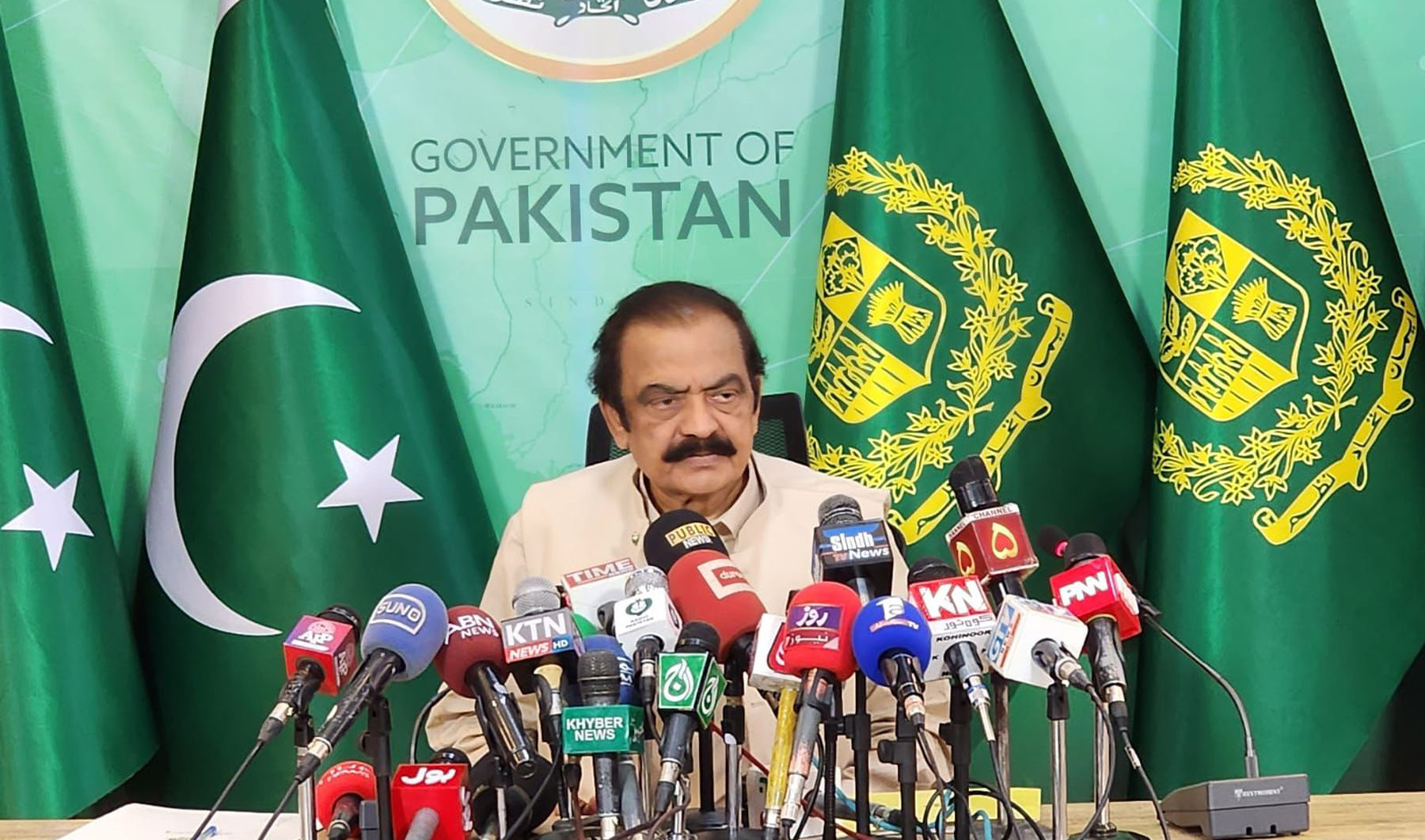


Pakistan's interior minister Rana Sanaullah addresses a press conference in Islamabad, Pakistan, on May 13, 2023. (PID)

In his address with supporters on Saturday, Khan distanced himself from the violence and said he wanted an “independent inquiry” into it, urging the country’s top judge to form a commission under his supervision for the probe. 

He thanked the “peaceful public” that turned out in his support after his arrest. 

Khan has a broad base of support around Pakistan. He presents himself as an outsider victimized by the military and the political dynasties that have long run the country. Opponents, meanwhile, call him a corrupt demagogue stirring his followers into violence. 

Also on Saturday, Prime Minister Shehbaz Sharif gave a 72-hour ultimatum to the authorities to arrest the protesters involved in vandalizing and torching state properties, including the official residence of a top army general, and said he wanted them to be tried in an anti-terrorism court. 

Army Chief General Asim Munir also expressed his resolve to bring all those responsible for targeting military installations. 

The warnings came as a sign of further escalation in the long-running showdown between the government and Khan, who was ousted from power in a parliamentary no-trust vote in April 2022. 

Khan won the 2018 election on an anti-corruption campaign, voted in by an electorate weary of decades of dynastic politics. Independent analysts say he was brought to power with the support of the military, before falling out with the generals. 

The political crisis has simmered for months, with Khan attempting to disrupt the coalition government by dissolving two provincial parliaments he controlled and agitating for early elections. 


Pakistan condemns Sudan attack that killed Bangladeshi UN peacekeepers, calls it war crime

Updated 16 sec ago
Follow

Pakistan condemns Sudan attack that killed Bangladeshi UN peacekeepers, calls it war crime

  • Six peacekeepers were killed in a drone strike in Kadugli as fighting between Sudan’s army and the RSF grinds on
  • Pakistan, a major troop contributor to the UN, says perpetrators of the attack must be identified, brought to justice

ISLAMABAD: Pakistan on Sunday extended condolences to the government and people of Bangladesh after six United Nations peacekeepers from the country were killed in a drone strike in southern Sudan, condemning the attack and describing it as a war crime.

The attack took place amid a full-scale internal conflict that erupted in April 2023 between the Sudanese Armed Forces (SAF) and the Rapid Support Forces (RSF), a powerful paramilitary group, following a power struggle after the collapse of Sudan’s post-Bashir political transition.

Omar Al-Bashir, who ruled Sudan for nearly three decades, was ousted by the military in 2019 after months of mass protests, but efforts to transition to civilian rule later faltered, plunging the country back into violence that has since spread nationwide.

The drone strike hit a logistics base of the United Nations Interim Security Force for Abyei (UNISFA) in Kadugli, the capital of South Kordofan state, on Saturday, killing the Bangladeshi peacekeepers. Sudan’s army blamed the RSF for the attack, though there was no immediate public claim of responsibility.

“Pakistan strongly condemns the attack on @UNISFA in Kadugli, resulting in the tragic loss of 6 Bangladeshi peacekeepers & injuries to several others,” the country’s permanent mission to the UN said in a social media message. “We honor their supreme sacrifice in the service of peace, and express our deepest condolences to the government and people of #Bangladesh.”

“Such heinous attacks on UN peacekeepers amount to war crimes,” it added. “Perpetrators of this horrific attack must be identified and brought to justice. As a major troop-contributing country, we stand in complete solidarity with all Blue Helmets serving the cause of peace in the perilous conditions worldwide.”

According to Pakistan’s UN mission in July, the country has deployed more than 235,000 peacekeepers to 48 UN missions across four continents over the past eight decades.

Pakistan also hosts one of the UN’s oldest peacekeeping operations, the United Nations Military Observer Group in India and Pakistan (UNMOGIP), and is a founding member of the UN Peacebuilding Commission.

More than 180 Pakistani peacekeepers have lost their lives while serving under the UN flag.

Pakistan and Bangladesh have also been working in recent months to ease decades of strained ties rooted in the events of 1971, when Bangladesh — formerly part of Pakistan — became independent following a bloody war.

Relations have begun to shift following the ouster of former Bangladeshi prime minister Sheikh Hasina last year amid mass protests.

Hasina later fled to India, Pakistan’s neighbor and arch-rival, creating space for Islamabad and Dhaka to rebuild their relationship.