Estonian defense forces prepare for Spring Storm exercise with NATO participation

1 / 2
French troops will be among those taking part in the Spring Storm exercise. (AN Photo by Ali Salman)
2 / 2
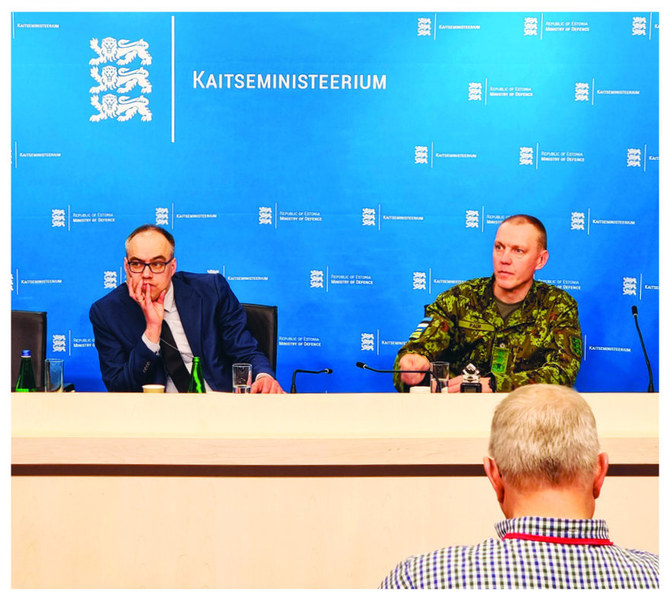
Maj. Gen. Veiko-Vello Palm, commander of the division of the Estonian Defense Forces, and Peeter Kuimet, head of the international cooperation department at Estonia’s Ministry of Defense. (AN Photo by Ali Salman)
Short Url
Updated 14 May 2023
Follow

Estonian defense forces prepare for Spring Storm exercise with NATO participation

  • The upcoming annual war game hosted by Estonia is expected to involve 14,000 troops from 11 countries
  • Spring Storm is one of several NATO military exercises designed to send a clear message to the Kremlin

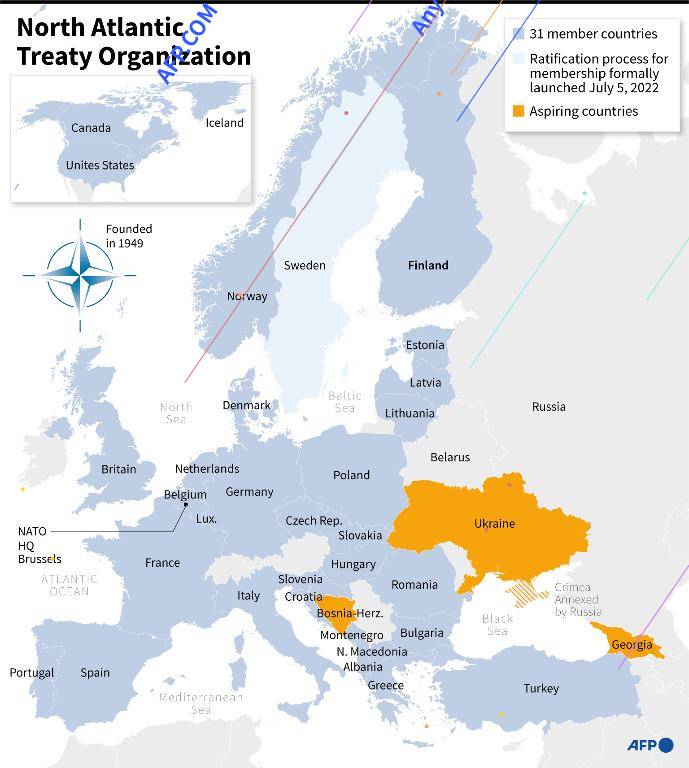
TALINN: As the Russia-Ukraine conflict rages on, NATO members are preparing for any scenario, with representatives arriving in Estonia for an upcoming annual war game, expected to involve 14,000 troops from 11 countries.

The site of the military exercise, Tapa base, is Estonia’s largest and one of the closest of any NATO member to the Russian border. As the Lennart Meri Conference brings experts from around the world to the capital Tallinn, British, French, Estonian and other country forces are descending on the base in preparation for Spring Storm.

The exercise is meant to test how allied forces will perform in the event of a Russian military attack. Reports say the UK has dispatched Wildcat and Apache attack helicopters, while France has sent VBMR Griffon armored personnel carriers, AMX-10 RC fighting vehicles and Caesar self-propelled howitzers.

“Here we’re in a defensive mission alongside our other allies,” including NATO troops, French Maj. Jean Christophe told Arab News. “We’re maybe about 400 French people on this exercise, and we’ll do the exercise with British troops and the Estonians.”
The UK has confirmed its participation, as part of a bilateral agreement with Estonia, in “a multilateral exercise supporting the Estonian Defense Forces and the aircraft we deployed.”

Col. Al Rivett of the British Army Air Corps said: “One of the key reasons that we do deployments such as this is to provide aviation support to the Estonian Defense Forces so they get effectively used to operating with aircraft such as these.”

Spring Storm will involve “combined arms,” an approach to warfare that seeks to integrate different combat arms of a military to achieve mutually complementary effects — for example, using infantry and armor in an urban environment in which each supports the other.

“The enhanced forward presence battle group is a force that is assigned to NATO under SACEUR (Supreme Allied Commander Europe),” Rivett said.

“Under that agreement and, effectively, that force is always aligned to NATO and is formally attributed to him for the SACEUR to use as he sees fit.”

Spring Storm is one of a number of military exercises that NATO countries intend to hold with the objective of sending a clear message to Kremlin. The exercises have grown bigger and more elaborate since last year when Russia invaded Ukraine.

Data from NATO shows it plans to stage 18 military exercises, involving thousands of troops, between May and September this year.



Greek police detain 313 in raid at university after mob attacked police

Updated 07 February 2026
Follow

Greek police detain 313 in raid at university after mob attacked police

  • Such attacks against riot police near the university campus are not uncommon
  • Riot police used tear gas and stun grenades to beat back the attackers

THESSALONIKI, Greece: Authorities in Greece on Saturday detained 313 people in a raid on the university campus of the country’s second-largest city, Thessaloniki, after riot police were attacked by mobs of people hurling more than 100 Molotov cocktails.
Greek police said roving groups of people wearing hoods emerged from the campus of the Aristotle University of Thessaloniki in the predawn hours Saturday to attack a squad of riot police. The unit is usually deployed some distance from the campus to quell any disturbances after all-night parties that take place on university grounds.
Police said all 313 people were released without being charged.
Such attacks against riot police near the university campus are not uncommon but it’s the first time that so many people were detained after such a clash during which an unusually high number of firebombs was used.
Riot police used tear gas and stun grenades to beat back the attackers. One officer was taken to a military hospital for burns to his face and leg while a 21-year-old civilian was treated for respiratory problems, police said.
The university said in a statement that off-campus “extremists” in conjunction with some individuals from within university grounds had committed the attacks. They said an investigation is underway to determine if any students had taken part. They added that no permission had been granted for any party to take place on university grounds.