Estonian defense forces prepare for Spring Storm exercise with NATO participation

1 / 2
French troops will be among those taking part in the Spring Storm exercise. (AN Photo by Ali Salman)
2 / 2
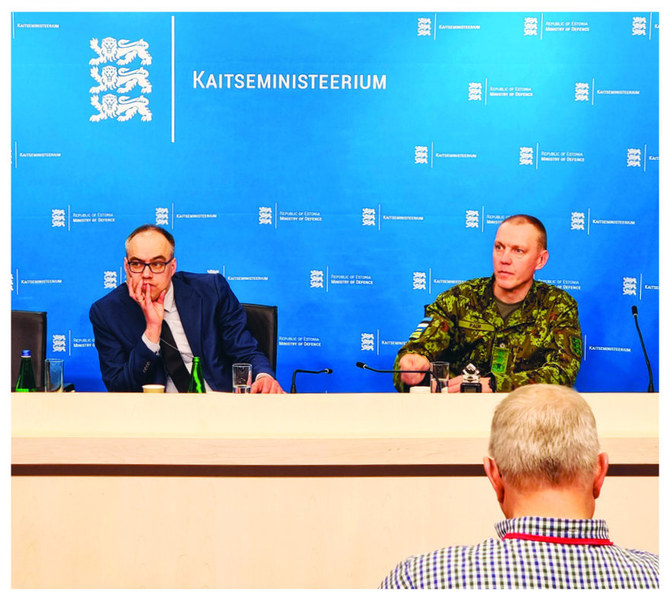
Maj. Gen. Veiko-Vello Palm, commander of the division of the Estonian Defense Forces, and Peeter Kuimet, head of the international cooperation department at Estonia’s Ministry of Defense. (AN Photo by Ali Salman)
Short Url
Updated 14 May 2023
Follow

Estonian defense forces prepare for Spring Storm exercise with NATO participation

  • The upcoming annual war game hosted by Estonia is expected to involve 14,000 troops from 11 countries
  • Spring Storm is one of several NATO military exercises designed to send a clear message to the Kremlin

TALINN: As the Russia-Ukraine conflict rages on, NATO members are preparing for any scenario, with representatives arriving in Estonia for an upcoming annual war game, expected to involve 14,000 troops from 11 countries.

The site of the military exercise, Tapa base, is Estonia’s largest and one of the closest of any NATO member to the Russian border. As the Lennart Meri Conference brings experts from around the world to the capital Tallinn, British, French, Estonian and other country forces are descending on the base in preparation for Spring Storm.

The exercise is meant to test how allied forces will perform in the event of a Russian military attack. Reports say the UK has dispatched Wildcat and Apache attack helicopters, while France has sent VBMR Griffon armored personnel carriers, AMX-10 RC fighting vehicles and Caesar self-propelled howitzers.

“Here we’re in a defensive mission alongside our other allies,” including NATO troops, French Maj. Jean Christophe told Arab News. “We’re maybe about 400 French people on this exercise, and we’ll do the exercise with British troops and the Estonians.”
The UK has confirmed its participation, as part of a bilateral agreement with Estonia, in “a multilateral exercise supporting the Estonian Defense Forces and the aircraft we deployed.”

Col. Al Rivett of the British Army Air Corps said: “One of the key reasons that we do deployments such as this is to provide aviation support to the Estonian Defense Forces so they get effectively used to operating with aircraft such as these.”

Spring Storm will involve “combined arms,” an approach to warfare that seeks to integrate different combat arms of a military to achieve mutually complementary effects — for example, using infantry and armor in an urban environment in which each supports the other.

“The enhanced forward presence battle group is a force that is assigned to NATO under SACEUR (Supreme Allied Commander Europe),” Rivett said.

“Under that agreement and, effectively, that force is always aligned to NATO and is formally attributed to him for the SACEUR to use as he sees fit.”

Spring Storm is one of a number of military exercises that NATO countries intend to hold with the objective of sending a clear message to Kremlin. The exercises have grown bigger and more elaborate since last year when Russia invaded Ukraine.

Data from NATO shows it plans to stage 18 military exercises, involving thousands of troops, between May and September this year.


Venezuela advances amnesty bill that could lead to mass release of political prisoners

Updated 06 February 2026
Follow

Venezuela advances amnesty bill that could lead to mass release of political prisoners

  • Such an amnesty is a central demand of the country’s opposition and human rights organizations with backing from the United States

CARACAS: Venezuela’s legislature on Thursday advanced an amnesty bill proposed by acting President Delcy Rodríguez that could lead to the release of hundreds of opposition leaders, journalists and human rights activists detained for political reasons.
Such an amnesty is a central demand of the country’s opposition and human rights organizations with backing from the United States. But the contents of the bill have not been released publicly, and rights groups have so far reacted with cautious optimism — and with demands for more information.
The bill, introduced just weeks after the US military captured then-President Nicolás Maduro, still requires a second debate that has yet to be scheduled. Once approved, it must be signed by Rodríguez before it can go into effect.
In announcing the bill late last month, Rodríguez told a gathering of justices, magistrates, ministers, military brass and other government leaders that the ruling party-controlled National Assembly would take up the legislation with urgency.
“May this law serve to heal the wounds left by the political confrontation fueled by violence and extremism,” she said in a pre-taped televised event. “May it serve to redirect justice in our country, and may it serve to redirect coexistence among Venezuelans.”
Rights groups, fearing some political detainees will be excluded, want more details about the requirements for amnesty before any final vote.
The Venezuelan Program for Education-Action in Human Rights, or PROVEA, issued a statement emphasizing that the bill must be made public urgently due to its potential impact on victims’ rights and broader Venezuelan society.
Based on what is known so far about the legislation, the amnesty would cover a broad timeline, spanning the administration of the late Hugo Chávez from 1999 to 2013 and that of his political heir, Maduro, until this year. It would exclude people convicted of murder, drug trafficking, and serious human rights violations, reports indicate.