

Pakistan anti-graft agency that arrested Imran Khan has wide powers

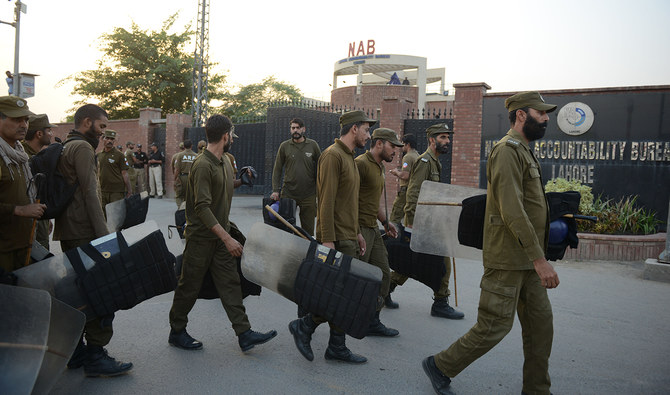
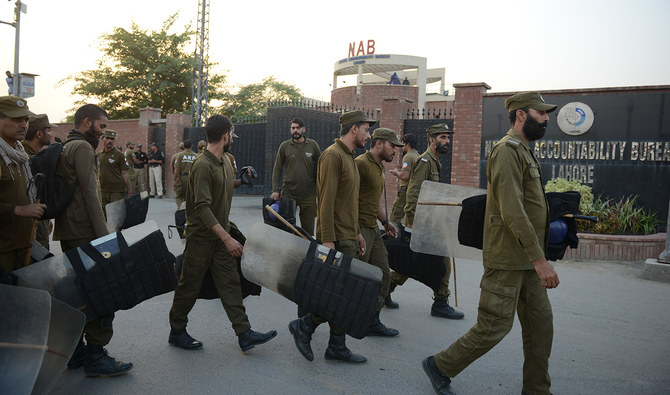
Pakistan policemen patrol outside the office of National Accountability Bureau in Lahore on October 5, 2018. (AFP/File)
Short Url
Updated 12 May 2023
Follow

Pakistan anti-graft agency that arrested Imran Khan has wide powers

  • NAB created by military ruler late General Musharraf, currently headed by a retired general
  • Agency has been controversial since its inception, mainly due to its unbridled powers

Created by military dictator late General Pervez Musharraf and currently headed by a retired general, Pakistan’s powerful anti-graft agency that arrested former prime minister Imran Khan in a land fraud case has a mandate to end corruption in the country.

The National Accountability Bureau (NAB) has investigated, tried and jailed at various times all prime ministers since 2008 including current premier Shehbaz Sharif, former president Asif Ali Zardari, and other top political figures.
On Thursday, Pakistan’s Supreme Court said that the NAB’s arrest of Khan for graft was illegal.

Below are some facts about the NAB and its working.

LAUNCH

The NAB began operations in 1999 under a chairman who was a former army general. It is headquartered in Islamabad, with regional offices in all major Pakistani cities.

WORKING

It is an autonomous body but analysts and politicians say that it has often been used as a tool to crack down on the opposition in the South Asian nation where the army has long held sway on who rules the country.

The agency denies any misuse of its powers.

It has its own investigators, unbridled powers of arrest as well as prison cells to hold suspects. The NAB has prosecutors and judges and runs its own courts, separate from the main judicial system.

Prime Minister Sharif was arrested by the agency and detained for several months in 2020 when he was an opposition leader in Khan’s parliament.

It investigates only public office holders and government officials as per law but there have been complaints by businessmen that they have also been investigated and tried.

Investigations and subsequent trials can take months, at times years, and suspects can be locked up during that period.

MANDATE

The NAB’s mandate is to eliminate corruption through enforcement, prosecution, awareness and prevention, according to the law ministry, and establish a legal framework for the drive against corruption.

CONTROVERSIAL

The agency has been controversial since its inception, mainly due to its unbridled powers, and the stigma attached to anyone investigated even if they were cleared later.

While there is broad consensus that the country should be purged of corruption, analysts say the agency hasn’t had much success in that mission.

On the flip side, fear of an investigation by the NAB is so high that government officials have often dragged their feet in clearing projects.

PROSECUTIONS, CASES

According to NAB data, the agency has conducted 4,747 investigations until March this year, of which 3,538 were filed in court. The cases resulted in 1,190 convictions and 771 acquittals while others were in progress or dormant. One hundred cases were withdrawn.

Former Prime Minister Nawaz Sharif, the brother of the current prime minister, and his daughter Maryam Nawaz were convicted of corruption by the NAB court in 2018.

Maryam Nawaz’s conviction was later overturned by a higher court.

AMENDMENTS

In March, politicians from across the spectrum barring Khan’s party joined hands to amend the law to limit the agency’s powers, such as holding a suspect for up to 90 days without recourse to bail. The maximum period is now 14 days. The agency must also complete a case within a year.

Khan’s party had opposed the move, saying Sharif’s coalition government was trying to make the agency a toothless body. 


Pakistan PM reviews internal, regional security after Khamenei killing, Afghanistan strikes

Updated 4 sec ago
Follow

Pakistan PM reviews internal, regional security after Khamenei killing, Afghanistan strikes

  • At least 16 people were killed and dozens more injured in clashes over killing of the Iranian supreme leader
  • The unrest came amid Pakistan’s offensive against Afghan forces, which officials say has killed 415 fighters

ISLAMABAD: Prime Minister Shehbaz Sharif on Sunday convened a high-level meeting to review internal and regional security situation, Sharif’s office said, amid nationwide protests over the killing of Iran’s Supreme Leader Ayatollah Ali Khamenei and Islamabad’s ongoing military operation against Afghan forces.

Protests erupted in several cities across Pakistan on Sunday after the killing of the Iranian supreme leader in US-Israeli joint strikes, with at least 16 people killed and dozens more injured in clashes with law enforcement agencies.

The unrest came amid Pakistan’s ongoing military operation against Afghan forces following a series of tit-for-tat strikes by the neighbors which began after Islamabad hit what it said were Tehreek-e-Taliban Pakistan and Daesh camps in Afghanistan on Feb 21-22.

During Sunday’s meeting, officials briefed PM Sharif and other participants about the country’s internal situation and security arrangements in place to thwart any untoward incident, according to Sharif’s office.

“Pakistan’s role and various measures to establish peace in the region were reviewed at the meeting,” Sharif’s office said. “The situation in Afghanistan was also reviewed in detail at the meeting.”

The development came shortly after Pakistan’s Information Minister Attaullah Tarar said that 415 Afghan Taliban fighters had been killed and more than 580 wounded since the latest phase of hostilities between the neighbors began on Thursday.

Afghan officials earlier said that dozens of Pakistani soldiers had been killed and several Pakistan posts had been captured by their forces. None of the casualty figures or battlefield claims from either side could be independently verified.

Earlier in the day, gunshots and explosions were reported in Kabul. Afghan government spokesperson Zabihullah Mujahid said the sounds were the result of Afghan forces targeting Pakistani aircraft over the capital.

“Air defense attacks were carried out in Kabul against Pakistani aircraft,” Mujahid wrote on X. “Kabul residents should not be concerned.”

KHAMENEI KILLING ‘VIOLATION’ OF INTERNATIONAL LAW

Separately, Sharif said the killing of Khamenei was a “violation” of international law.

“People of Pakistan join the people of Iran in their hour of grief and sorrow and extend the most sincere condolences on the martyrdom [of Khamenei],” he wrote on X.

“Pakistan also expresses concern over violation of the norms of international law.”

EVACUATION OF PAKISTANIS FROM IRAN

At Sunday’s meeting, officials of the foreign ministry also briefed the prime minister on the evacuation of Pakistani citizens from Iran, according to a statement issued from Sharif’s office.

“The evacuation of Pakistani citizens from Iran is being made possible through Azerbaijan,” they were quoted as saying.

Pakistan earlier asked its citizens in Gulf countries to exercise caution, avoid travel and strictly follow official adviseries, amid escalating tensions following the killing of Khamenei.

The foreign ministry shared emergency contact details of Pakistani embassies and consulates for the facilitation of Pakistani nationals abroad.