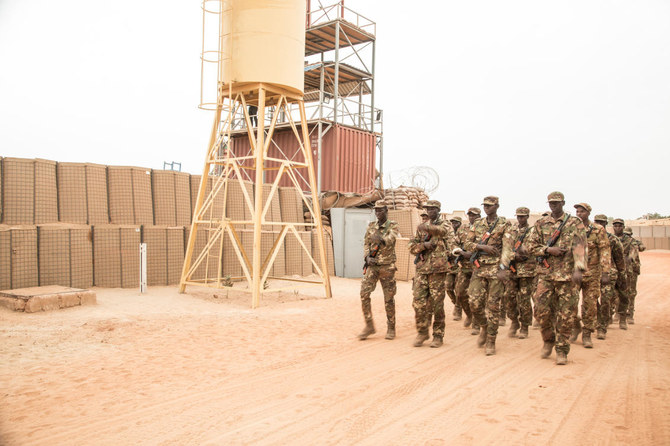
DAKAR: The Malian army and foreign fighters executed at least 500 people during an anti-militant operation in Mali in March 2022, according to a much-awaited UN report released on Friday.
The figures by the UN High Commissioner for Human Rights (OHCHR) amount to the worst atrocity the Sahel country has experienced since a militant insurgency flared in 2012.
It is also the most damning document yet against Mali’s armed forces and their foreign allies.
Their nationality is not explicitly identified in the report, although Mali has brought in Russians that western countries and others say are Wagner mercenaries.
Describing events that unfolded in the central town of Moura between March 27-31 2022, the OHCHR said it had “reasonable grounds to believe that at least 500 people were killed in violation of norms, standards, rules and/or principles of international law.”
The victims were “executed by the FAMa (Malian Armed Forces) and foreign military personnel” who had complete control over the area, it said.
The report was published after a lengthy investigation by the human rights division of the UN peacekeeping mission in Mali, MINUSMA.
Around 20 women and seven children were among those killed, while evidence suggests 58 women and girls were victims of rape and other forms of sexual violence, the report said.
Acts of torture were carried out on people who had been detained, it added.
UN High Commissioner for Human Rights Volker Turk called the findings “extremely disturbing.”
“Summary executions, rape and torture during armed conflict amount to war crimes and could, depending on the circumstances, amount to crimes against humanity,” he said in a statement.
Mali is ruled by a military junta which in 2020 toppled the country’s elected president amid protests over the failure to roll back the militants.
Since then, the junta has brought in Russian operatives and warplanes to help its beleaguered armed forces and severed ties with France, the country’s traditional ally.
It says the Russians are providing military training and denies accusations that they are Wagner mercenaries.
The UN report does not explicitly say who the foreign fighters were.
However, it cites Malian official statements on Russian military “instructors,” as well as comments attributed to Russian Foreign Minister Sergei Lavrov on Wagner’s presence in Mali.
The report also cites local testimony, collected by UN investigators, describing the foreigners as white men in fatigues speaking an “unknown” language — indicating they were not speaking French, the official language, or English.
Witnesses said the foreign soldiers “supervised” the operations, according to the report.
Moura, in the Mopti region of central Mali, has for years been known as a stronghold of the Katiba Macina, a group affiliated with the Al-Qaeda-linked Support Group for Islam and Muslims (GSIM).
The report details the arrival of Malian soldiers and their allies, supported by five helicopters, in the late morning on March 27, 2022.
A livestock fair had that day attracted thousands of civilians who had come to buy supplies in preparation for Ramadan.
About 30 Katiba Macina members were mingling with the fairgoers and civilians that day, the report said.
A helicopter reportedly opened fire “indiscriminately” in the direction of the market, and the militants returned fire.
Around 30 people, including a dozen militants, were killed.
The Malian army took control of the area within a few hours and arrested around 3,000 people, rounding them up in four locations, according to the report.
They reportedly continued to sweep the area in the following days.
Malian soldiers and their allies “allegedly selected several hundred people who were summarily executed over at least four days,” the report said.
The men executed were allegedly chosen on the basis of signs such as having long beards.
The victims were reportedly buried in mass graves.
On April 1, 2022, the junta described the events in Moura as a successful anti-militant operation that had put 203 “terrorists” out of action.
But five days later, Human Rights Watch (HRW) said 300 civilian men, some of them suspected militants, were summarily killed. White foreigners, identified by several sources as Russian, took part, it said.
A Malian military court prosecutor announced an investigation in April 2022.
The new report comes as the UN is preparing to consider whether to renew the mandate of the 10-year-old MINUSMA mission.
The Malian authorities frequently attack MINUSMA’S activities in the field of human rights, and earlier this year expelled the head of its rights division.
The report is based on a seven-month investigation between March and October 2022 and on 157 individual interviews and 11 group interviews.
The junta persistently denied access to Moura for the investigators, apart from one initial flyover.


![]()

Army, ‘foreign’ fighters killed 500 in Mali in March 2022: UN report
Short Url
https://arab.news/ynset
Army, ‘foreign’ fighters killed 500 in Mali in March 2022: UN report
- Mali is ruled by a military junta which in 2020 toppled the country’s elected president amid protests over the failure to roll back the militants


Latest updates


© 2026 SAUDI RESEARCH & PUBLISHING COMPANY, All Rights Reserved And subject to Terms of Use Agreement.