Gold retreats as dollar gains upper hand

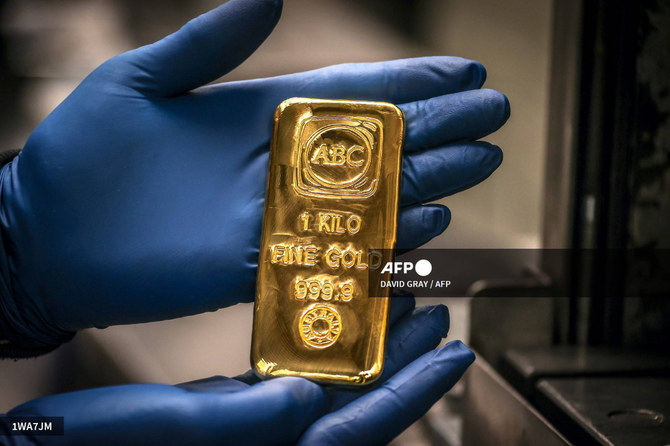
Gold is traditionally considered a hedge against inflation, but elevated interest rates dim appeal for zero-yield bullion. (AFP file photo)
Short Url
Updated 12 May 2023
Follow

Gold retreats as dollar gains upper hand

  • Dollar gains 0.6 percent to one-week high
  • Silver down nearly 5 percent, palladium down 3 percent

BENGALURU, India: Gold retreated on Thursday as rival safe-haven dollar advanced and outweighed support for bullion from lingering economic risks, while traders digested the impact of weak data on the interest rate outlook.

Spot gold was down 0.8 percent to $2,013.84 per ounce by 1:40 p.m. EDT (1740 GMT), while US gold futures settled down 0.8 percent to $2,020.50.

Gold popped up after data showed a jump in weekly jobless claims and the smallest annual increase in producer prices last month in over two years.
However, the metal soon gave up those gains as the dollar rose, making bullion more expensive for overseas buyers.
The banking situation with PacWest has prompted some safe haven demand into the US dollar, said Jim Wyckoff, senior analyst at Kitco Metals.
Investors also took stock of comments from Minneapolis Fed chief Neel Kashkari that an extended period of high rates would be necessary if inflation stayed stubbornly high.
While this weighs on sentiment for gold “to a certain extent, the precious metal remains in its uptrend channel established in November,” said Alexander Zumpfe, a precious metals dealer at Heraeus.
Gold is traditionally considered a hedge against inflation, but elevated interest rates dim appeal for zero-yield bullion.
On Wednesday, data showed the annual increase in US consumer prices slowed to below 5 percent in April for the first time in two years, but remained well above the Fed’s 2 percent target.
With inflation still sticky amid a slow deterioration in the US economy, the Fed is less likely to feel the need to hike rates further, keeping gold in a sideways to higher trend, said David Meger, director of metals trading at High Ridge Futures.
Silver plunged 4.9 percent to $24.18 per ounce, platinum shed 2 percent to $1,091.86 and palladium lost 3.4 percent to $1,551.96.


Global trade isn’t deglobalizing — it’s reshuffling, Harvard economist says

Updated 09 February 2026
Follow

Global trade isn’t deglobalizing — it’s reshuffling, Harvard economist says

ALULA: Global trade is not retreating into deglobalization despite geopolitical shocks, but is instead undergoing a structural reshuffling led by US-China tensions, according to Harvard University economist Pol Antras. 

Presenting research at the AlUla Emerging Market Economies Conference, Antras said there is no evidence that countries are systematically turning inward. Instead, trade flows are being redirected across markets, creating winners and losers depending on export structure and exposure to Chinese competition. 

This comes as debate intensifies over whether supply-chain disruptions, industrial policy and rising trade barriers signal the end of globalization after decades of expansion. 

Speaking to Arab News on the sidelines of the event, Antras said: “I think the right way to view it is more a reorganization, where things are moving from some countries to others rather than a general trend where countries are becoming more inward looking, in a sense of producers selling more of their stuff domestically than internationally, or consumers buying more domestic products than foreign products.”  

He said a change of that scale has not yet happened, which is important to recognize when navigating the reshuffling — a shift his research shows is driven by Chinese producers redirecting sales away from the US toward other economies. 

He added that countries are affected differently, but highlighted that the Kingdom’s position is relatively positive, stating: “In the case of Saudi Arabia, for instance, its export structure, what it exports, is very different than what China exports, so in that sense it’s better positioned so suffer less negative consequences of recent events.” 

He went on to say that economies likely to be more negatively impacted than the Kingdom would be those with more producers in sectors exposed to Chinese competition. He added that while many countries may feel inclined to follow the United States’ footsteps by implementing their own tariffs, he would advise against such a move.  

Instead, he pointed to supporting producers facing the shock as a better way to protect and prepare economies, describing it as a key step toward building resilience — a view Professor Antras underscored as fundamental. 

Elaborating on the Kingdom’s position amid rising tensions and structural reorganization, he said Saudi Arabia holds a relative advantage in its economic framework. 

“Saudi Arabia should not be too worried about facing increased competitive pressures in selling its exports to other markets, by its nature. On the other hand, there is a benefit of the current situation, which is when Chinese producers find it hard to sell in US market, they naturally pivot to other markets.” 

He said that pivot could benefit importing economies, including Saudi Arabia, by lowering Chinese export prices. The shift could increase the Kingdom’s import volumes from China while easing cost pressures for domestic producers.