

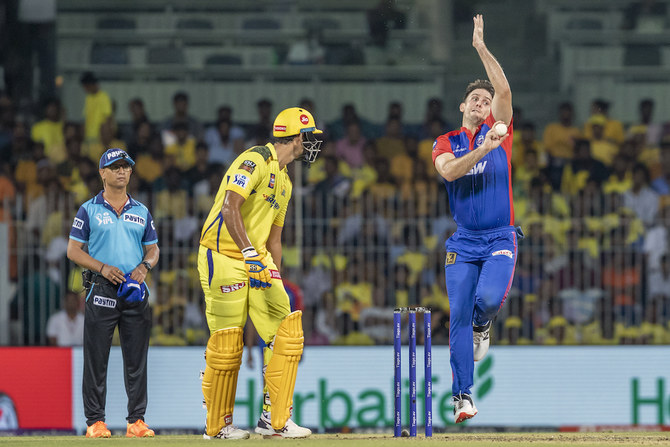

There is no more exhilarating sight in cricket than that of a fast bowler running in to deliver the ball, except, that is, if you are the person holding the bat.
In my youth, I faced one of England’s fastest bowlers of the time. I barely saw the ball, let alone possessed the hand-eye coordination to make a proper reaction to play an intended shot.
It is, therefore, unimaginable what it would have been like to face the fastest bowler ever recorded. In 2002, Shoaib Akhtar, known as the Rawalpindi Express, became the first bowler to break the 100 miles per hour barrier, equivalent to 161.3 kilometers per hour. His achievement still stands.
A radar gun has been used since 1999 to calculate bowling speeds in international matches and some first-class matches.
A gun is mounted on a pole located next to the sight screen behind the boundary and behind the bowler. It measures the speed of the ball from one end of the pitch to the other, in comparable manner to how the speed of a motor vehicle is calculated. Speeding tickets were first introduced in the late 1940s in the US, but it was some time before speed-gun technology arrived in sport.
First it was baseball in the 1970s, to measure speed of pitch, then tennis in 1989, to calculate the speed of service. It was another 10 years before cricket adopted the technology.
The gun transmits a microwave beam toward the entire distance of the pitch and detects the movement of any object along with the pitch. Spectators, coaches, analysts, and players can see the ball-speed calculation displayed on screen.
Sceptics are apt to point out that the speed gun is not 100 percent accurate, suggesting that Akhtar may not have achieved 100 mph. He said: “It doesn’t matter to me whether somebody recognises the speed gun or not. For me, it’s satisfying that I have bowled the fastest-ever delivery.”
It is, however, the case that the gun is accurate to within 1 mph up to 60 mph and within 3 percent over this. The laser could be 2.7 mph out at 90 mph. Generally, bowlers are categorised as slow, if delivering the ball between 40 mph and 60 mph, medium pace between 60 mph and 80 mph, and fast over 80 mph.
The characteristics which determine which bowlers fit into which category are complex. These relate to technique, physical condition, mental strength, and aptitude for practice.
There are five stages in bowling technique — run-up, pre-delivery stride, delivery stride, ball release, and follow through. In the case of fast bowlers, the run-up assumes increased importance. This needs to be at a level appropriate to produce high linear velocity while still allowing the bowler to perform the bowling action properly.
Every bowler has a different body shape, so each one has a separate way of generating acceleration in the run-up. Foot contact on the ground is also important, as ground reaction forces are used to generate both pace and deceleration in the delivery stage.
One of the great fast bowlers, Michael Holding of Jamaica, had such a smooth, silent, run-up that he was nicknamed Whispering Death. Another great, Australia’s Dennis Lillee, appeared from the distance, almost back to the sight screen on some grounds, in menacing fashion. During his furious sprint to the wicket, his mane of hair would blow in the wind, his moustache bristle, while his unbuttoned shirt revealed a bouncing gold chain.
In the pre-delivery stage, the bowler leaps into the air to allow the body to be organized for the delivery. This means that the lower body is decelerated, and the upper body of hips, shoulders, and bowling arm are accelerated.
In the delivery stage, the back foot contacts the ground first, exerting pressure on the spine. When the front foot contacts the ground, there are forces up to nine times the bowler’s body weight relying on the front leg to keep the body stable. Prior to delivery, the upper body is driven forward, pivoting on the front knee. At the point of ball release, the position of the bowling arm in relation to the front foot impacts on ball speed. The faster bowlers tend to delay delivery.
It is little wonder that fast bowlers succumb to injury. In 1973, Lillee’s lower vertebrae were fractured in three places, his career possibly over. Displaying the mental toughness required for fast bowlers, he embarked on a fastidiously planned recouperation that included a remodelling of his action. A year-and-a-half later, he returned to international cricket, an even more potent performer.
Lillee had added a change of pace, deliveries which cut into the batters to complement his natural ability to swing the ball away, and a more strategic use of the bouncer.
In addition to bowling technique, there is also the ability to swing the ball in the air and make it deviate off the pitch. Fast bowlers who can ally these facets with superior bowling technique are fearsome prospects to face.
Ultimately, Lillee claimed 355 Test wickets. Richard Hadlee of New Zealand, although slightly slower, claimed 431 Test wickets with a similar range of talents. In similar fashion, James Anderson of England has so far now taken 685 Test wickets.
All three started their careers erratically, maintained incredible levels of fitness, overcame injury, trained and worked hard, and possessed innate technical skills which they honed as they grew older and wiser. In Lillie’s words they “never gave in, no matter the condition of the match.”
All of this demands a particular type of personality to overcome setbacks and dismiss batters. Fast bowlers express this in separate ways.
Lillee had a reputation for getting involved in or starting duels and altercations, Anderson has a reputation for appearing grumpy when things are not going well, while Hadlee displayed a deeply forensic and strategic approach to his task. Each of them has shown that raw pace needs to be allied to technical and mental attributes for success to be achieved.


