

Pakistani foreign minister says against banning political parties, advises PTI to forgo violence

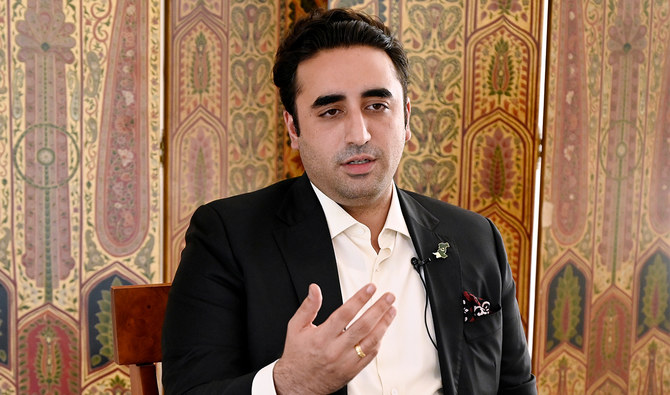
Pakistan's Foreign Minister Bilawal Bhutto Zardari, speaks during an interview at the Embassy of Pakistan in Washington, DC, September 27, 2022. (AFP/File)
Short Url
Updated 11 May 2023
Follow

Pakistani foreign minister says against banning political parties, advises PTI to forgo violence

  • Bhutto-Zardari says will be ‘last person’ to condone banning Imran Khan’s PTI party
  • Says ban, if imposed, should be done through an impartial process and as a last resort

KARACHI: Pakistani foreign minister Bilawal Bhutto-Zardari said on Thursday he was “principally” opposed to banning political parties and such a drastic step should only be used as a last resort against ex-prime minister Imran Khan’s Pakistan Tehreek-e-Insaf (PTI) party.

The minister issued the statement against the backdrop of violent demonstrations that erupted across the country following Khan’s arrest from the Islamabad High Court in a graft case on Tuesday. He is currently on physical remand of the National Accountability Bureau which is investigating him for allegedly receiving land as a bribe from a major property tycoon.

Meanwhile, Khan’s supporters have reacted to his arrest by storming sensitive army buildings and setting public property on fire, including military and government buildings, leading the army to put out a strongly worded statement on Wednesday that “facilitators, planners, and political activists” behind organized attacks on its properties and installations would be punished. Prime Minister Shehbaz Sharif also promised to punish all miscreants “as per the law and constitution.”

In the backdrop of the army and PM’s strongly-worded statements, many analysts have conjectured whether the destruction wrought by the protesters, which military and political leaders say was directly instigated by the PTI, will be used as a pretext to ban the party.

“I am principally against imposing a ban on any political party and would be the last person to condone such a move,” the foreign minister said in a news conference on Thursday.

“If another party had engaged in terrorist activities that we saw yesterday, they would have been pushed towards [a ban], but we cannot make such a decision on TV screens on the basis of the videos [of violent protests] that we saw.”

Bhutto-Zardari said if a ban had to be eventually imposed on the PTI, then it should be done as a "last resort."

“An impartial process has to be in place for such a decision [to be taken],” he said.

“The only advice I can give to the PTI is what’s done is done, and those who were involved in [violence] have to be made answerable, but the party should not make matters worse,” he added.

“Call an end to the violent protests, declare that you would abide by the rule of law and constitution, and accept that you would engage the [anti-graft] National Accountability Bureau as citizens and not as terrorists.”


Kazakhstan president to explore trade, connectivity cooperation in first state visit to Pakistan this week

Updated 4 sec ago
Follow

Kazakhstan president to explore trade, connectivity cooperation in first state visit to Pakistan this week

  • Kazakhstan President Kassym-Jomart Tokayev to visit Pakistan from Feb. 3-4 with high-level delegation, says Pakistan’s foreign office
  • Kazakh president to meet Pakistani counterpart, hold talks with PM Shehbaz Sharif and address Pakistan-Kazakhstan Business Forum

ISLAMABAD: Kazakhstan President Kassym-Jomart Tokayev will explore bilateral cooperation with Pakistan in trade, regional connectivity, logistics and other sectors when he undertakes his first official visit to the country this week, Pakistan’s foreign office said on Monday. 

Tokayev will arrive in Pakistan leading a high-level delegation comprising senior cabinet ministers and high-ranking officials from Feb. 3-4, the Pakistani foreign office said in a statement. 

Tokayev is expected to meet his Pakistani counterpart President Asif Ali Zardari, hold talks with Prime Minister Shehbaz Sharif and address the Pakistan-Kazakhstan Business Forum during the visit, the foreign office said. 

“The visit will provide the two sides an important and timely opportunity to undertake a comprehensive review of bilateral relations, discuss new avenues for broadening cooperation, particularly in trade, logistics, regional connectivity, people-to-people contacts, and explore collaboration at regional and international forums,” the statement said. 

The foreign office said Tokayev’s visit reflects the strengthening bonds between Pakistan and Kazakhstan, their mutual commitment to transforming historic and cultural affinities into robust cooperation, as well as their common desire for peace and progress in the region. 

Relations between Pakistan and Kazakhstan are rooted in shared Islamic heritage and a growing strategic partnership, with Pakistan offering landlocked Central Asian republics access to southern seaports for global trade. Pakistan was among the first countries to recognize Kazakhstan when it gained independence in December 1991 and formally established diplomatic relations with it on Feb. 24, 1992. 

The two countries have held regular interactions over the past couple of years on the sidelines of the Shanghai Cooperation Organization (SCO) meetings and other international events. Kazakhstan’s Deputy Prime Minister Murat Nurtleu visited

Pakistan in September 2025 to discuss economic and trade cooperation with Islamabad. 

Islamabad and Astana engage with each other to promote business and political ties via three forums mainly, which are: Bilateral Political Consultations, the Intergovernmental Joint Commission on Trade, Economic, Scientific, Technological and Cultural Cooperation, and the Joint Business Council. 

According to the government of Kazakhstan, bilateral trade between the two countries amounted to $53.7 million in 2024. Pakistan’s main exports to Kazakhstan include citrus fruits, pharmaceutical products, garments, soap, sports equipment and gear and others.

Kazakhstan’s exports to Pakistan primarily include onions and garlic, dried leguminous vegetables, oats, buckwheat and other cereal grains, seeds and fruits of other oil-bearing crops, among others.