

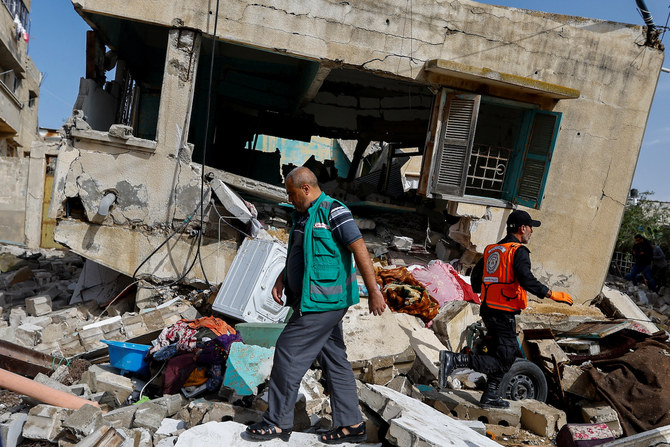

GAZA CITY: Israeli military aircraft on Thursday bombed an apartment building in a residential complex in the southern Gaza Strip city of Khan Yunis, killing three Palestinians and wounding seven.
Islamic Jihad announced the killing of Ali Hassan Ghali, the commander of the rockets program of Saraya Al-Quds, the body’s military wing, during the attack, along with his brother Mahmoud and his nephew.
Ghali is the fourth prominent military commander killed by Israel during the current round of fighting that started before dawn on Tuesday.
He is a member of the military council and leads the military wing of Islamic Jihad.
The Israeli warplanes also completely destroyed three homes in Khan Yunis in the south, and Beit Lahiya in the northern Gaza Strip, after warning its residents to evacuate, without causing any injuries.
“The Zionist occupation continues to target people who are safe in their homes and apartments with US-manufactured missiles, which the occupation planes struck again, targeting a residential building in Hamad Town in Khan Yunis,” the militant group said in a statement.
It said the attack led to the “martyrdom” of three people and the destruction of homes, apartments and residential buildings.
“The policy of assassination by bombing residential buildings will not give the enemy victory, and the upcoming strikes will reveal its weakness and impotence,” the statement added.
It said the “martyrdom of Commander Ali Ghali will not stop the rocket fire, and the Al-Quds Brigades are able to expand and increase the beam of fire.”
On Wednesday morning, the Palestinian Ministry of Health announced that the number of victims of the Israeli bombing had risen to 25 Palestinians, including six children and four women, and that more than 70 others were injured, with some of them in critical condition.
Palestinian militants continued to fire rockets at Israeli towns, despite the Israeli bombardment of various areas in the Gaza Strip, the largest of which was on the city of Tel Aviv on Wednesday evening.
Tariq Selmi, spokesman for the Islamic Jihad in Gaza, said: “The resistance is capable of confronting the occupation’s attacks and inflicting casualties on its ranks.”
The Israeli bombardment, and the firing of missiles from Gaza, continue amid attempts by Egypt and other parties to reach a ceasefire that will restore calm to the Gaza Strip.
Officials of Islamic Jihad had traveled to Cairo for the talks — most notably Muhammad Al-Hindi — the political official from the organization in the Gaza Strip, who is currently living in Istanbul.
“We received an invitation from our Egyptian brothers to discuss the details of the ceasefire, and a number of leaders traveled to Cairo for that,” Selmi told Arab News.
The Palestinian group requires that Israel stop the “assassination” policy against its leaders and Palestinian factions, in addition to returning the body of Khader Adnan, who died in an Israeli prison after a hunger strike.
“A ceasefire agreement will not be reached without the occupation’s pledge to completely stop the policy of assassinations,” the spokesman said.
The residents of the Gaza Strip continue to suffer as a result of the continued fighting with Israel, and the closure of the Erez and Kerem Shalom crossings.
The government’s information office stated that “the occupation prevented the supply of fuel needed for the only power plant in the Gaza Strip for the third day in a row, threatening the continuation of the work of the power plant and its ability to produce electricity.”
The statement added: “The quantities of fuel have begun to run out, and the countdown to shutting down the station has begun, which foreshadows a humanitarian, health and environmental crisis in the Gaza Strip.”
An Israeli political official, in a statement distributed to Hebrew-language media from Prime Minister Benjamin Netanyahu’s office, said: “We will not stop the policy of assassinations, and we will not return the body of Khader Adnan under any conditions.”
The official added that “there are continuous contacts, and we did not promise Egypt anything, and we will not accept any conditions.”


