

Chinese mediation between Riyadh, Tehran shows dialogue ‘only pathway’ to peace — Pakistani minister

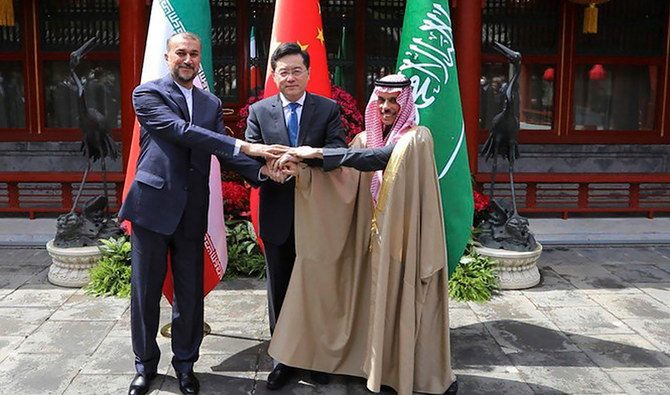
Saudi Arabia’s foreign minister Prince Faisal bin Farhan Al-Saud (right), shakes hand with his Iranian counterpart Hossein Amirabdollahian(left), and Chinese counterpart Qin Gang in Beijing on Thursday, April 6, 2023. (Photo courtesy: Iranian foreign ministry via AFP)
Short Url
Updated 11 May 2023
Follow

Chinese mediation between Riyadh, Tehran shows dialogue ‘only pathway’ to peace — Pakistani minister

  • Pakistan’s National Security Division organized two-day Security Dialogue featuring international experts
  • Ahsan Iqbal says Pakistan wanted to contribute to consensus building on key international issues 

ISLAMABAD: Pakistan’s Minister for Planning Ahsan Iqbal said on Wednesday the example of China mediating the revival of diplomatic relations between Saudi Arabia and Iran showed that dialogue was the “only pathway toward lasting peace and stability.”

The minister was addressing the opening ceremony of the third edition of the annual ‘Islamabad Security Dialogue-2023,’ organized by the Pakistan government’s National Security Division. The conference will run for two days and features over 40 leading international and Pakistani speakers who will discuss global economic and international law challenges, climate change and how transitions in the global order are impacting middle powers.

“Pakistan deeply appreciates the Chinese role in mediating between the brotherly countries of Saudi Arabia and Iran,” Iqbal said, adding that this would help usher a new era of stability and cooperation in the region.

The foreign ministers of Iran and Saudi Arabia met in Beijing last month for the first formal gathering of their top diplomats in more than seven years, after China brokered a deal in March to restore relations between the top regional powers. The two nations have since been working on modalities to reopen embassies and consulates. 

“This is a positive manifestation of the fact that dialogue and diplomacy remain the only pathway toward lasting peace and stability,” the planning minister added.

He said Pakistan too wanted to contribute to consensus building on key international issues such as counterterrorism, peace, climate change and infrastructure development.

“Our strategic thrust remains to preserve our relationship with all the major powers and seek their positive convergence for developmental partnerships and economic growth,” he said, adding that his country believed that lowering of tensions was crucial for conflict resolution and shared economic prosperity.

“While China remained our major investment partner and the largest source of imports, the United States and European Union are Pakistan’s largest export markets, while the Gulf Cooperation Council (GCC) is the major source of remittances for Pakistan’s economy,” Iqbal said, highlighting Pakistan’s multiple foreign ties.


IMF hails Pakistan privatization drive, calls PIA sale a ‘milestone’

Updated 10 January 2026
Follow

IMF hails Pakistan privatization drive, calls PIA sale a ‘milestone’

  • Fund backs sale of national airline as key step in divesting loss-making state firms
  • IMF has long urged Islamabad to reduce fiscal burden posed by state-owned entities

KARACHI: The International Monetary Fund (IMF) on Saturday welcomed Pakistan’s privatization efforts, describing the sale of the country’s national airline to a private consortium last month as a milestone that could help advance the divestment of loss-making state-owned enterprises (SOEs).

The comments follow the government’s sale of a 75 percent stake in Pakistan International Airlines (PIA) to a consortium led by the Arif Habib Group for Rs 135 billion ($486 million) after several rounds of bidding in a competitive process, marking Islamabad’s second attempt to privatize the carrier after a failed effort a year earlier.

Between the two privatization attempts, PIA resumed flight operations to several international destinations after aviation authorities in the European Union and Britain lifted restrictions nearly five years after the airline was grounded following a deadly Airbus A320 crash in Karachi in 2020 that killed 97 people.

“We welcome the authorities’ privatization efforts and the completion of the PIA privatization process, which was a commitment under the EFF,” Mahir Binici, the IMF’s resident representative in Pakistan, said in response to an Arab News query, referring to the $7 billion Extended Fund Facility.

“This privatization represents a milestone within the authorities’ reform agenda, aimed at decreasing governmental involvement in commercial sectors and attracting investments to promote economic growth in Pakistan,” he added.

The IMF has long urged Islamabad to reduce the fiscal burden posed by loss-making state firms, which have weighed public finances for years and required repeated government bailouts. Beyond PIA, the government has signaled plans to restructure or sell stakes in additional SOEs as part of broader reforms under the IMF program.

Privatization also remains politically sensitive in Pakistan, with critics warning of job losses and concerns over national assets, while supporters argue private sector management could improve efficiency and service delivery in chronically underperforming entities.

Pakistan’s Cabinet Committee on State-Owned Enterprises said on Friday that SOEs recorded a net loss of Rs 122.9 billion ($442 million) in the 2024–25 fiscal year, compared with a net loss of Rs 30.6 billion ($110 million) in the previous year.