

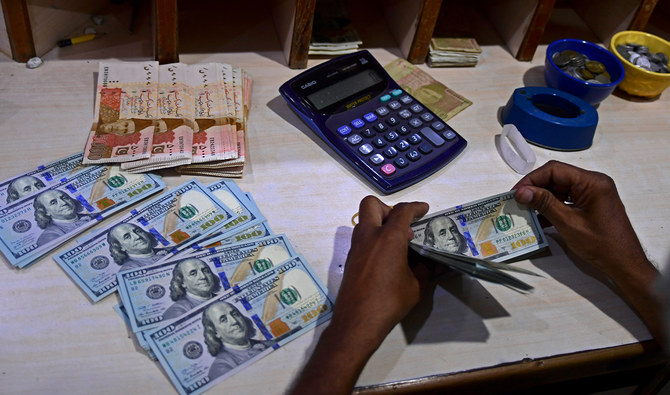

KARACHI: The Pakistani rupee plunged to an all-time low against the United States Dollar on Wednesday amid lingering uncertainty over an International Monetary Fund (IMF) bailout loan and as protests against the arrest of popular opposition politician Imran Khan entered the second day, traders and equity analysts said.
The former prime minister’s arrest and subsequent violent nationwide protests have come as the South Asian nation of 220 million people is running out of dollars, inflation is running at over 36 percent and an expected IMF bailout has been delayed by months.
Industrial activity has virtually ground to a halt as the central bank has raised interest rates to a record 21 percent to battle inflation, worsening already-high unemployment and poverty. Women and children have been killed in stampedes at food distribution centers as food inflation rises to an all-time high of 40 percent.
The Pakistani national currency, which closed at Rs284.84 against the greenback on Tuesday, dropped by 1.8 percent on Wednesday to close at Rs290.22.
“The rupee has weakened amid the uncertain political situation and pressure of upcoming [debt] repayments by June 2023,” Samiullah Tariq, a director of research at the Pakistan-Kuwait Investment Company, told Arab News.
“Prior to today’s depreciation of the rupee, the national currency was comparatively stable but political uncertainty has dented the sentiments at the currency market.”
Malik Bostan, the chairman of the Exchange Company Association of Pakistan, said “political uncertainty” was the major contributor to the rupee’s fall.
“The major concern in the currency market was the arrest of Imran Khan,” Bostan told Arab News. “The upcoming [debt] repayments and delayed IMF program have also played a key role in weakening the rupee.”
He said the rupee would recover some loses if normalcy returned to the country’s political landscape.
A former adviser at the finance ministry, Dr. Khaqan Najeeb, said continuing political instability had taken a toll on market sentiment, pushing the Pakistani rupee to hit a record low and increasing uncertainty regarding the resumption of the IMF program.
“The heightened political turmoil has come at a time when the economy has been in doldrums for months largely due to an acute balance of payment crisis, with falling State Bank of Pakistan reserves barely covering a month of highly controlled imports,” Najeeb said.
Farhan Mahmood, Head of Research at Sherman Securities, however, downplayed the impact of Khan’s arrest on the freefall of the rupee, saying concerns around the delayed IMF program and around $14 billion in debt payments by December this year were more to blame for the currency depreciation.
“There would have been an indirect effect of Khan’s arrest on rupee depreciation but the major concerns are the impending $13-14 billion repayments by December this year, including around $3 billion by June,” Mahmood said.
“As the delay [in getting IMF bailout] prolongs, the concern in the market is growing and we think that the currency may further devalue in the coming days and may hit Rs300 mark against the greenback,” Mahmood added, “unless some big inflows halt the freefall or oil prices post sharp falls.”
Najeeb said even if Pakistan was able to finance the $3.7 billion due by June 30, Pakistan’s financing options beyond June were highly uncertain
“It would be hard to arrange dollar financing without the umbrella of the IMF program,” Najeeb added. “Negotiating a new program is an uphill task till there is certainty in the political cycle.”
A revenue shortfall for the fiscal year through June is projected to overshoot targets substantially by most estimates, while the rupee remains weak.
The suspension of mobile and broadband services in the country since Tuesday in response to the ongoing protests has also caused huge financial losses, experts said.
The telecom operators have incurred an estimated revenue loss of Rs820 million ($3 million) while the government has lost around Rs28 million in tax revenue since Tuesday, a senior telecom sector official who declined to be named said.
Those who depend on digital apps such as Careem, InDrive, FoodPanda, and others for their income have suffered a significant loss in earnings, while digital payments have come to a standstill, officials said.


