

Artist’s paralyzing illness inspires Saudi Film Festival VR ode to nature

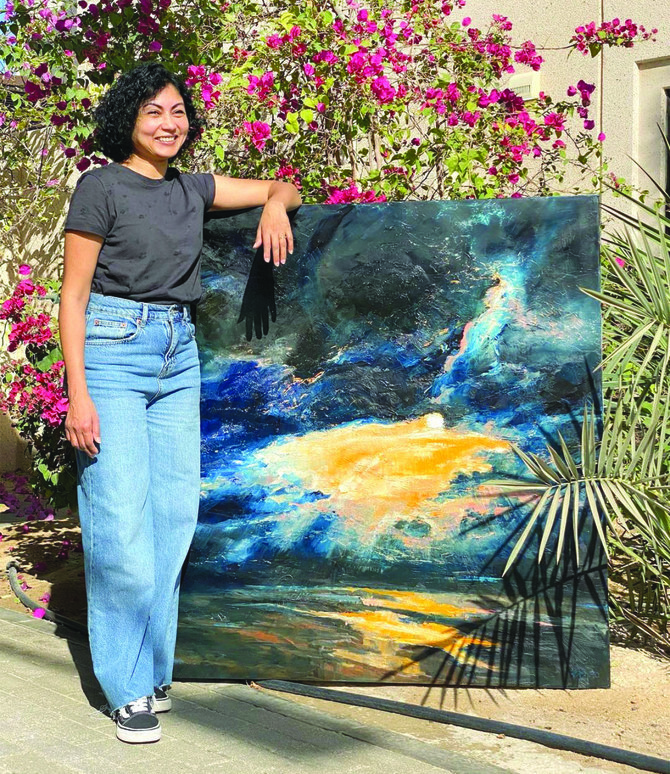
In this picture, posted on May 9, 2021, Bangladeshi Dutch artist Naima Karim gestures with her artwork. (Photo courtesy: Instagram/naimakarim_)
Short Url
Updated 09 May 2023
Follow

Artist’s paralyzing illness inspires Saudi Film Festival VR ode to nature

  • Bangladeshi Dutch artist with neurological disorder harnesses her love of nature to wow Saudi Film Festival audiences
  • Naima Karim’s “The Anticipation of Rain” is a virtual reality experience that has captivated viewers with its ode to nature

DHAHRAN: A Bangladeshi Dutch artist struck down by a neurological disorder has harnessed her love of nature to wow Saudi Film Festival audiences.

Naima Karim’s “The Anticipation of Rain” is a virtual reality experience that has captivated viewers with its ode to nature’s beauty and strength.

Karim was in the final year of studies when her life took an unexpected turn.

She said: “I was completely paralyzed because of a neurological disorder in 1999. It took a long time to recover. I spent most of my time in bed. During those days, I observed how beautiful nature was around me and was motivated to get better and to walk again.

“I dreamt every day of running across a grass field, and the beautiful sky above me was limitless. That was the most inspiring thing for me when I started to paint again in 2015, after a long break.”

In 2013, Karim and her family moved to Saudi Arabia where she began showcasing her artworks.

“I had my first solo exhibition at Dhahran Art Gallery in 2016. Since then, I have tried different mediums like watercolor, acrylic, oil, and more.

“The VR experience came to mind only when I wanted to create something beyond my canvases. I wanted my audience to immerse fully in monsoon rain,” she added.

“The Anticipation of Rain” is Karim’s first multi-sensory VR project, and despite having no prior technical background, after pitching her idea to the Creative Solutions program, she was enrolled onto master classes.

She said: “I created the 3-D environment using Open Brush, a VR tool, and painted it in the same style that I paint on canvas. I wanted to keep my same artistic style even in the 3-D world, which is long brushstrokes. These long brushstrokes are also a celebration of a movement that I used to miss because of my paralysis.”

Growing up in Bangladesh, she has childhood memories of monsoons that she described as theatrical and exciting.

“My VR experience is about three things: The monsoon rain that inspires me a lot, my personal story of recovering from paralysis that made me a positive person, and to inspire my viewers to see the beauty around us and take care of our one world,” Karim added.

During the film festival VR experience at the King Abdulaziz Center for World Culture (Ithra), viewers are given two pieces of scented paper to replicate the smell of rain — a special touch to fully immerse the senses.

She said: “I wanted my viewers to experience a storm that was scary but exciting and beautiful to me. It also gets very humid before it starts to rain, and when it rains, the smell changes, mixing the rainwater and the soil.

“That’s why I created the scents of humidity and rain with a perfumer, which will immerse my audience even more in the monsoon rain.”

Her “The Anticipation of Rain” experience has been nominated for the VR social impact award by AIXR, and the Crystal Owl Awards by Stereopsia Europe. It was also presented at the International Documentary Film Festival Amsterdam, the world’s largest of its kind.

“‘The Anticipation of Rain’ was born at Ithra and was first demoed at the plaza in Ithra. After that, it was showcased at several festivals worldwide.

“It is now part of the Saudi Film Festival as Creative Solutions program submitted it and it was selected to be a part of the VR experiences at the festival,” Karim added.

She is currently working on her second VR project.

Manager of the VR experience at Ithra, Mohammed Almadani, said: “It feels like I’m on an isolated island, surrounded by nature, enjoying myself and absorbing the beauty. With the scents it feels so real, if there was just actual rain, you would feel like it’s real life.

“I really recommend everyone to try it, because its different than other VRs. It’s interactive and it takes you to a different level.”

Karim said: “‘The Anticipation of Rain’ is to inspire my audience to be hopeful. When we really want something that we love, I believe hope is something that takes us forward and makes us stronger.”


CNN suggests ‘false information’ could be behind UAE-KSA tensions

Updated 10 min 23 sec ago
Follow

CNN suggests ‘false information’ could be behind UAE-KSA tensions

  • Abu Dhabi mobilized STC after being falsely informed that Riyadh asked for sanctions on UAE

RIYADH: Tensions between Riyadh and Abu Dhabi could have been sparked by false information provided to the UAE about the Saudi Crown Prince’s recent visit to Washington, CNN has reported.

The American news channels says it has learned from its sources that Saudi Arabia believes Abu Dhabi mobilized the separatist Southern Transitional Council (STC) forces, which it backs, in provinces bordering the kingdom after being falsely informed that Saudi Crown Prince Mohammed bin Salman had asked US President Donald Trump during a White House visit in November to impose sanctions on Abu Dhabi over its alleged support for a warring party in Sudan’s civil war.

CNN’s reporting also suggests that Riyadh has reached out to the UAE to explain that it made no such request.

Meanwhile, the American channel says the UAE official who spoke to it on the condition of anonymity didn’t directly address the matter when asked about the false information claims.

During the November visit, President Trump did publicly announce that he had instructed his government to intervene in a bid to resolve the ongoing, bloody conflict in Sudan, based on a request from the Saudi Crown Prince.

However, neither the statements of the president, the crown prince, nor any reports published by Saudi or US media made any reference to the UAE at the time.

On Dec. 30, Riyadh launched airstrikes on what it says was a UAE military equipment shipment to Yemen, which was uncoordinated with the Coalition.

The Kingdom also backed the Yemeni government’s call for UAE forces to leave the country, which Abu Dhabi has agreed to honor, issuing a statement that insinuates it has done so of its own will.

The UAE statement also claimed an unwavering commitment on the part of Abu Dhabi to Saudi Arabia’s security and sovereignty, rejecting any actions that could threaten the Kingdom or undermine regional stability.

Meanwhile, CNN said it also understands that further Saudi strikes targeting the STC remain on the table should the separatists not withdraw. After the UAE pulled its troops from Yemen last week, the STC moved toward secession, but under intense military pressure from Riyadh and its local allies, it lost territory, and it now claims it is happy to enter a dialogue with other Yemeni parties.

The Kingdom, for its part, has reaffirmed numerous times its belief that the Southern cause is a just one and has called for it to be discussed among the various parties at the negotiation table and away from the battlefield. Saudi Arabia has called for a dialogue to occur in Riyadh to discuss the Southern separation issue, and its call has been welcomed by the Yemeni government, various Yemeni factions — including the STC itself, as mentioned — and the majority of Arab and Muslim countries.

A problematic figure in the equation is Aidarous Al-Zubaidi, President of the STC, who is believed to have dual citizenship, and many Yemenis on social media have been posting images of his UAE passport and renouncing him as unfit for governing, claiming he serves a foreign agenda. Others also posted videos of him making statements that he would be happy to establish ties with Israel, should Southern Yemen gain its independence. Most recently as well, a post by Yemen’s Media Minister Moammar Eryani has accused the STC of allowing the theft and spread of weapons in Eastern provinces.

Eryani added that the STC has been deliberately causing chaos and “using Al Qaeda as a scarecrow to achieve its own political gains at the expense of Yemeni people”. CNN also says it has learned that

Saudi concerns extend beyond UAE involvement in Yemen and Sudan. Riyadh, according to the report, is also wary of the UAE’s policies in the Horn of Africa and in Syria, where it believes Abu Dhabi has cultivated ties with elements of the Druze community, some of whose leaders have openly discussed secession.

While no Saudi source was mentioned in the reporting, CNN’s narrative is in line with several public Saudi statements, which have objected to the recent Israeli recognition and endorsement of Somaliland’s separation from Somalia, Israeli attempts to undermine and attack the new Syrian government, and any attempt to impose a Southern Yemeni state by military means.

Israel maintains a close relationship with Abu Dhabi and an even closer one since the signing of the 2020 Abraham Accords, while Saudi Arabia has refused normalization with Tel Aviv until it recognizes a Palestinian State and adheres to a credible and irreversible path to achieving a Two-State Solution. This Saudi position has been reiterated yet again during the Crown Prince’s November visit to Washington.