SEOUL: Japanese Prime Minister Fumio Kishida arrived in South Korea on Sunday as Seoul and Tokyo seek to restart their “shuttle diplomacy” and mend ties in the face of growing nuclear threats from Pyongyang.
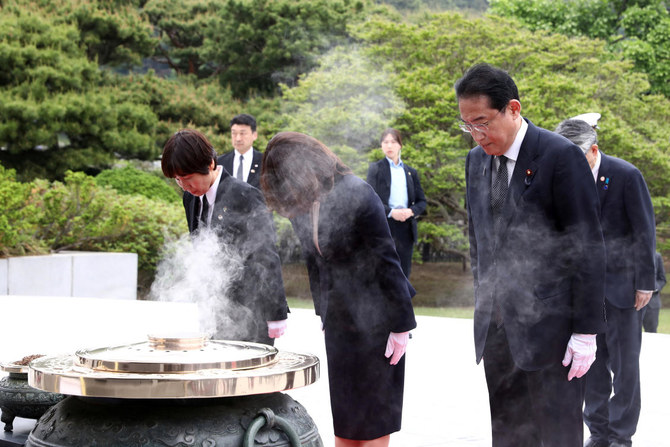
Kishida is making the first official bilateral visit by a Japanese leader to South Korea in over a decade. He first headed to Seoul’s National Cemetery — where war veterans, including from the fight against Japanese colonial rule, are buried — to lay flowers and pay his respects.
Kishida will hold a key summit later in the day with South Korean President Yoon Suk Yeol, who has made resetting ties with Japan a top priority for his administration. Yoon was in Tokyo in March for a fence-mending visit.
The East Asian neighbors, both crucial security allies of the United States, have long been at odds over historic issues linked to Japan’s brutal 1910 to 1945 colonial occupation of the Korean peninsula, including sexual slavery and forced labor.
Kishida said Sunday ahead of his departure that the two leaders were working to resume so-called “shuttle diplomacy” — paused for years during a bitter trade spat linked to the forced labor issue.
During their March summit, Kishida and Yoon agreed to end tit-for-tat trade curbs, with Kishida inviting the South Korean leader to a G7 meeting in Hiroshima this month.
Kishida said he was looking forward to “an honest exchange of views” with Yoon, “based on a relationship of trust.”
Yoon is expected to host a dinner party at the presidential residence — likely serving Korean barbeque — and he may even cook for Kishida, according to local reports.
The fact that Kishida headed straight for Seoul’s National Cemetery to pay his respects is noteworthy, Lim Eun-jung, an associate professor at Kongju National University, told YTN news.
“It is a rare scene for a sitting Japanese prime minister to visit, so it makes me watch very closely.”
Yoon and Kishida are set to hold what Tokyo’s leader said would be “candid discussions” about the tricky topic of forced labor, which torpedoed ties in 2018.
That year, South Korea’s Supreme Court ordered Japanese firms to compensate the wartime victims of forced labor, enraging Tokyo and triggering an escalating series of economic measures.
But Yoon, who took office last year, has sought to bury the historical hatchet, earlier announcing a plan to compensate victims without direct involvement from Tokyo — a move that was unpopular domestically.
Dozens of South Koreans gathered Saturday to protest Kishida’s trip, saying that Japan’s wartime animosities must top the agenda at Sunday’s summit.
Kishida “must sincerely apologize for Japan’s crimes against humanity and fulfil its responsibilities,” said demonstrator Kim Jae-won.
The best possible outcome for Koreans would be for “Kishida to apologize in his own words,” Benjamin A. Engel, research professor at the Institute of International Affairs at Seoul National University, told AFP.
Efforts to mend ties come as North Korean leader Kim Jong Un, who last year declared his country an “irreversible” nuclear power, doubles down on weapons development and testing.
Pyongyang has conducted a record-breaking string of launches in 2023, including test-firing the country’s first solid-fuel ballistic missile — a technical breakthrough.
The United States and South Korea have in turn been ramping up their defense cooperation, staging a series of major military exercises including two trilateral drills involving Japan this year.
“By reinstating ‘shuttle diplomacy,’ President Yoon will achieve a significant diplomatic victory before his first year in office concludes,” Tongfi Kim of the Brussels School of Governance wrote.
“Barring diplomatic ‘accidents’ due to careless mistakes, Kishida’s visit to South Korea will have a positive impact on the bilateral relationship and pave the way for deepening US-Japan-South Korea trilateral cooperation in the coming months.”


![]()


Japanese PM arrives in South Korea for landmark summit
Short Url
https://arab.news/nqq8v
Japanese PM arrives in South Korea for landmark summit
- Kishida is making the first official bilateral visit by a Japanese leader to South Korea in over a decade
- Kishida to hold a key summit later in the day with South Korean President Yoon Suk Yeol


Australia rules out repatriating citizens from Syrian camp
- “We have a very firm view that we won’t be providing assistance or repatriation,” Albanese told ABC News
SYDNEY: Australian Prime Minister Anthony Albanese said on Tuesday his government would not repatriate Australians living in a Syrian camp that holds families of suspected Daesh militants.
“We have a very firm view that we won’t be providing assistance or repatriation,” Albanese told ABC News.
Thirty-four Australians released on Monday from a camp in northern Syria were returned to the detention center due to “technical reasons,” two sources told Reuters.


Latest updates


Recommended


© 2026 SAUDI RESEARCH & PUBLISHING COMPANY, All Rights Reserved And subject to Terms of Use Agreement.