KHARTOUM: US President Joe Biden on Thursday threatened to impose new sanctions over Sudan’s conflict, saying the fighting “must end,” as gunfire and explosions rocked Khartoum for a 20th straight day.
Hundreds of people have been killed in Sudan since the fighting between army chief Abdel Fattah Al-Burhan’s forces and his former deputy Mohamed Hamdan Daglo’s Rapid Support Forces began on April 15 over a dispute on the planned integration of the RSF into the regular army.
As the latest cease-fire expired at midnight, the army said it was ready to abide by a new seven-day truce, but there was no word from its foes in the paramilitary RSF.
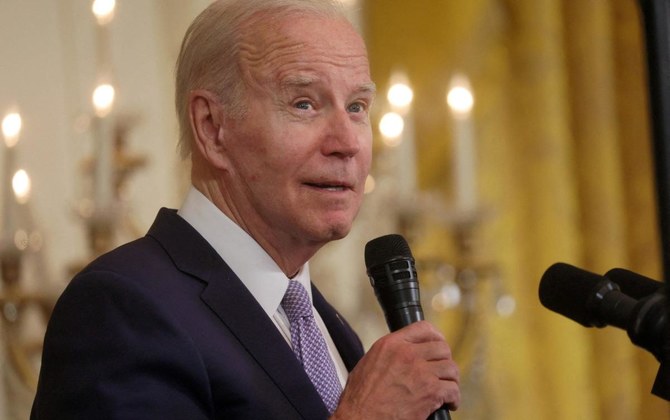
Biden signed an executive order on Thursday that broadens authority to impose sanctions on those responsible for the violence, although it does not name potential targets.
The US leader said in a statement that those facing the sanctions were “individuals responsible for threatening the peace, security, and stability of Sudan; undermining Sudan’s democratic transition; using violence against civilians; or committing serious human rights abuses.”
“The violence taking place in Sudan is a tragedy — and it is a betrayal of the Sudanese people’s clear demand for civilian government and a transition to democracy. It must end,” he said.
Within hours of the latest supposed cease-fire taking effect, witnesses in Khartoum reported loud explosions and exchanges of fire on the streets around dawn and clashes during the day in the city of five million people.
The foreign ministry later accused the RSF of attacking the Indian embassy in Khartoum, the latest in a spate of such incidents which the diplomatic mission did not immediately confirm.
The fighting has killed about 700 people so far across Sudan, most of them in Khartoum and Darfur, according to the Armed Conflict Location and Event Data Project.
The UN refugee agency said it was preparing for an outflow of 860,000 people from the north African country, adding $445 million would be needed to support them just through October.
“The needs are vast, and the challenges are numerous. If the crisis continues, peace and stability across the region could be at stake,” said Raouf Mazou, the UNHCR’s assistant chief of operations.
More than 100,000 people have already fled Sudan since the fighting erupted.
On the day the fighting began, Burhan and Daglo had been due to meet with international mediators to discuss the RSF’s integration into the army — a key condition for the transition to democratic rule.
Instead, Khartoum awoke to the sound of gunfire ringing through the streets.
The UN’s top humanitarian official, Martin Griffiths, on Wednesday visited Sudan to try to negotiate safe passage for aid and aid workers, after six trucks laden with food supplies from the World Food Programme were looted on their way to the war-torn western region of Darfur.
Darfur is still scarred by a war that erupted in 2003 when then president Omar Bashir unleashed the Janjaweed militia, mainly recruited from Arab pastoralist tribes, against ethnic minority rebels.
The Janjaweed — whose actions led to war crimes charges against Bashir and others — later evolved into the RSF.
The United Nations said Darfur civilians were again being armed in the latest fighting.
The Norwegian Refugee Council said violence in the West Darfur state capital, El Geneina, has “resulted in the loss of at least 191 lives.”
“Dozens of settlements have been burnt and destroyed, and thousands have been displaced,” it said.
UN Secretary-General Antonio Guterres acknowledged Wednesday the international community had “failed” Sudan.
“A country like Sudan, that has suffered so much... cannot afford a struggle for power between two people,” said the UN chief.
Mediation efforts have multiplied since the conflict began, but the army said Wednesday it favored those of the East African regional bloc IGAD, because it wanted “African solutions to the continent’s issues.”
Arab League foreign ministers are to meet on Sunday to discuss the conflict ahead of a summit in Saudi Arabia later this month, a diplomat told AFP.
Nearly 450,000 civilians have fled their homes since fighting began, the International Organization for Migration said, including the more than 115,000 who have sought refuge in neighboring countries.
Since Bashir’s ouster in a 2019 coup, international mediators have sought to bring civilians and the military to the negotiating table.
But in the process, analysts believe, they gave too much credit to Burhan and Daglo, who worked together in the coup that derailed the transition to elective civilian rule before falling out in a power struggle.
Exiled rebel leader Abdel Wahid Nur — a veteran of decades of fighting in Darfur — said “the Sudanese people want neither of them.”
“They want a civilian government,” he told AFP, adding there can be “no winner” in the current conflict.


President Biden threatens Sudan sanctions as latest truce unravels
https://arab.news/mn4yr
President Biden threatens Sudan sanctions as latest truce unravels

- Biden signed an executive order on Thursday that broadens authority to impose sanctions on those responsible for the violence
- The fighting has killed about 700 people so far across Sudan


The art of war: fears for masterpieces on loan to Louvre Abu Dhabi
- UAE paid more than €1 billion to borrow priceless works, but experts in France want them back
PARIS: The Middle East war has raised fears for the safety of priceless masterpieces on loan from France to the Louvre Abu Dhabi, the museum’s only foreign branch.
The Abu Dhabi museum, which opened in 2017, has so far escaped damage from nearly 1,800 Iranian drone and missile strikes launched since the conflict erupted on Feb. 28.
However, concerns are mounting in France. “The works must be removed,” said Didier Selles, who helped broker the original agreement between France and the UAE.
French journal La Tribune de l’Art echoed that alarm. “The Louvre’s works in Abu Dhabi must be secured!” it said.
France’s culture ministry said French authorities were “in close and regular contact with the authorities of the UAE to ensure the protection of the works loaned by France.”
Under the agreement with the UAE, France agreed to provide expertise, lend works of art and organize exhibitions, in return for €1 billion, including €400 million for licensing the use of the Louvre name. The deal was extended in 2021 to 2047 for an additional €165 million.
Works on loan include paintings by Rembrandt and Chardin, Classical statues of Isis, Roman sarcophagi and Islamic masterpieces: such as the Pyxis of Al-Mughira.
A Louvre Abu Dhabi source said the museum was designed to protect collections from both security threats and natural disasters.


