Pakistan calls for ‘aggressive marketing’ to expand exports to Saudi Arabia

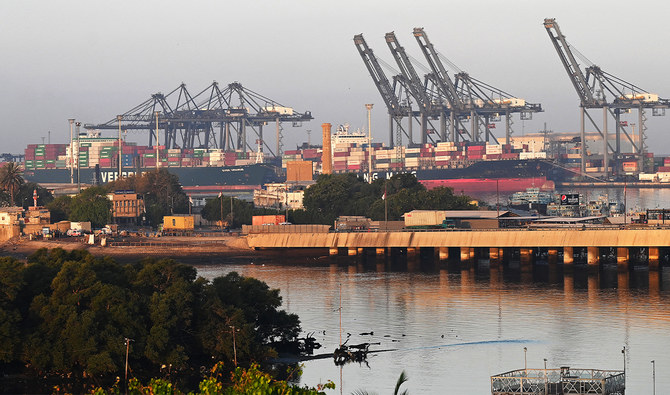
Shipping containers are seen stacked on a ship at a sea port in Karachi on April 6, 2023. (AFP/File)
Short Url
Updated 04 May 2023
Follow

Pakistan calls for ‘aggressive marketing’ to expand exports to Saudi Arabia

  • Commerce minister Syed Naveed Qamar discusses trade ties with Pakistan’s ambassador-designate to Saudi Arabia
  • Exports to Saudi Arabia have seen consistent increase from $336.9 million in 2017 to $446.18 million in 2020

ISLAMABAD: Pakistani commerce minister Syed Naveed Qamar said on Thursday “aggressive marketing” in the fields of agriculture and technology was needed to expand Pakistani exports to Saudi Arabia, a statement from the ministry of commerce said.

Pakistani exports to the kingdom mainly comprise food products, textiles, and engineering goods. According to the United Nations COMTRADE database on international trade, Pakistan’s exports to Saudi Arabia stood at $402.81 million in 2021.

Exports to Saudi Arabia have seen a consistent increase from $336.9 million in 2017 to $342.08 million in 2019 and $446.18 million in 2020.

Qamar’s statement came after a meeting with Pakistan’s ambassador-designate to Saudi Arabia, Ahmed Farooq, in which the two discussed trade ties between the two brotherly countries.

“The federal minister stressed the need for aggressive marketing in the field of agriculture and technology to expand Pakistani exports to Saudi Arabia,” the statement from the commerce ministry said.

“He emphasized that Pakistan had immense potential to export agricultural products and technology to Saudi Arabia, and both countries needed to work together to identify new areas of cooperation.”

The minister also assured the ambassador-designate of his full support and cooperation.

“The ambassador-designate appreciated the efforts of Syed Naveed Qamar to improve the trade ties between the two countries and expressed his desire to work closely with the Ministry of Commerce to explore avenues for mutual investment,” the statement added. 

Prior to meeting the commerce minister, Farooq also met Pakistan’s state minister for foreign affairs, Hina Rabbani Khar, to talk about how to enhance bilateral relations with Saudi Arabia.

Saudi Arabia is home to over two million Pakistanis and the largest contributor of remittance inflows to the South Asian nation.

Saudi authorities have also helped Pakistan deal with an ongoing economic crisis by offering a deferred oil payment facility and depositing about $3 billion in the central bank to help shore up forex reserves.


IMF discussing electricity tariffs revisions with Pakistan

Updated 4 sec ago
Follow

IMF discussing electricity tariffs revisions with Pakistan

  • Pakistan announced proposed tariff overhaul which analysts said would lift inflation while easing pressure on industry
  • The talks come as Islamabad seeks to meet conditions under its $7 billion bailout with ⁠another review of program ‌approaching

KARACHI: The International Monetary Fund is discussing proposed electricity tariff revisions with ​Pakistan authorities, the fund said in a statement to Reuters on Saturday, adding that the burden of the revisions should not fall on middle- or lower-income households.

“The ongoing discussions with the authorities will assess whether the proposed tariff revisions are ‌consistent with these commitments ‌and evaluate their ​potential ‌impact ⁠on ​macroeconomic stability, including ⁠inflation,” it said in its statement.

Pakistan announced proposed tariff overhaul which analysts said would lift inflation while easing pressure on industry, as it seeks to meet conditions under its $7 billion Extended Fund Facility (EFF) as ⁠another review of the program ‌approaches.

The EFF is ‌a longer-term IMF loan program ​designed to help countries ‌address deep-seated economic weaknesses and medium-term balance-of-payments ‌problems.

Electricity carries significant weight in Pakistan’s consumer price index, making tariff adjustments highly sensitive at a time when inflation, though sharply lower than ‌its near-40 percent peak in 2023, remains a key political and economic pressure point.

Pakistan’s ⁠power ⁠sector has long been weighed down by circular debt — a chain of unpaid bills and subsidies that builds up across generation companies, distributors and the government — prompting repeated tariff increases under IMF-backed reforms since 2023.

The accumulation of power sector circular debt has been contained within program targets, supported by improved performance on recoveries and ​loss prevention, the ​Fund added.