
KARACHI: Aspiring Hajj pilgrims in Pakistan have started shopping for essential items required to carry out the Muslim spiritual journey to the holy cities of Makkah and Madinah in Saudi Arabia, even as unprecedented inflationary pressure has raised the prices of ihram garments and other products in the country.
Pakistan has so far approved the applications of 72,869 pilgrims under the government program. The country’s overall quota, which also includes all those people who avail the services of private Hajj operators, is 179,210 this year. The government is expected to surrender the unutilized portion of its Hajj share amid an ongoing economic crisis to the Saudi authorities in the coming days.
As the special Hajj flight operations begin from May 21, pilgrims have started buying essential items, including the ihram clothing. The sale of other items, including prayer rugs, rosaries, skull caps, belts, sandals, fragrance-free soaps, and pouches for pebbles, has also increased.
Ihram is the most essential item that consists of two white sheets, one wrapped around the waist and the other draped over the upper body. It symbolizes the equality of all Muslims in God’s eyes since the plain white garment removes any outward sign of wealth, status, or nationality.
Pakistani traders said the prices of ihram have almost doubled since last year, reflecting the overall price hike in the country where inflation hit a 60-year high last month.
“Ihram which was available from 800 to 900 rupees has gone up to 1,500 or 2,000 rupees,” Tanveer Rasheed, who sells the item in Karachi’s Bolton market, told Arab News. “As the rates of yarn have increased, the rate of ihram has also increased, while the prices of packing materials have also gone up.”

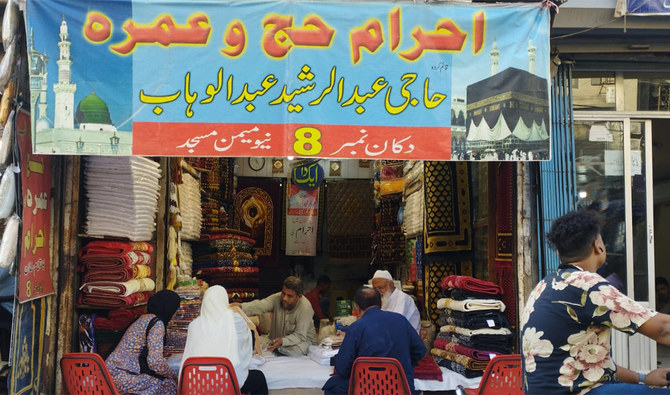
Ihram, prayer mats and roseries are displayed at a shop near the famous Memon Masjid in Karachi, Pakistan, on April 3, 2023. (AN Photo)
Rasheed, who said that he opened the first shop in the market to sell ihram and other products, said his sales had gained pace after the government announced Hajj flights. Prior to that, he continued, people mostly came to him to inquire about the rates of different items.
Ali Ramzan, another trader, said he was happy the sales of ihram and other products were “going well.”
“Sales are good,” he said. “The turnover is also good along with the sales of prayer mats, roseries, and caps.”
He acknowledged the prices of all products had increased in the market, adding the rates were continuously fluctuating on a daily basis.
As the Islamic pilgrimage is a mandatory religious duty for all adult Muslims who are physically and financially capable of undertaking the journey, many ihram buyers said they were fortunate to be undertaking the sacred journey even in the midst of high inflation.
“Inflation or deflation does not matter to those who can afford to perform Hajj,” Syed Nazar Ali, who was buying prayer mats for his wife and son said. “My son is coming from Australia to take his mother for Hajj and will return to Pakistan after that before returning to Australia.”
Shabir Ahmed, an aspiring pilgrim, said he was going for the sacred journey for the first time and found different rates of essential items at different shops.
“Every shop is offering its own rate,” he continued. “One buys according to one’s own requirements and affordability.”
As the regular Hajj cost increased under the government scheme increased to Rs1.17 million, options offered by private Hajj operators are beginning to cost as high as Rs3.6 million.
“The Hajj under private arrangement can cost anywhere between Rs1.6 million to Rs3.6 million,” Masood Khan, chairman of the Hajj Organizers Association of Pakistan, told Arab News. “If one opts for further facilities, this cost can even increase Rs7 million.”
Khan added many of the Hajj packages offered by private operators did not even include the price of the sacrificial animal which was around 600 Saudi Riyal.