MANILA: The United States has laid out in clear terms the extent of its defense treaty commitments to the Philippines, issuing new guidelines that refer specifically to attacks in the South China Sea, including on its coast guard.
The six-page “bilateral defense guidelines” agreed in Washington on Wednesday follow a renewed push under President Ferdinand Marcos Jr to update the Mutual Defense Treaty with the former colonial ruler, at a time of increased tension and maritime confrontation with China.
The guidelines were a first since the treaty was signed in 1951 and follow scores of Philippine diplomatic protests in the past year over what it calls China’s “aggressive” actions and threats against its coast guard.
The guidelines said the bilateral treaty commitments would be invoked if either is attacked specifically in the South China Sea and also if coast guard vessels were the target.
It was also updated to include references to modern forms of warfare, including “grey zone tactics,” which China is accused of using to assert its claims to sovereignty. The guidelines did not mention China specifically.
“Recognizing that threats may arise in several domains – including land, sea, air, space, and cyberspace – and take the form of asymmetric, hybrid, and irregular warfare and grey-zone tactics, the guidelines chart a way forward to build interoperability in both conventional and non-conventional domains,” according to the Pentagon.
The South China Sea, a waterway vital to global trade, has become a major flashpoint in the increasingly testy relationship between China and the United States.
The guidelines send a “warning” to China against targeting the Philippine coast guard said Rommel Ong, former vice commander of the Philippine navy and a professor at the Ateneo School of Government.
Julio Amador, head of the Foundation for the National Interest, a Manila-based think-tank focusing on strategic and security issues, said of the security guidelines “It’s clear that it will give China some pause.”
China’s foreign ministry on Thursday said it opposed the use of bilateral defense treaties to interfere in the South China Sea, which “should not be a hunting ground for external forces.”
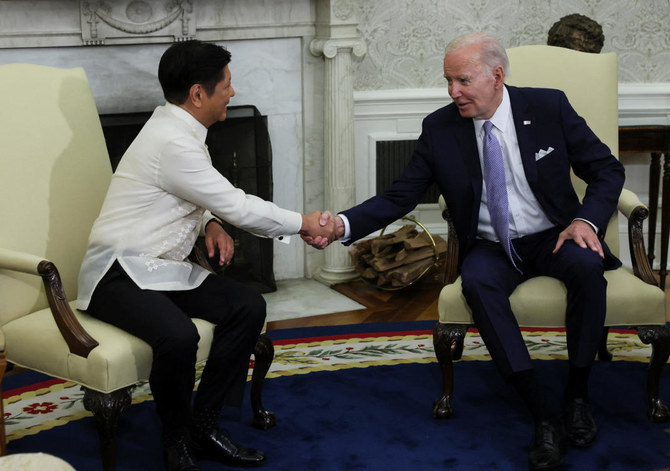
The guidelines were released during visit to Washington this week by Marcos, which included talks with counterpart Joe Biden.
Marcos also met Defense Secretary Lloyd Austin, who told him “we will always have your back, in the South China Sea or elsewhere in the region.”
Ties with the United States have deepened under Marcos, who in February granted its military access to more of his country’s bases, prompting accusations from China that the deal was “stoking the fire” of regional tension.

US issues guidelines on defending Philippines from South China Sea attack
Short Url
https://arab.news/2y9g4
US issues guidelines on defending Philippines from South China Sea attack
- The South China Sea, a waterway vital to global trade, has become a major flashpoint in the increasingly testy relationship between China and the US
De-escalate in Ethiopia’s Tigray before ‘too late’: UN rights chief
- The United Nations rights chief called Tuesday on all parties in the conflicts in Ethiopia to urgently de-escalate amid a precarious situation in the Tigray region
GENEVA: The United Nations rights chief called Tuesday on all parties in the conflicts in Ethiopia to urgently de-escalate amid a precarious situation in the Tigray region.
Recent clashes between the Ethiopian army and regional forces in Tigray highlight the risk of a return to full conflict and a deepening of the human rights crisis in the northern region, Volker Turk warned.
“The situation remains highly volatile, and we fear it will further deteriorate, worsening the region’s already precarious human rights and humanitarian situation,” he said in a statement.
“There must be concerted and sustained efforts by all parties, with the help of the international community, to de-escalate tensions before it is too late.”
The UN rights chief insisted “political dialogue and confidence-building measures are urgently needed — not renewed resort to armed violence.”
The renewed tensions risk a return to conflict following a war between Ethiopian forces and the Tigray People’s Liberation Front (TPLF) that the African Union says killed at least 600,000 people before it ended in late 2022.
More than one million civilians remain internally displaced since the civil war, the UN rights office said.
It voiced deep concern over hostilities that intensified late last month between the Ethiopian military and the regional Tigray Security Forces (TSF) in Tsemlet, western Tigray, an area claimed by forces from the neighboring Amhara region.
The TSF withdrew from the area on February 1.
The rights office highlighted that drones, artillery and other powerful weapons were used by both sides, and both sides engaged in arrests and detentions, Turk saying these activities “must stop.”
In the south and southeast of the Tigray region, near the Afar border, clashes are also continuing between the TSF and rival faction the Tigray Peace Forces.
“Both sides must step back from the brink and work to resolve their differences through political means,” Turk said.
He demanded that all allegations of serious violations and abuses “be promptly and independently investigated, irrespective of the perpetrators.”
Recent clashes between the Ethiopian army and regional forces in Tigray highlight the risk of a return to full conflict and a deepening of the human rights crisis in the northern region, Volker Turk warned.
“The situation remains highly volatile, and we fear it will further deteriorate, worsening the region’s already precarious human rights and humanitarian situation,” he said in a statement.
“There must be concerted and sustained efforts by all parties, with the help of the international community, to de-escalate tensions before it is too late.”
The UN rights chief insisted “political dialogue and confidence-building measures are urgently needed — not renewed resort to armed violence.”
The renewed tensions risk a return to conflict following a war between Ethiopian forces and the Tigray People’s Liberation Front (TPLF) that the African Union says killed at least 600,000 people before it ended in late 2022.
More than one million civilians remain internally displaced since the civil war, the UN rights office said.
It voiced deep concern over hostilities that intensified late last month between the Ethiopian military and the regional Tigray Security Forces (TSF) in Tsemlet, western Tigray, an area claimed by forces from the neighboring Amhara region.
The TSF withdrew from the area on February 1.
The rights office highlighted that drones, artillery and other powerful weapons were used by both sides, and both sides engaged in arrests and detentions, Turk saying these activities “must stop.”
In the south and southeast of the Tigray region, near the Afar border, clashes are also continuing between the TSF and rival faction the Tigray Peace Forces.
“Both sides must step back from the brink and work to resolve their differences through political means,” Turk said.
He demanded that all allegations of serious violations and abuses “be promptly and independently investigated, irrespective of the perpetrators.”
© 2026 SAUDI RESEARCH & PUBLISHING COMPANY, All Rights Reserved And subject to Terms of Use Agreement.


