

ICRC calls for ceasefire in Sudan to be respected

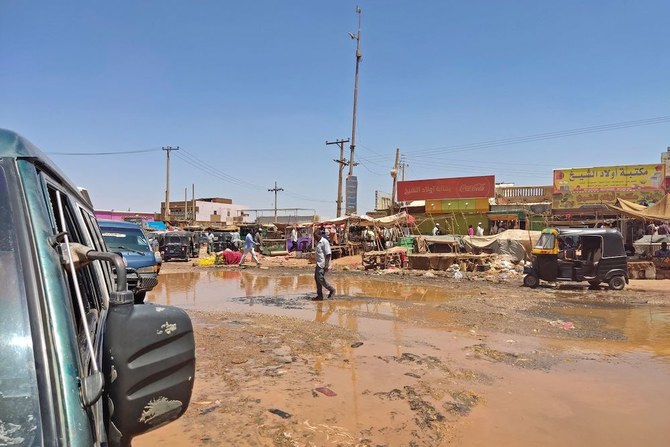
People shop at a market in southern Khartoum on May 3, 2023. The International Committee of the Red Cross has been present in the country since 1978. (AFP)
Short Url
Updated 04 May 2023
Follow

ICRC calls for ceasefire in Sudan to be respected

  • Red Cross spokesperson: ‘It is vital for humanitarian actors to be able to move as soon as possible’
  • As fighting continues, damaging infrastructure, hospitals and health facilities have already used up their stocks

PARIS: As fighting rages around the Sudanese capital, the country is close to collapse, with water and electricity infrastructure severely damaged and the health sector hard hit.

Drug shortages are being felt throughout the country, and most hospitals in the capital are no longer functioning. The International Committee of the Red Cross, which has been present in the country since 1978, has reorganized and relocated its field teams, which are struggling to work in “normal” conditions.

An eight-ton shipment of humanitarian relief supplies, including medical equipment to help local hospitals and Sudanese Red Crescent volunteers treat people injured in the fighting, arrived in Port Sudan from Amman, Jordan, on Sunday, yet it is impossible to release and distribute the shipment.

“We are still not in a position to continue the operation, to distribute these resources to the most affected towns and locations. For the time being, we do not have the capacity to give information about the transfer of these materials, especially because of the security situation, which remains unpredictable,” Imene Trabelsi, ICRC spokesperson for the Near and Middle East, told Arab News in French.

Communication has also suffered between teams on the ground and regional offices and headquarters.

“The situation on the ground is serious. As the fighting continues, hospitals and health facilities have already used up their stocks. Doctors and nurses cannot access hospitals or their facilities because the security situation does not allow it,” Trabelsi said.

“Currently, there are no health professionals to treat the people who need help. Not to mention the shortage of water and electricity supplies, which makes it almost impossible for hospitals to operate.

“In the most affected areas, we have been able to support the Sudanese Red Crescent, our main partner in Sudan. Over the last two weeks, we have been delivering kits for war injuries from hospitals in Darfur. We have tried to deliver these kits to a number of hospitals. The need is great and the situation is dire, but we have not always been able to do so because of the security situation, which does not allow for a proper humanitarian operation.

“There are no exact figures, but the World Health Organization estimates that only 16 percent of the health infrastructure in Khartoum is still operational,” she said.

Faced with the virtual paralysis of the health sector, the ICRC is appealing “for a ceasefire on humanitarian grounds to be fully respected and for the various parties to the conflict to assume their responsibilities with regard to security guarantees for humanitarians, in the interests of the population.”

Trabelsi said: “It is vital for humanitarian actors such as the Red Cross to be able to move as soon as possible. In order for us to move and support the sector, we need the parties to the conflict to understand their legal obligations in this kind of situation. These obligations are to take all possible precautions to protect civilian lives but also to protect infrastructure vital to the survival of the civilian population and to humanitarian work and to provide the necessary security guarantees so that humanitarian actors can do their work safely.

“We are not talking about a choice; we are talking about a legal obligation according to international humanitarian law that is applicable in conflict zones, which is the case of Sudan.”

This article originally appeared on Arab News en Francais


Displaced Cambodians in limbo as nationalist victory in Thailand adds to pressure

Updated 7 sec ago
Follow

Displaced Cambodians in limbo as nationalist victory in Thailand adds to pressure

PREAH VIHEAR: Six weeks after a ceasefire ended fighting at ‌the Thai-Cambodian border, thousands of displaced Cambodians still hope to return home, despite an election victory in Thailand by nationalists who want to wall off the disputed frontier.
In Banteay Meanchey province, Proeung Sopheap, 59, was visiting her abandoned home ​in the border village of Prey Chan for the first time since the December clashes to collect some personal belongings and cooking utensils.
“I don’t know what led to this fighting,” she said. “Like other Cambodians, I want peace, not war.”
In an election last week, Thailand’s Prime Minister Anutin Charnvirakul romped to victory on a platform that includes building a wall at the border.
During a visit to the area on the Cambodian side, most of the people Reuters spoke to said they knew nothing about last week’s Thai vote or what the implications might be for the area.
Pich Vorn, displaced from ‌the neighboring village ‌of Chouk Chey, said he just wanted his house and land ​back.
“Even ‌if ⁠it is ​small, ⁠it is where I have lived for many years.”
The worst fighting in more than a decade has left Sopheap’s village Prey Chan divided: Thai authorities say part of it is in Thailand, and have put up barbed wire fencing, now reinforced with a barrier formed of metal shipping containers.
On the Thai side, authorities say all residents have been able to return home since fighting ended.
But on the Cambodian side, officials estimate that about 80 percent of land and homes in Prey Chan and Chouk Chey communes are now inaccessible, ⁠leaving more than 4,600 people living in temporary shelters.
Thailand said in a ‌statement on Friday the installation of barriers “to enhance safety and ‌security along the border” was “fully consistent” with the joint statement ​agreed by the two countries during the ceasefire ‌on December 27.
The border clashes killed at least 149 people and displaced hundreds of thousands along ‌the 817-kilometer border (508-mile) before Thailand and Cambodia agreed to a second ceasefire in late December, after an earlier truce from July collapsed.
Both sides have traded accusations of aggression. They have tussled over their shared border for decades.

FIGHTING SCARS THOUSAND-YEAR-OLD TEMPLE
At the Preah Vihear Temple, an 11th-century UNESCO World Heritage site at the border, Cambodian authorities ‌say bullet holes, dents and unexploded ordnance scattered across the complex were the result of Thai artillery during border clashes.
The Thai foreign ministry did ⁠not comment on this ⁠issue when asked by Reuters.
“It is truly regrettable to see a World Heritage site fired at and destroyed like this,” Pheng Sam Oeun, deputy director general of National Authority for Preah Vihear temple said.
Cambodia has submitted damage reports to UNESCO and implemented emergency measures to stabilize the most severely affected sections of the temple. Sam Oeun said funding for full restoration remains uncertain.
The Cambodian Mine Action Center is clearing cluster munitions and unexploded artillery shells around the grounds.
Mines and unexploded ordnance remain a menace on both sides of the frontier. Demining manager Ean Sothea said Cambodian authorities had shut more than 40 schools across Preah Vihear province and prioritized clearance at hospitals, pagodas and homes of returning residents.
On the Thai side, a soldier lost a limb on Wednesday after stepping on a land mine at a ​border area in Kantharalak district of Sisaket province, ​the Thai army said.
Landmine blasts along disputed frontier areas were among the catalysts behind the border clashes last year, with at least 12 Thai soldiers severely injured since last July.