Global gas markets rebalancing, to remain tight in 2023: IEA

In Europe, gas consumption fell by a record 16 percent, or 55 billion cubic meters, during the 2022/23 heating season (Shutterstock)
Short Url
Updated 04 May 2023
Follow

Global gas markets rebalancing, to remain tight in 2023: IEA

LONDON: Global gas markets are gradually rebalancing but are expected to remain tight in 2023 amid lower Russian pipeline gas deliveries to Europe, the International Energy Agency said on Thursday, according to Reuters.

The European and global gas markets suffered a major supply shock in 2022 when Russia reduced its pipeline gas deliveries to the EU by 80 percent, triggering a global energy crisis.

Mild weather, an increase in liquefied natural gas exports and a strong decline in demand helped to cushion the shock, leaving Europe’s storage 60 percent full.

“The reduced market strains and relatively well-stocked storage sites ahead of the summer are reasons for cautious optimism for supply security,” the IEA said in its quarterly gas market report.

“The improved outlook for gas markets in 2023 is no guarantee against future volatility ... global gas supply is set to remain tight in 2023, and the global balance is subject to an unusually wide range of uncertainties,” the report added.

The risks, which include adverse weather, such as a dry summer, lower availability of LNG, and the possibility of a further decline in Russian deliveries to Europe, could renew market tensions and price volatility.

In Europe, gas consumption fell by a record 16 percent, or 55 billion cubic meters, during the 2022/23 heating season.

The report said that the EU only needs half of the storage injection level seen in summer 2022 to reach its 90 percent storage target by the start of the 2023/24 heating season.

LNG now accounts for two-thirds of Europe’s gas imports, meeting around one-third of its gas demand during the 2022/23 heating season. European LNG imports rose by 25 percent, or 20 bcm during the heating season, with the US supplying over 45 percent of incremental supply.

But global LNG supply is forecast to increase by just 4 percent — or over 20 bcm — in 2023, which would not be sufficient to offset the expected reduction in Russia’s piped gas supplies to Europe.

Meanwhile, China’s LNG imports, which declined by 20 percent in 2022 and therefore enabling higher LNG flows to Europe, recovered in March, supported by higher domestic demand.

LNG inflows to China are expected to increase by 10-15 percent compared with 2022, but will remain below 2021 levels, the IEA said.


Global Markets: Stocks set for tough week, oil eyes strong gains as Middle East war rages

Updated 28 sec ago
Follow

Global Markets: Stocks set for tough week, oil eyes strong gains as Middle East war rages

  • Oil prices set for largest weekly rise since Russia’s invasion of Ukraine
  • Stocks take a beat, ‌but Asia shares set for 6 percent weekly fall
  • Yields jump as global rate expectations turn hawkish

SINGAPORE: A slight pullback in oil prices on Friday offered some reprieve to battered global stocks, though share markets in Asia remained on track for their sharpest weekly ​drop in six years as the conflict in the Middle East showed few signs of easing.

Oil prices, headed for their largest weekly gain since Russia launched its full-scale invasion of Ukraine in February 2022, slipped on news that the US government is weighing potentially intervening in the futures market to blunt rising prices.

Still, they remained up close to 20 percent for the week.

Brent crude futures last traded at $84.73 per barrel, on track for a 17 percent weekly rise. US crude retreated from a 20-month high and was last at $80 a barrel, taking its weekly gain to more than 19 percent.

“What we see is ... markets (consolidating) for a time, chopping around current levels, as a ‘wait and see’ approach takes (precedence) for the time being,” said Michael Brown, senior research strategist ‌at Pepperstone.

The US-Israel ‌war on Iran convulsed global markets this week and left investors seeking the safety ​of ‌cash, ⁠as they sobered ​up ⁠to the fact that the conflict could drag on longer than initially anticipated.

Traders also moved to price in more hawkish rate expectations from major central banks, spooked by the prospect of a resurgence in inflation if the spike in energy prices persists.

Yields on US Treasuries have shot up some 18 basis points this week, their most in nearly a year, while the dollar was set for its largest weekly gain in 16 months.

“The range of plausible outcomes (of the war) has expanded to include both the possibility of an exceptionally constructive resolution and a highly destructive one,” said Daleep Singh, chief global economist at PGIM Fixed Income.

“Markets are being asked ⁠to price a much fatter set of tails with very little reliable information about the ‌likelihood of each, or the path in between.”

EUROSTOXX 50 futures were up 0.95 percent ‌in Asia on Friday, while FTSE futures and DAX futures rose 0.5 percent and ​0.8 percent, respectively.

Nasdaq futures added 0.27 percent, while S&P 500 futures rose ‌0.16 percent.

High-flying stocks tumble 

MSCI’s broadest index of Asia-Pacific shares outside Japan last traded 0.2 percent higher, though it was set to fall ‌6 percent for the week, which would mark its steepest weekly drop since March 2020.

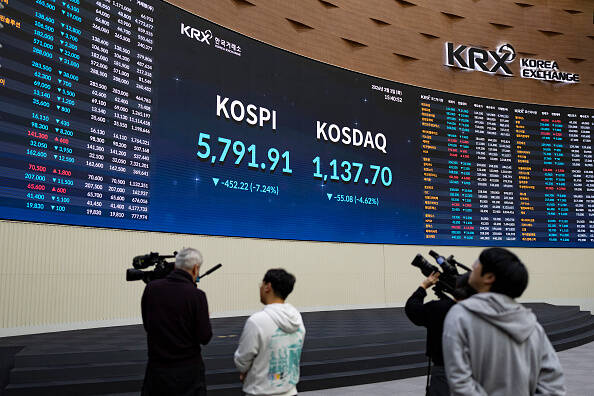
Japan’s Nikkei was up 0.6 percent but on track for a 5.5 percent weekly loss, while South Korea’s Kospi was headed for its largest weekly fall in six years with a 10.5 percent slide.

The market rout this week sent even high-flying technology stocks and indexes such as the Kospi tumbling, as investors scrambled to book profits to cover losses ‌elsewhere.

“When the dollar rallies and US yields rise, funding conditions are tightening, which will often exacerbate broader moves particularly if there’s leverage involved,” said Ben Bennett, head of Asia investment ⁠strategy at L&G Asset Management.

Dollar is king

The dollar has emerged as one of few winners this week in volatile sessions that have dragged stocks, bonds and, at times, even safe-haven precious metals lower.

The rally in the dollar hit pause on Friday, but it was still on track for a weekly gain of close to 1.5 percent, bolstered by safe-haven demand and reduced US rate-easing expectations.

The euro, which remains vulnerable to a spike in energy prices, was set to fall 1.8 percent for the week, while sterling was headed for a 1 percent weekly drop.

Investors are now pricing in about 40 basis points of easing from the Federal Reserve this year, down from 56 bps a week ago , while odds for a rate cut from the Bank of England this month have fallen to 22 percent from a near certainty just last week.

The European Central Bank is seen hiking rates by year-end.

The shifting rate expectations have, in turn, pushed up global bond yields, and in Asia on Friday, the yield on the benchmark 10-year US ​Treasury was steady at 4.1421 percent, having risen some 18 ​bps this week.

The two-year yield has jumped 20 bps for the week.

Elsewhere, spot gold was steady at $5,118.79 an ounce, though it was headed for a 3 percent weekly fall as rising yields and a stronger dollar eclipsed the yellow metal’s safe-haven appeal.