

Pakistan’s foreign minister says ‘happy’ to reach India to participate in regional moot

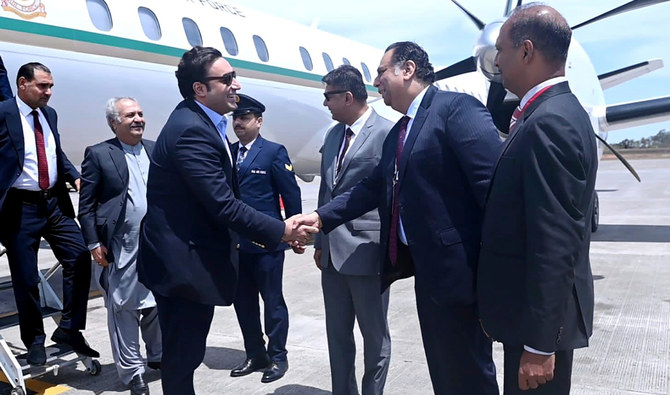
Pakistan Foreign Minister Bilawal Bhutto-Zardari, third left, being received on his arrival at the Goa international airport, India, on May 4, 2023. (Pakistan's Ministry of Foreign Affairs/AP)
Short Url
Updated 04 May 2023
Follow

Pakistan’s foreign minister says ‘happy’ to reach India to participate in regional moot

  • Bilawal Bhutto-Zardari hopes the Shanghai Cooperation Organization meeting in Goa is ‘very successful’
  • The conference comes over three years after Pakistan downgraded ties with India due to situation in Kashmir

ISLAMABAD: Pakistan’s foreign minister Bilawal Bhutto-Zardari on Thursday said he was “happy” to be in India to participate in the meeting of the Council of Foreign Ministers (CFM) of the Shanghai Cooperation Organization (SCO) while expressing hope that the regional gathering would be “very successful.”

The Pakistani minister, along with his delegation, arrived in India on Thursday morning to attend the two-day meeting.

The development is thought to be significant since Pakistan downgraded its relations with the rival South Asian nuclear-armed nation after New Delhi revoked the special constitutional status of Indian-administered Kashmir in August 2019 to integrate the Muslim-majority disputed Himalayan territory with the rest of the Indian union.

Bhutto-Zardari’s visit is the first one by a high-profile Pakistani official since Prime Minister Nawaz Sharif attended Indian PM Narendra Modi’s swearing-in in 2014 and de facto Foreign Minister Sartaj Aziz went to Amritsar in December 2016 to attend the Heart of Asia conference.

“I am very happy to reach Goa today to participate in the Shanghai Cooperation Organization (SCO) [meeting] and to lead the Pakistani delegation,” he said in a video message from India.

“I hope that the SCO’s CFM meeting will be very successful,” he added.

Prior to his departure, the Pakistani minister said his participation in the moot sent out a “clear message that Pakistan attributed tremendous significance to the SCO and seriously took its membership [responsibilities].”

He added that during the two-day trip, he would engage bilaterally with other countries which were part of the organization.

The foreign minister is attending the SCO’s CFM meeting at the invitation of the current SCO chair, Dr. S. Jaishankar, who is also India’s minister for external affairs.

The foreign office said Pakistan had been actively and constructively contributing to all SCO activities to realize its multi-sectoral aims and objectives in a mutually beneficial manner since becoming a member in 2017.

“The Foreign Minister will also meet with his counterparts of friendly countries on the sidelines of the CFM,” said the statement.

Speaking to Arab News after the announcement of the foreign minister’s visit, international affairs analyst Dr. Huma Baqai referred to the development as a “positive” one and urged political parties to refrain from indulging in politics since it was a national issue.

“We have been hostage to the Kashmir conflict for decades now, and people on both sides [Pakistan and India] remain at the losing end,” she said.

“Both countries should move on to normalize their relations for the benefit of their people,” she added.



Pakistan, global crypto exchange discuss modernizing digital payments, creating job prospects 

Updated 8 sec ago
Follow

Pakistan, global crypto exchange discuss modernizing digital payments, creating job prospects 

  • Pakistani officials, Binance team discuss coordination between Islamabad, local banks and global exchanges
  • Pakistan has attempted to tap into growing crypto market to curb illicit transactions, improve oversight

ISLAMABAD: Pakistan’s finance officials and the team of a global cryptocurrency exchange on Friday held discussions aimed at modernizing the country’s digital payments system and building local talent pipelines to meet rising demand for blockchain and Web3 skills, the finance ministry said.

The development took place during a high-level meeting between Finance Minister Muhammad Aurangzeb, Pakistan Virtual Assets Regulatory Authority (PVARA) Chairman Bilal bin Saqib, domestic bank presidents and a Binance team led by Global CEO Richard Teng. The meeting was held to advance work on Pakistan’s National Digital Asset Framework, a regulatory setup to govern Pakistan’s digital assets.

Pakistan has been moving to regulate its fast-growing crypto and digital assets market by bringing virtual asset service providers (VASPs) under a formal licensing regime. Officials say the push is aimed at curbing illicit transactions, improving oversight, and encouraging innovation in blockchain-based financial services.

“Participants reviewed opportunities to modernize Pakistan’s digital payments landscape, noting that blockchain-based systems could significantly reduce costs from the country’s $38 billion annual remittance flows,” the finance ministry said in a statement. 

“Discussions also emphasized building local talent pipelines to meet rising global demand for blockchain and Web3 skills, creating high-value employment prospects for Pakistani youth.”

Blockchain is a type of digital database that is shared, transparent and tamper-resistant. Instead of being stored on one computer, the data is kept on a distributed network of computers, making it very hard to alter or hack.

Web3 refers to the next generation of the Internet built using blockchain, focusing on giving users more control over their data, identity and digital assets rather than big tech companies controlling it.

Participants of the meeting also discussed sovereign debt tokenization, which is the process of converting a country’s debt such as government bonds, into digital tokens on a blockchain, the ministry said. 

Aurangzeb called for close coordination between the government, domestic banks and global exchanges to modernize Pakistan’s payment landscape.

Participants of the meeting also discussed considering a “time-bound amnesty” to encourage users to move assets onto regulated platforms, stressing the need for stronger verifications and a risk-mitigation system.

Pakistan has attempted in recent months to tap into the country’s growing crypto market, crack down on money laundering and terror financing, and promote responsible innovation — a move analysts say could bring an estimated $25 billion in virtual assets into the tax net.

In September, Islamabad invited international crypto exchanges and other VASPs to apply for licenses to operate in the country, a step aimed at formalizing and regulating its fast-growing digital market.