

Pakistan moves up seven places in World Press Freedom Index

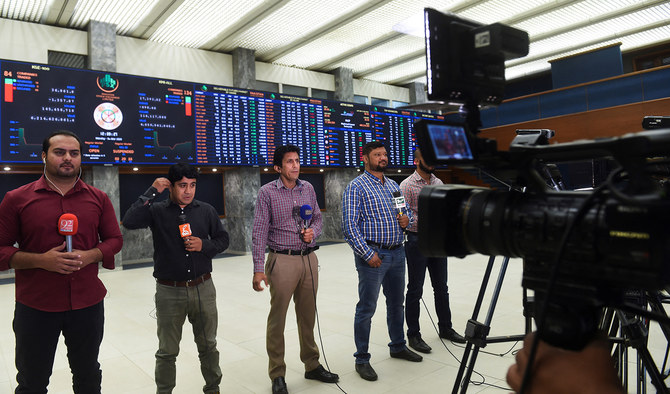
Journalists report from the trading floor at the Pakistan Stock Exchange (PSX) in Karachi on March 9, 2020. (AFP/File)
Short Url
Updated 03 May 2023
Follow

Pakistan moves up seven places in World Press Freedom Index

  • Pakistan now ranks 150 out of 180 countries, with a score of 39.95 as compared to 37.99 last year
  • Freedom Network said last week violations rose by 60% in Pakistan from May 2022 to March 2023

ISLAMABAD/KARACHI: Pakistan has improved its ranking by seven places in the latest World Press Freedom Index after “changes of government loosened constraints on the media,” international media watchdog Reporters Without Borders (RSF) said in its annual report, released on Wednesday to coincide with World Press Freedom Day.

Pakistan is counted among the world’s most dangerous countries for journalists. Last year, the RSF said 93 journalists had been killed over the past 20 years in the South Asian nation where incidents of arrests, media censorship, online abuse, and physical attacks against journalists are common.

The latest RSF index, however, said Pakistan now ranks 150 out of 180 countries, with a score of 39.95 as compared to 37.99 last year.

The report evaluates each country or territory’s score using five contextual indicators, political context, legal framework, economic context, sociocultural context, and safety.

“Changes of government loosened constraints on the media in Pakistan (150th) and the Philippines (132nd), even if these two countries continue to be among the world’s most dangerous countries for journalists,” the RSF said in its 2023 analysis. 

“Despite changes in political power, a recurring theme is apparent: political parties in opposition support press freedom but are first to restrict it when in power," RSF added, saying Pakistan’s media regulators were directly controlled by the government and put the defence of the executive government before the public’s right to information. 

"As the military has tightened its grip on civilian institutions, coverage of military and intelligence agency interference in politics has become off limits for journalists,” RSF said.

The Pakistan military denies it suppresses the press. 

Media watchdog Freedom Network said in its annual ‘Pakistan Press Freedom Report’ released last week that violations rose by over 60% in Pakistan from May 2022 to March 2023.


Pakistan’s top military commander hails Saudi defense pact as ‘historic’ at scholars’ conference

Updated 5 sec ago
Follow

Pakistan’s top military commander hails Saudi defense pact as ‘historic’ at scholars’ conference

  • Asim Munir says Pakistan has a unique bond with the Kingdom, citing the ‘honor’ of helping safeguard the holy sites
  • He says only the state can declare jihad, urging religious scholars to counter extremist narratives and promote unity

ISLAMABAD: Chief of Defense Staff Field Marshal Asim Munir on Wednesday described the country’s joint security pact with Saudi Arabia as a “historic” milestone, telling a gathering of religious scholars that Pakistan and the kingdom share a deep strategic relationship.

Signed in September, the Strategic Mutual Defense Agreement has solidified decades of Saudi–Pakistan defense cooperation, covering intelligence-sharing, counterterrorism and regional stability.

The two nations have long coordinated on defense matters, with Pakistani military personnel deployed in the Kingdom.

“The defense agreement [with Saudi Arabia] is historic,” he said in an address to the conference in the federal capital.

The top military commander said Pakistan regarded its connection with the Kingdom as unique.

“Among all Muslim countries, Allah has given Pakistan the honor of helping safeguard the Haramain,” he continued, referring to the two holiest sites of Islam in Makkah and Madinah.

Munir used his speech to warn against extremism, saying that under the Islamic framework, only the state could declare jihad, a pointed reference to groups such as the Tehreek-e-Taliban Pakistan (TTP), which claims to act in the name of religion while carrying out attacks on civilians and security forces.

“When nations abandon knowledge and the pen, disorder takes hold,” he said, urging the religious scholars to help keep society unified and to “broaden the nation’s vision.”

Munir also criticized India, describing “terrorism” as “India’s habit, not Pakistan’s.”

His remarks came months after a four-day military confrontation in May, during which the two nuclear-armed neighbors exchanged artillery and missile fire and deployed drones and fighter jets.

India blamed Pakistan for a militant attack in Indian-administered Kashmir before launching a missile attack. Islamabad denied involvement and called for an international probe.

Pakistan claimed it had shot down six Indian fighter jets before a US-brokered ceasefire took effect.

“We do not hide when confronting the enemy,” Munir said. “We challenge openly.”