

IMF says inflation to slow growth across Middle East, Pakistan this year

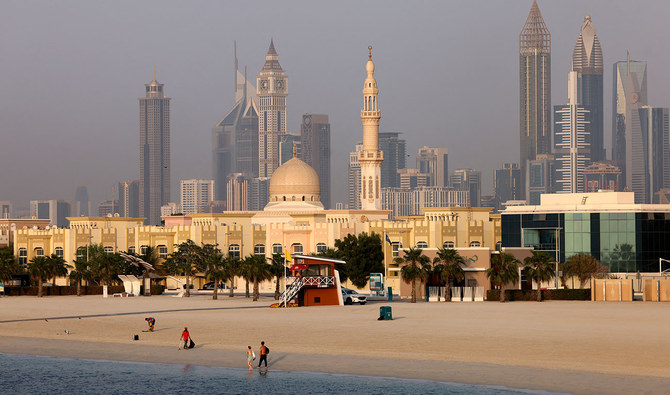
In this file photo taken on September 14, 2022 People gather at a beach in the Gulf emirate of Dubai. (AFP/File)
Short Url
Updated 03 May 2023
Follow

IMF says inflation to slow growth across Middle East, Pakistan this year

  • The international lending agency predicts regional growth to drop from 5.3 percent last year to 3.1 percent
  • Rising interest rates, used by central banks to stem inflation’s rise, are increasing the costs of borrowing money

DUBAI: Economies across the Middle East and Central Asia will likely slow this year as persistently high inflation and rising interest rates bite into their post-pandemic gains, the International Monetary Fund (IMF) said Wednesday.

The IMF’s Regional Economic Outlook blamed in part rising energy costs, as well as elevated food prices, for the estimated slower growth. The report said that while oil-dependent economies of the Gulf Arab states and others in the region have reaped the benefits of elevated crude prices, other countries — such as Pakistan — have seen growth collapse after an unprecedented flooding last summer or as economic woes worsened.

The regional slowdown also comes as an explosion of fighting in Sudan between two top rival generals — who only a year ago as allies orchestrated a military coup that upended the African country’s transition to democracy — threatens a nation where IMF and World Bank debt relief remains on hold.

Rising interest rates, used by central banks worldwide to try to stem inflation’s rise, increase the costs of borrowing money. That will affect nations carrying heavier debts, the IMF warned.

“This year we’re seeing inflation again being the most challenging issue for most of the countries,” Jihad Azour, the director of the Middle East and Central Asia Department at the IMF, told The Associated Press. “For those who have high level of debt, the challenge of increase in interest rate globally, as well as also the tightening of monetary policy, is affecting them.”

The IMF forecast predicts regional growth will drop from 5.3 percent last year to 3.1 percent this year. Overall, regional inflation is expected to be at 14.8 percent, unchanged from last year, as Russia’s war on Ukraine continues to pressure global food supplies and affect energy markets.

It will be even worse in Pakistan, where the IMF projected inflation to more than double, to about 27 percent. Pakistan and IMF officials have held repeated talks over the release of a stalled key tranche of a $6 billion bailout package loan to Islamabad.

The IMF warned that financial conditions worldwide will tighten this year, brought on in part by two bank failures in the United States in March. The sudden collapse of Credit Suisse before it was purchased by UBS also strained markets.

For Sudan, Azour acknowledged the challenge as the country faces a humanitarian crisis brought on by the weeks of fighting there. The violence has also worsened a debt crisis that has gripped the country for decades as it faced Western sanctions.

“We have worked with the government of Sudan, for the Sudanese people, in order to help them by achieving a debt operation that would allow Sudan to have a debt relief of more than $50 billion,” Azour said.

“But unfortunately, the recent developments ... put in a halt to all of those efforts,” he added.


Pakistan’s Punjab deports more than 31,000 Afghans under nationwide removal campaign

Updated 4 sec ago
Follow

Pakistan’s Punjab deports more than 31,000 Afghans under nationwide removal campaign

  • Police say hundreds more Afghans remain in holding centers as repatriation process continues
  • Pakistan has expelled over 1.5 million Afghans since launching the drive campaign in late 2023

ISLAMABAD: Police in Pakistan’s Punjab province said on Saturday they have deported more than 31,000 Afghan nationals living in various districts without legal documentation, as authorities continue a sweeping campaign to expel such people.

Pakistan launched its nationwide deportation drive in late 2023, ordering all “illegal immigrants,” mostly Afghan nationals, to leave the country. The decision was taken after a series of deadly suicide attacks in which the government said Afghan nationals were involved. Kabul denied its citizens were involved in the bombings, describing Pakistan’s security challenges as its own internal issue.

Last month, state broadcaster Radio Pakistan said Islamabad had repatriated over 1.5 million Afghan citizens since November 2023.

“The Punjab Police have so far deported 31,377 Afghans among other illegally residing foreign nationals from Lahore and across the province,” the law enforcement agency said in a statement.

“Another 203 undocumented individuals are currently present in holding points,” it added.

The statement did not specify the period in which these people were rounded up and sent back to their home countries.

According to the statement, the deportees include 11,576 men, 6,679 women and 13,133 children.

Police said those removed comprised individuals with partial documentation such as proof of residence (10,043 people), Afghan Citizen Cards (11,067) and those found to be living illegally (10,267).

“There are five holding centers in Lahore and 46 across the province,” the statement said.

The province’s top cop, Inspector-General of Police Dr. Usman Anwar, said security had been heightened to ensure the removal of undocumented foreign nationals.

“Punjab Police is implementing the policy for the evacuation of illegally residing foreigners under international laws,” he said. “Human rights are being fully taken into account during the process.”

Pakistan has hosted millions of Afghans since the Soviet invasion of Afghanistan in 1979, but deteriorating security concerns and strained relations with Kabul have led Islamabad to initiate the latest deportation campaign, which rights groups have criticized as abrupt and lacking adequate safeguards.