Guardian apologizes for ‘antisemitic’ cartoon of BBC chief

Martin Rowson has also apologised, saying that the artwork was a failure “on many levels” and Sharp was not “the main target of the satire”. (AFP/File)
Short Url
Updated 01 May 2023
Follow

Guardian apologizes for ‘antisemitic’ cartoon of BBC chief

  • Cartoon depicting Richard Sharp featured a series of antisemitic motifs

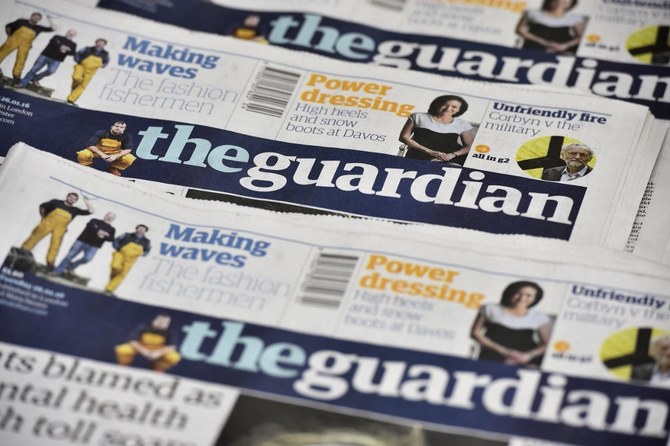
LONDON: The Guardian has issued an apology following the publication of a satirical cartoon of outgoing BBC chairman Richard Sharps which was widely condemned as antisemitic.

The newspaper apologized over the weekend and removed Martin Rowson’s drawing from its website saying it “does not meet our editorial standards.”

“We understand the concerns that have been raised,” added a spokesperson for the Guardian in the statement.

“The Guardian apologizes to Mr Sharp, to the Jewish community and to anyone offended.”

The cartoon, which was published the day after Sharp’s resignation, depicted the former chairman, who is Jewish, with exaggerated features and carrying what it appears to be a box stuffed with a squid, gold coins and a puppet of British Prime Minister Rishi Sunak.

The cartoon was condemned by Jewish groups as “explicitly racist” for its use of “outsized, grotesque features” that “falls squarely into an antisemitic tradition."

Such caricatures had been used by both the Nazis and the Soviet Union to derogatorily depict Jewish people.

Dave Rich, an author and antisemitism expert, said on Twitter that squid and money are also recurring antisemitic motifs “used to depict a supposed Jewish conspiracy with its tentacles wrapped around whatever parts of society the Jews supposedly control. Especially money.”

Stephen Pollard, editor-at-large of the Jewish Chronicle, said that “it takes a lot to shock me. But I still find it genuinely shocking that not a single person looked at this and said, ‘No, we can’t run this.’”

Richard Sharp resigned as chairman of the BBC on Friday after a report found he had broken conflict of interest rules when he was appointed.

He had been under pressure from the broadcaster’s board for months over his role in facilitating a loan of up to £800,000 for Boris Johnson, the prime minister who appointed him.

Rowson has also apologised, saying that the artwork was a failure “on many levels” and Sharp was not “the main target of the satire”.

He added that even though he went to school with Sharp and knew he was Jewish, he never considered offending or including any discriminatory connotations.

“To work effectively, cartoons almost more than any other part of journalism require eternal vigilance, against unconscious bias as well as things that should be obvious and in this case, unforgivably, I didn't even think about,” Rowson wrote.

“There are sensitivities it is our obligation to respect in order to achieve our satirical purposes.”

The incident comes a week after the Guardian published a letter by former Labour Shadow Minister Diane Abbott suggesting that Jewish, Irish and Traveller people were not subject to racism “all their lives.”

She was suspended as a Labour MP and party leader Keir Starmer described her remarks as antisemitic.


To infinity and beyond: Grendizer’s 50 years of inspiring Arabs

Updated 27 December 2025
Follow

To infinity and beyond: Grendizer’s 50 years of inspiring Arabs

  • ⁠ ⁠50 years after its creation, the Grendizer anime series continues to capture Arab imagination
  • ⁠ ⁠⁠Arab News Japan speaks to creator Go Nagai, Middle Eastern fans and retells the story behind the UFO Robot tasked with protecting our planet

LONDON: Few cultural imports have crossed borders as unexpectedly, or as powerfully, as Grendizer, the Japanese giant robot that half a century ago became a childhood hero across the Arab world, nowhere more so than in Saudi Arabia.

Created in Japan in the mid-1970s by manga artist Go Nagai, Grendizer was part of the “mecha” tradition of giant robots. The genre was shaped by Japan’s experience during the Second World War, and explored themes of invasion, resistance and loss through the medium of science fiction.

But while the series enjoyed moderate success in Japan, its true legacy was established thousands of kilometers away in the Middle East.

By the early 1980s, “Grendizer” had spread across the Middle East, inspiring fandoms in Saudi Arabia, Kuwait, Iraq and beyond. (Supplied)

The anime “UFO Robot Grendizer” arrived on television in the region in 1979, dubbed into Arabic and initially broadcast in Lebanon during the Lebanese civil war. The story it told of the heroic Duke Fleed, a displaced prince whose planet had been destroyed by alien invaders, struck a chord with children growing up amid regional conflict and occupation by Israel.

Its themes of defending one’s homeland, standing up to aggression and protecting the innocent were painfully relevant in the region, transforming the series from mere entertainment into a kind of emotional refuge.

Much of the show’s impact came from its successful Arabization. The powerful Arabic dubbing and emotionally charged voice-acting, especially by Lebanese actor Jihad El-Atrash as Duke Fleed, lent the show a moral gravity unmatched by other cartoons of the era.

While the series enjoyed moderate success in Japan, its true legacy was established thousands of kilometers away in the Middle East. (Supplied)

The theme song for the series, performed by Sami Clark, became an anthem that the Lebanese singer continued to perform at concerts and festivals right up until his death in 2022.

By the early 1980s, “Grendizer” had spread across the Middle East, inspiring fandoms in Saudi Arabia, Kuwait, Iraq and beyond. For many, it was not only their first exposure to anime, it also delivered lessons on values such as justice and honor.

Grendizer was so influential in the region that it became the subject of scholarly research, which in addition to recognizing the ways in which the plight of the show’s characters resonated with the audience in the Middle East, also linked the show’s popularity to generational memories of displacement, particularly the Palestinian Nakba.

By the early 1980s, “Grendizer” had spread across the Middle East, inspiring fandoms in Saudi Arabia, Kuwait, Iraq and beyond. (Supplied)

Half a century later, “Grendizer” remains culturally alive and relevant in the region. In Saudi Arabia, which embraced the original version of the show wholeheartedly, Manga Productions is now introducing a new generation of fans to a modernized version of the character, through a video game, The Feast of The Wolves, which is available in Arabic and eight other languages on platforms including PlayStation, Xbox and Nintendo Switch, and a new Arabic-language anime series, “Grendizer U,” which was broadcast last year.

Fifty years after the debut of the show, “Grendizer” is back — although to a generation of fans of the original series, their shelves still full of merchandise and memorabilia, it never really went away.


Grendizer at 50
The anime that conquered Arab hearts and minds
Enter
keywords